Quick Answer
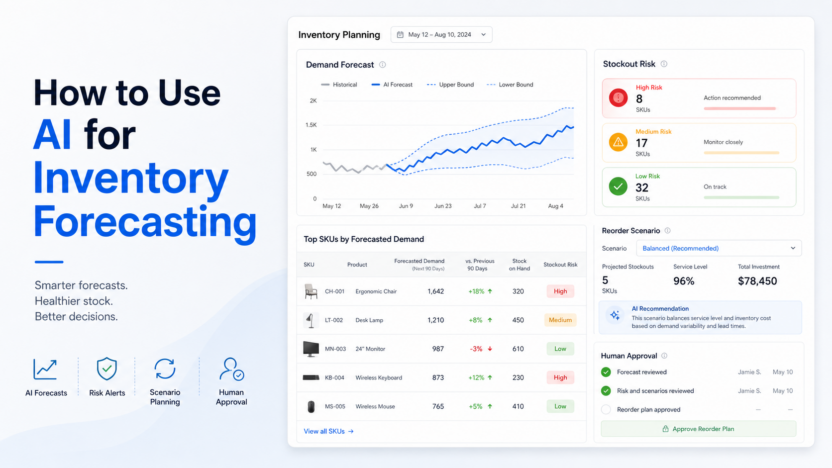
The safest way to use AI for inventory forecasting is to combine clean sales history, current stock, lead times, promotions, seasonality, and supplier constraints, then use AI to summarize risks and prepare planning scenarios. AI should help the team ask better questions and spot patterns. It should not place purchase orders, change reorder points, or override human judgment without review.
Pricing last checked on July 26, 2026. Pricing references in this guide are based on official sources for tools commonly used in this workflow, including Google Workspace pricing, Airtable AI billing, and official product documentation where linked.
Related Dailytimespro reading:
- How to Use ChatGPT for Excel
- Best AI Workflow Automation Tools
- How to Use AI for Sales Forecasting
- Best AI Survey Analysis Tools
Best For
This workflow is best for ecommerce stores, wholesalers, agencies managing product clients, small manufacturers, and operators who already track sales and stock but need clearer weekly planning.
Not Best For
It is not a replacement for formal demand planning software when the business has complex supply chains, regulated inventory, multi-warehouse constraints, or high financial risk. It is also weak when product data is messy, lead times are unknown, or stock counts are unreliable.
Our Evaluation Criteria
This article evaluates AI inventory forecasting workflows through practical small-business criteria: ease of setup, pricing clarity, AI quality, workflow fit, integrations, admin controls, reporting, support process, and value for money. The goal is to help operators and ecommerce teams building practical forecasting processes make a real buying or implementation decision, not to list every feature on a vendor page.
The strongest option is the one a team can explain in one sentence: what data goes in, what AI creates, who reviews it, and where the approved result goes. If those steps are unclear, the tool may still be capable, but the workflow is not ready for a wider rollout.
Switching cost matters as much as feature depth. A tool that looks stronger on paper may be the wrong choice if it forces the team to rebuild habits, duplicate records, or add review work that cancels out the AI benefit. A narrower tool can be the better first purchase when it solves one repeated job cleanly and leaves room to expand later.
What AI Can Actually Help With
AI can summarize weekly sales changes, highlight products with unusual demand, group slow-moving products, explain possible stockout risks, draft supplier update questions, and turn messy notes into a structured planning brief. It can also help build spreadsheet formulas, clean categories, and prepare scenario tables.
AI should not be treated as an autonomous buyer. Forecasts depend on real-world constraints: supplier reliability, shipping delays, seasonality, promotions, cash flow, substitutions, returns, and merchandising choices. The best use of AI is decision support.
The Inventory Forecasting Workflow
| Step | Input | AI-assisted output | Human review |
|---|---|---|---|
| Clean data | Sales, returns, stock, purchase orders | Standardized table and missing-field notes | Check product IDs and dates |
| Build baseline | Historical weekly demand | Demand summary by SKU/category | Remove unusual one-time events |
| Add context | Promotions, holidays, launches | Context notes for demand changes | Confirm business assumptions |
| Estimate risk | Current stock and lead time | Stockout and overstock watchlist | Confirm supplier and cash limits |
| Plan actions | Reorder options | Draft purchase recommendation | Manager approves final action |
Step 1: Prepare the Data
Start with product ID, product name, category, current stock, units sold by week, returns, incoming purchase orders, supplier lead time, cost, margin, and next promotion dates. The model can help clean inconsistent names, but it cannot repair missing stock counts by itself.
If the team uses Shopify, exported reports can help build a sales and product-performance baseline. If the team works in spreadsheets, Google Sheets, Excel, Rows, or Airtable can become the planning workspace.
Step 2: Ask for a Baseline Summary
Use AI to summarize what changed in the last 4, 8, and 12 weeks. Ask for products with rising demand, falling demand, erratic sales, high returns, or low stock relative to recent sales. Keep the output descriptive before asking for recommendations.
Good prompt: "Review this SKU table. Identify products with rising weekly demand, products with falling demand, products at risk of stockout within four weeks, and products that may be overstocked. Explain the reason using the columns provided."
Step 3: Add Business Context
AI forecasting improves when the input includes context. Add promotion dates, holidays, product launches, supplier delays, price changes, marketplace issues, and stockout periods. If a product sold poorly because it was out of stock, AI should not treat that as weak demand.
Step 4: Create Scenario Tables
Ask AI to prepare three scenarios: conservative, expected, and aggressive. Each scenario should show projected weekly demand, reorder quantity, expected stockout date, and assumptions. The assumptions are as important as the numbers because they reveal where the forecast may be weak.
Step 5: Review and Approve
A manager should approve purchase decisions. AI can draft the recommendation, but human review should check cash flow, supplier reliability, storage capacity, margin, minimum order quantities, and customer commitments.
Useful Tool Stack
| Tool type | Example tools | Best use | Limitation |
|---|---|---|---|
| Spreadsheet AI | Google Sheets with Gemini, Excel with Copilot, Rows | Cleanup, summaries, formulas, scenario tables | Needs clean source data |
| Database workspace | Airtable | SKU records, workflows, ownership | Needs structured setup |
| Automation | Zapier, Make | Weekly alerts and report routing | Should not auto-order without approval |
| Commerce reporting | Shopify reports | Sales and product history | Needs interpretation |
Real Use Cases
Stockout prevention
An ecommerce team can review weekly sales and current stock to flag products likely to run out before the next supplier shipment.
Overstock review
A product manager can identify slow-moving inventory and prepare markdown, bundle, or reorder-hold decisions.
Supplier planning
An operations lead can draft supplier questions based on lead time, minimum order quantity, and expected sales changes.
Promotion planning
A marketing team can compare campaign dates against inventory availability before launching ads.
Weekly owner report
A founder can receive a short weekly inventory risk brief instead of opening multiple exports manually.
Pros and Cons
Pros
- Makes spreadsheet review faster.
- Helps non-technical operators summarize inventory risk.
- Improves weekly planning discipline.
- Can connect sales, stock, promotion, and supplier context.
- Works with tools many small businesses already use.
Cons
- Poor stock counts create poor forecasts.
- AI may miss operational constraints if they are not in the data.
- Supplier issues and cash limits still need human review.
- Forecasts can look precise even when assumptions are weak.
- Sensitive vendor and margin data needs access control.
Realistic Small-Business Use Cases
In a typical small business workflow, AI inventory forecasting should improve one repeated job. A team might use AI to turn raw notes into tasks, summarize support patterns, classify customer requests, build a first draft, compare records, or prepare a manager-ready report. The important point is that a person still owns the final decision.
A SaaS team could use the same pattern for weekly operating work. The workflow owner reviews examples from the previous week, updates the source material, checks which outputs were accepted or edited, and adjusts prompts or connected records before expanding usage.
An agency could use it for client work when the review path is clear. AI can prepare a first summary, brief, comparison, or table, but the agency should still check claims, pricing, brand language, and client-specific details before anything is shared.
An ecommerce team could use it for product, support, inventory, or marketing work. Useful examples include cleaning product copy, summarizing customer questions, finding repeated stock issues, routing returns questions, or preparing weekly performance summaries.
Practical Rollout Plan
Start with one workflow that happens every week. For AI inventory forecasting, that means choosing a small, repeatable process rather than trying to automate the whole department. Write down the source material, the owner, the review step, and the place where the approved output should live.
During the first week, configure the smallest useful version. Use real internal examples, but keep sensitive customer, employee, legal, or financial information out of the workflow until permissions are clear. The goal is to understand setup effort and output quality.
During the second week, compare the reviewed output against the old process. Look for concrete workflow signals: clearer handoffs, fewer repeated questions, faster summaries, cleaner status updates, better task routing, or shorter editing cycles. Do not judge the tool only by whether the first output looks polished.
During the third week, involve the people who will actually depend on the result. If they ignore the output, rewrite it manually, or keep separate notes, the process needs adjustment. Adoption problems often reveal unclear ownership, weak source material, or a tool that does not fit the daily workflow.
During the fourth week, decide whether to keep, expand, or pause. Keep the setup if the team can name a repeated improvement. Pause expansion if output quality is inconsistent, review takes too long, pricing depends on usage the team has not estimated, or the tool duplicates software already in the stack.
Buyer Decision Framework
Before choosing a tool for AI inventory forecasting, separate the buying decision into three parts: workflow fit, data fit, and operating cost. Workflow fit asks whether the product improves a real repeated process. Data fit asks whether the source material is clean enough for AI to produce useful output. Operating cost asks whether the plan, seats, usage limits, add-ons, and review time make sense after the first month.
The safest buyer path is to score each option against the same internal checklist. Use simple labels such as strong fit, workable fit, weak fit, or not needed. Avoid fake precision. A small business does not need a complex scoring model to make a good software decision. It needs a clear reason why the tool improves a job that already matters.
Ask these questions before buying:
| Decision area | Question to answer | Why it matters |
|---|---|---|
| Workflow owner | Who will configure, review, and maintain the process? | AI workflows fail when ownership is vague |
| Source quality | Is the input data, document, ticket, call, or table reliable? | Bad source material creates confident but weak output |
| Review path | Who approves customer-facing or business-critical results? | Human review protects trust and accuracy |
| Integration fit | Where does the approved output go next? | Value drops when teams copy data manually |
| Pricing trigger | What makes the monthly cost rise? | Seats, usage, credits, sessions, and add-ons can change the real cost |
| Stop condition | What result would make the team cancel or pause? | Clear stop rules prevent subscription sprawl |
For most small businesses, the best tool is not the most advanced one. It is the one that fits the existing team rhythm, reduces repeated manual effort after review, and can be explained to a new team member without a long training session.
Common Mistakes to Avoid
1. Forecasting from sales history without marking stockout periods. 2. Letting AI recommend reorders without lead-time and cash-flow context. 3. Mixing SKUs with inconsistent product names. 4. Ignoring returns, cancellations, and seasonal promotions. 5. Automating purchase actions before the workflow is proven.
Final Recommendation
Use AI for inventory forecasting as a weekly decision-support process. Start with clean data, ask for risk summaries, create scenarios, and require a human approval step before purchasing decisions. For many small businesses, this gives most of the practical benefit without pretending AI can fully manage supply chain risk.
FAQs
Can ChatGPT forecast inventory?
It can help summarize trends and build forecast scenarios when given structured data, but it should not be the only source for purchase decisions.
What data do I need?
At minimum, use product ID, current stock, weekly units sold, incoming inventory, lead time, promotions, returns, and supplier constraints.
Should AI automatically reorder products?
Most small businesses should avoid automatic reordering until the process has been validated and approval rules are clear.
Which tools are useful?
Spreadsheets with AI, Airtable, Shopify reports, and automation tools can all help when the workflow is clearly owned.
What is the biggest risk?
The biggest risk is confident output from incomplete or messy inventory data.