Quick Verdict
Choose Juro if your team wants a browser-based contract workflow that helps business teams create, approve, negotiate, sign, and manage contracts with less legal bottleneck. Choose Ironclad if the organization needs a broader enterprise contract lifecycle management platform with deeper workflow, analytics, and legal operations controls. Both products are serious contract platforms, so the right choice depends on contract volume, legal team maturity, workflow complexity, and implementation appetite.
Pricing last checked on July 26, 2026. Pricing details below are based on official vendor sources: Juro pricing, Juro AI contract management, Ironclad pricing, and Ironclad AI overview.
Related Dailytimespro reading:
- Best AI Proposal Software
- Best AI Workflow Automation Tools
- Best AI Work Management Tools
- Best AI Knowledge Base Tools
Best For
Juro is best for teams that want legal and business users to collaborate on routine contracts with templates, workflows, and a clear browser-based process. Ironclad is best for legal operations teams, enterprise contracting, complex approvals, analytics, and organization-wide contract lifecycle management.
Not Best For
Neither platform is ideal for a very small business that only needs occasional e-signature or a few simple document templates. If contract volume is low, a lighter proposal, document, or e-signature workflow may be enough.
Our Evaluation Criteria
This article evaluates Juro vs Ironclad through practical small-business criteria: ease of setup, pricing clarity, AI quality, workflow fit, integrations, admin controls, reporting, support process, and value for money. The goal is to help business and legal teams comparing AI contract management software make a real buying or implementation decision, not to list every feature on a vendor page.
The strongest option is the one a team can explain in one sentence: what data goes in, what AI creates, who reviews it, and where the approved result goes. If those steps are unclear, the tool may still be capable, but the workflow is not ready for a wider rollout.
Switching cost matters as much as feature depth. A tool that looks stronger on paper may be the wrong choice if it forces the team to rebuild habits, duplicate records, or add review work that cancels out the AI benefit. A narrower tool can be the better first purchase when it solves one repeated job cleanly and leaves room to expand later.
Main Difference
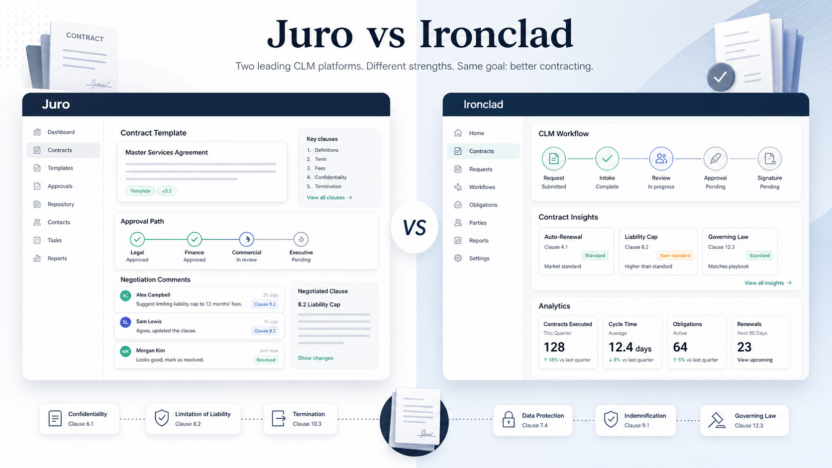
Juro emphasizes an all-in-one contract automation experience for creating, negotiating, signing, and managing contracts in one browser-based workflow. Ironclad is positioned as AI contract lifecycle management software with workflow design, contract data, insights, and legal operations depth.
The practical decision is whether your biggest problem is business-user contract self-service or enterprise-grade contract process control. Juro often makes sense when legal wants business teams to move faster within approved templates. Ironclad often makes sense when contract operations need more structure, analytics, and legal process maturity.
Feature Comparison
| Criteria | Juro | Ironclad | Better fit |
|---|---|---|---|
| Core use case | Contract automation and collaboration | Enterprise contract lifecycle management | Depends on legal maturity |
| AI focus | AI contract management and routine admin automation | AI assistant and contract insights | Depends on workflow |
| Business self-service | Strong fit for template-led workflows | Strong but more enterprise-oriented | Juro for simpler business self-service |
| Legal operations depth | Good for structured contract workflows | Stronger for complex CLM operations | Ironclad |
| Analytics | Contract workflow and repository value | Ironclad Insights and contracting process analytics | Ironclad |
| Pricing model | Based on contract volume and integration complexity according to Juro | Product and solution-based custom proposal according to Ironclad | Both require sales evaluation |
| Implementation | Better for teams wanting a focused contract workspace | Better for organizations prepared for CLM rollout | Depends on capacity |
Pricing
| Product | Official pricing signal | Buyer guidance |
|---|---|---|
| Juro | Juro says plans are based on contract volumes and integration complexity, with unlimited users, workflows, and templates language on its pricing page | Model expected contract volume, templates, integrations, and legal involvement |
| Ironclad | Ironclad pricing asks buyers to pick contract lifecycle management, AI assistant, or eSignature solutions and get a proposal | Clarify products, user groups, implementation, analytics, and support needs |
For both tools, pricing should be evaluated as a workflow investment, not only a software line item. Ask what is included in implementation, templates, approvals, repository migration, integrations, admin controls, analytics, AI assistant access, and support.
Real Use Cases
Sales contracts
A sales team can create contracts from approved templates, route non-standard terms to legal, and track status. AI may help summarize clauses or surface contract context, but legal review remains important for risk-sensitive terms.
Vendor agreements
Operations teams can manage vendor contracts, renewal dates, approval routing, and obligation tracking. This is useful when renewal risk is currently hidden in inboxes or shared drives.
Legal intake
Business teams can request standard agreements through a structured workflow instead of sending scattered messages to legal. The value is faster intake and clearer approval paths.
Contract analytics
Legal operations teams can analyze contract metadata, cycle times, bottlenecks, and obligations. Ironclad's official AI overview highlights insights and analytics-oriented contract use cases.
Template governance
A business can standardize approved templates so common agreements move quickly while unusual clauses or custom terms are routed for review.
Pros and Cons
Juro Pros
- Strong fit for business-user contract collaboration.
- Official pricing model emphasizes contract volume rather than artificial user limits.
- Useful for routine contract self-service.
- Browser-based workflow can simplify contract creation and negotiation.
Juro Cons
- Pricing requires modeling contract volume and integration needs.
- May not fit enterprises needing very deep CLM customization.
- Requires template and approval process design before rollout.
- Not a lightweight e-signature-only tool.
Ironclad Pros
- Strong enterprise CLM positioning.
- AI overview and Insights language support analytics and contract process visibility.
- Fits complex legal operations and approval workflows.
- Can support broader contract lifecycle needs than a simple template tool.
Ironclad Cons
- Custom proposal process can make early budget comparison harder.
- May be too heavy for small teams with low contract volume.
- Implementation planning matters.
- Legal, sales, procurement, and finance teams need clear ownership.
Alternatives
| Alternative | Best for | Main strength | Limitation |
|---|---|---|---|
| DocuSign CLM | Enterprise contract workflows | Large contract ecosystem | May be more platform than smaller teams need |
| PandaDoc | Sales proposals and documents | Proposal-to-signature workflows | Not always a full legal CLM replacement |
| LinkSquares | Contract analytics and legal operations | Contract intelligence | Fit depends on contract repository needs |
| Contractbook | Contract workflow automation | Template and lifecycle workflow | Depth varies by use case |
Realistic Small-Business Use Cases
In a typical small business workflow, AI contract management software should improve one repeated job. A team might use AI to turn raw notes into tasks, summarize support patterns, classify customer requests, build a first draft, compare records, or prepare a manager-ready report. The important point is that a person still owns the final decision.
A SaaS team could use the same pattern for weekly operating work. The workflow owner reviews examples from the previous week, updates the source material, checks which outputs were accepted or edited, and adjusts prompts or connected records before expanding usage.
An agency could use it for client work when the review path is clear. AI can prepare a first summary, brief, comparison, or table, but the agency should still check claims, pricing, brand language, and client-specific details before anything is shared.
An ecommerce team could use it for product, support, inventory, or marketing work. Useful examples include cleaning product copy, summarizing customer questions, finding repeated stock issues, routing returns questions, or preparing weekly performance summaries.
Practical Rollout Plan
Start with one workflow that happens every week. For AI contract management, that means choosing a small, repeatable process rather than trying to automate the whole department. Write down the source material, the owner, the review step, and the place where the approved output should live.
During the first week, configure the smallest useful version. Use real internal examples, but keep sensitive customer, employee, legal, or financial information out of the workflow until permissions are clear. The goal is to understand setup effort and output quality.
During the second week, compare the reviewed output against the old process. Look for concrete workflow signals: clearer handoffs, fewer repeated questions, faster summaries, cleaner status updates, better task routing, or shorter editing cycles. Do not judge the tool only by whether the first output looks polished.
During the third week, involve the people who will actually depend on the result. If they ignore the output, rewrite it manually, or keep separate notes, the process needs adjustment. Adoption problems often reveal unclear ownership, weak source material, or a tool that does not fit the daily workflow.
During the fourth week, decide whether to keep, expand, or pause. Keep the setup if the team can name a repeated improvement. Pause expansion if output quality is inconsistent, review takes too long, pricing depends on usage the team has not estimated, or the tool duplicates software already in the stack.
Buyer Decision Framework
Before choosing a tool for AI contract management, separate the buying decision into three parts: workflow fit, data fit, and operating cost. Workflow fit asks whether the product improves a real repeated process. Data fit asks whether the source material is clean enough for AI to produce useful output. Operating cost asks whether the plan, seats, usage limits, add-ons, and review time make sense after the first month.
The safest buyer path is to score each option against the same internal checklist. Use simple labels such as strong fit, workable fit, weak fit, or not needed. Avoid fake precision. A small business does not need a complex scoring model to make a good software decision. It needs a clear reason why the tool improves a job that already matters.
Ask these questions before buying:
| Decision area | Question to answer | Why it matters |
|---|---|---|
| Workflow owner | Who will configure, review, and maintain the process? | AI workflows fail when ownership is vague |
| Source quality | Is the input data, document, ticket, call, or table reliable? | Bad source material creates confident but weak output |
| Review path | Who approves customer-facing or business-critical results? | Human review protects trust and accuracy |
| Integration fit | Where does the approved output go next? | Value drops when teams copy data manually |
| Pricing trigger | What makes the monthly cost rise? | Seats, usage, credits, sessions, and add-ons can change the real cost |
| Stop condition | What result would make the team cancel or pause? | Clear stop rules prevent subscription sprawl |
For most small businesses, the best tool is not the most advanced one. It is the one that fits the existing team rhythm, reduces repeated manual effort after review, and can be explained to a new team member without a long training session.
Which One Should You Choose?
Choose Juro if business self-service, contract templates, routine approvals, and collaborative contract creation are the main pain points. Choose Ironclad if the organization needs deeper CLM workflow, analytics, legal operations controls, and a more enterprise-oriented contract process.
The wrong move is buying a contract platform before mapping the actual contract lifecycle. Document request intake, template ownership, clause review, negotiation steps, signing, storage, renewal tracking, and reporting before the sales demo.
Final Recommendation
Juro is the more approachable choice for teams prioritizing contract collaboration and business-user self-service. Ironclad is the stronger fit for enterprise legal operations and complex CLM. For most growing teams, the best first step is to map the five most common contract workflows and compare each platform against those workflows rather than comparing feature lists in isolation.
FAQs
Is Juro cheaper than Ironclad?
Official pages do not provide a simple public side-by-side price. Juro says pricing is based on contract volume and integration complexity, while Ironclad uses a proposal process based on selected solutions.
Which tool is better for small business?
Juro is often easier to evaluate for business-user contract workflows, but very small teams may still need only templates and e-signature rather than a full contract platform.
Which tool is better for enterprise legal teams?
Ironclad is usually the stronger candidate when the organization needs enterprise CLM, analytics, legal operations controls, and complex workflows.
Can AI review contracts without lawyers?
AI can help summarize and organize contract information, but legal review should remain part of risk-sensitive contract work.
What should teams prepare before a demo?
Prepare contract volume, template types, approval steps, integrations, repository needs, reporting requirements, and renewal tracking needs.