Quick Verdict
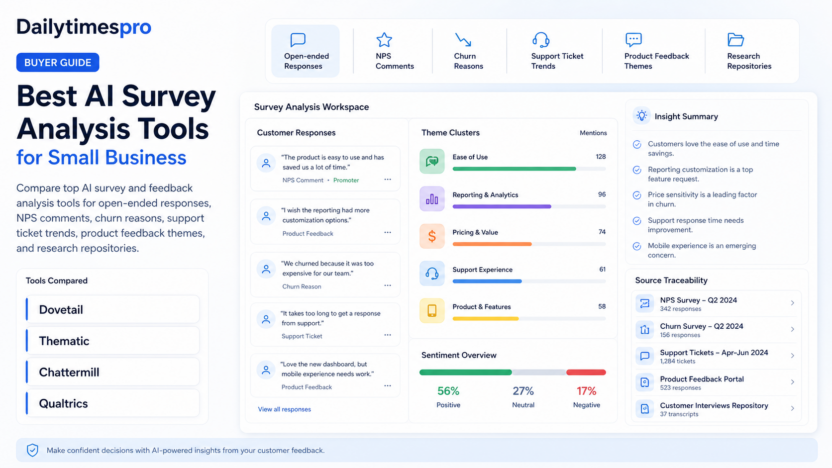
The best AI survey analysis tools help small businesses turn open-ended feedback into themes, priorities, and decisions. Dovetail is strong for research repositories and AI-assisted insight discovery. Thematic focuses on traceable customer feedback analysis. Chattermill is useful when feedback comes from support, reviews, surveys, and social channels. Qualtrics is a broader experience management platform for teams that need survey collection and analysis at scale.
Pricing last checked on July 19, 2026. Dovetail publishes a Free path for individuals and plan pricing on its official pricing page. Thematic and Chattermill are more sales-led for business use. Qualtrics publishes package and pricing paths but often requires choosing the right product package for the exact workflow.
Related Dailytimespro reading:
- Best AI Customer Support Tools
- Best AI Content Optimization Tools
- Best AI Workflow Automation Tools
- Best AI Sales Prospecting Tools
Best For
AI survey analysis tools are best for teams with open-ended customer responses, NPS comments, product feedback, churn reasons, onboarding feedback, support themes, review text, or user research notes.
Not Best For
They are not necessary if you only collect a few checkbox responses per month. A spreadsheet may be enough until feedback volume becomes difficult to read manually.
Our Evaluation Criteria
We evaluated tools by feedback ingestion, theme quality, traceability, reporting, collaboration, pricing clarity, data-source fit, ease of setup, and value for small teams. The strongest tools make it possible to trace insight back to the original response instead of treating AI themes as unexplained summaries.
Tool Reviews
Dovetail
Dovetail is useful when survey answers sit next to interviews, sales calls, support tickets, and research notes. Its official AI documentation describes ways to ask questions and summarize customer data. For small teams, that can help centralize customer understanding instead of leaving feedback scattered across forms and documents.
Thematic
Thematic focuses on customer intelligence from unstructured feedback. Its positioning emphasizes traceable analysis, which matters because decision makers need to see why a theme exists. This is useful when leaders want to prioritize roadmap issues, service complaints, churn reasons, or customer sentiment trends.
Chattermill
Chattermill is positioned as an AI-native customer intelligence platform that brings together feedback, support, reviews, and social data. It is a better fit when customer feedback is spread across multiple channels and the company wants a unified view.
Qualtrics
Qualtrics is broader than survey analysis alone. It fits organizations that need survey design, experience management, feedback programs, and reporting workflows. Small businesses should consider whether they need the full platform or a narrower analysis tool.
Pricing
Pricing last checked on July 19, 2026.
| Tool | Official pricing note | Best-fit buyer |
|---|---|---|
| Dovetail | Official pricing includes a Free $0 path for individuals with limits | Research teams and customer insight repositories |
| Thematic | Pricing is plan and scale oriented | Teams analyzing customer feedback at business scale |
| Chattermill | Business pricing is sales-led | Teams unifying feedback across channels |
| Qualtrics | Official pricing/package pages guide buyers by product need | Teams needing survey and experience management programs |
When budgeting, compare data sources, seats, response volume, storage, integrations, export needs, reporting, and whether the tool supports traceable evidence.
Real Use Cases
Customer Feedback Themes
A SaaS team could upload open-ended survey responses and identify repeated issues around onboarding, pricing, feature confusion, or support delays. The team should review representative responses before prioritizing roadmap changes.
Churn Reason Analysis
A subscription business can analyze cancellation comments and support notes to find repeated churn reasons. The output should guide follow-up questions and product decisions rather than produce a single simplistic label.
NPS Comment Review
AI can group promoter, passive, and detractor comments into themes. This helps leaders understand whether satisfaction is driven by support, product speed, price, integrations, or onboarding.
Support Ticket Trends
If feedback and support tickets are analyzed together, teams can connect survey complaints to actual support volume. This is useful for deciding whether to update documentation, improve onboarding, or fix product issues.
Product Research Repository
Dovetail is especially relevant when survey analysis is part of a larger research repository. Teams can connect interview notes, call summaries, and survey answers in one place.
Comparison Table
| Tool | Best for | Main strength | Limitation |
|---|---|---|---|
| Dovetail | Research repository and insight discovery | Combines research data and AI-assisted analysis | Teams need a repository habit |
| Thematic | Traceable feedback analysis | Customer feedback themes with evidence | Pricing and fit are sales-led |
| Chattermill | Unified customer intelligence | Multiple feedback channels in one view | Better for teams with enough feedback volume |
| Qualtrics | Experience management programs | Survey platform plus reporting ecosystem | May be broader than small teams need |
Pros
- Turns open-ended responses into usable themes.
- Helps teams prioritize repeated feedback.
- Reduces manual reading time when response volume grows.
- Can connect survey feedback with support and research data.
- Traceable evidence improves trust in summaries.
Cons and Limitations
- Weak survey questions produce weak analysis.
- AI themes should be reviewed against original responses.
- Sales-led pricing can be harder for small teams to estimate.
- Setup requires clear data sources and ownership.
- Sensitive customer feedback needs careful access control.
Alternatives
| Alternative | Best for | Main strength | Limitation |
|---|---|---|---|
| Google Sheets | Very small response sets | Low cost and familiar | Manual coding becomes slow |
| Typeform reports | Simple survey reporting | Easy collection and basic summaries | Limited deep research workflow |
| SurveyMonkey | General surveys | Familiar survey and reporting platform | AI depth depends on selected plan/features |
| Manual tagging | High-control qualitative review | Human judgment and nuance | Time-consuming as volume grows |
How to Run a Responsible Pilot
Start with one repeated workflow, one owner, and one review rule. For AI survey analysis, define where the work starts, what source material the AI can use, who reviews the output, and what system receives the final result. A useful pilot includes normal cases, incomplete inputs, edge cases, and one situation that should be escalated to a person.
Measure cleanup time, not only draft speed. The practical question is whether the approved result takes less effort after review. Track whether the tool reduced missed follow-ups, shortened review cycles, improved handoffs, created clearer reporting, or helped the team produce a more consistent result.
Keep permissions narrow during the pilot. Connect only the repositories, documents, tickets, call records, survey files, website data, or CRM records required for the first use case. If the tool touches customer data, code, contracts, support conversations, or internal notes, document who can see prompts, outputs, logs, and connected records.
At the end of the pilot, choose one of three outcomes. Adopt the workflow if it produces cleaner approved work. Revise it if prompts, permissions, data sources, or handoff rules need more structure. Stop it if cleanup time cancels the benefit or the team avoids using the process.
Buying Decision Details for Small Teams
The safest way to evaluate best AI survey analysis tools is to start from the workflow, not from the feature page. Write down the repeated task the team wants to improve, the person who owns the task, the source information the tool will use, and the final output that must be approved. This keeps the buying decision grounded in work that already happens instead of a broad promise that sounds useful but is hard to measure.
For a small business, the first question is whether the tool removes friction from a high-frequency process. A tool that saves ten minutes on a task done twice a year is less valuable than a tool that saves five minutes on a task done every business day. This matters in AI Business Tools because teams often buy software after seeing an impressive demo, then discover that setup, data cleanup, approvals, and user habits determine most of the value.
The second question is whether the tool fits existing systems. If your team already works in a CRM, help desk, repository, calendar, survey platform, document workspace, or publishing workflow, the tool should reduce handoff work. If it creates another isolated dashboard, adoption will usually be weaker. A practical implementation should make it clear where work starts, where the AI assists, when a person reviews the result, and where the approved output is stored.
The third question is whether pricing scales with real usage. Seat-based plans, credit-based plans, resolved-conversation pricing, annual contracts, API usage, and sales-led packages can all be reasonable, but they need different budget checks. Before buying, estimate monthly volume, required users, required integrations, review time, and the cost of mistakes. The cheapest plan is not always the best plan if it lacks the workflow control that keeps work reliable.
Setup Checklist
| Setup area | What to decide before rollout |
|---|---|
| Workflow owner | Who configures the tool, checks output quality, and decides whether to expand usage |
| Source material | Which repositories, documents, pages, tickets, chats, calls, survey answers, or CRM fields the tool can use |
| Review rule | What the AI may draft or suggest, and what a person must approve |
| Handoff | Where approved work goes after the AI step |
| Measurement | How the team will judge value after two to four weeks |
| Permissions | Which users can see source data, AI output, logs, and connected records |
| Pricing trigger | Which usage level, seat count, credit level, or contract threshold changes the monthly cost |
Common Buying Mistakes
The most common mistake is buying for a broad category instead of a specific workflow. A team may say it wants AI for productivity, lead capture, translation, support, code review, or feedback analysis, but that is not yet a buying requirement. A usable requirement is narrower: qualify website visitors before a sales call, summarize pull requests before maintainer review, translate support replies with human approval, or group survey comments into themes for a monthly product meeting.
Another mistake is treating AI output as the result instead of the starting point for review. The best tools in this category make people faster and more consistent, but they do not remove accountability. A small team should still define what good output looks like, what information must be checked, and which situations require escalation.
A third mistake is ignoring the operating cost. Even when subscription pricing looks acceptable, the team may need time for setup, prompt refinement, data cleanup, workflow mapping, training, and review. That cost is normal, but it should be planned. If the team has no owner for setup, even a strong product can become shelfware.
What Good Looks Like After 30 Days
After 30 days, the team should be able to point to a concrete improvement. For Best AI Survey Analysis Tools for Small Business, good outcomes could include faster review cycles, cleaner handoffs, fewer missed follow-ups, better insight summaries, more consistent customer responses, stronger documentation updates, or reduced manual sorting. The metric should match the workflow, not the marketing category.
The team should also know where the tool is not useful. This is an important sign of a mature pilot. If users can explain which tasks still need human judgment, which inputs create weak results, and which cases should be escalated, the workflow is safer and easier to improve. If everyone treats the output as automatically correct, the process needs more control before it expands.
Finally, the tool should have a clear place in the stack. It should not duplicate another subscription without a reason. If two tools cover the same workflow, decide which one owns the process and which one should be removed or kept for a different job. Small teams benefit from fewer, better-defined systems.
Final Recommendation
Choose Dovetail if survey analysis should live inside a research repository. Choose Thematic if traceable customer feedback intelligence is the main need. Choose Chattermill if feedback comes from many customer channels. Choose Qualtrics if the team needs a broader experience management platform. For most small businesses, the right first step is to centralize feedback and prove that AI themes lead to better decisions.
FAQs
What is the best AI survey analysis tool?
Dovetail, Thematic, Chattermill, and Qualtrics are all credible options. The best choice depends on feedback volume, source systems, reporting needs, and whether the team needs a research repository or a broader survey platform.
Can AI analyze open-ended survey responses?
Yes. AI can group responses into themes, summarize patterns, and highlight representative feedback. Teams should still check important themes against original responses.
Is Dovetail good for small teams?
Dovetail can be useful for small teams that want to organize research notes, survey responses, and customer insight in one workspace.
When is a spreadsheet enough?
A spreadsheet is enough when response volume is low and one person can read every answer carefully. Dedicated tools become useful when feedback is frequent or spread across channels.
What should teams avoid?
Avoid turning AI themes directly into product decisions without reviewing source responses and checking whether the sample is representative.