Quick Verdict
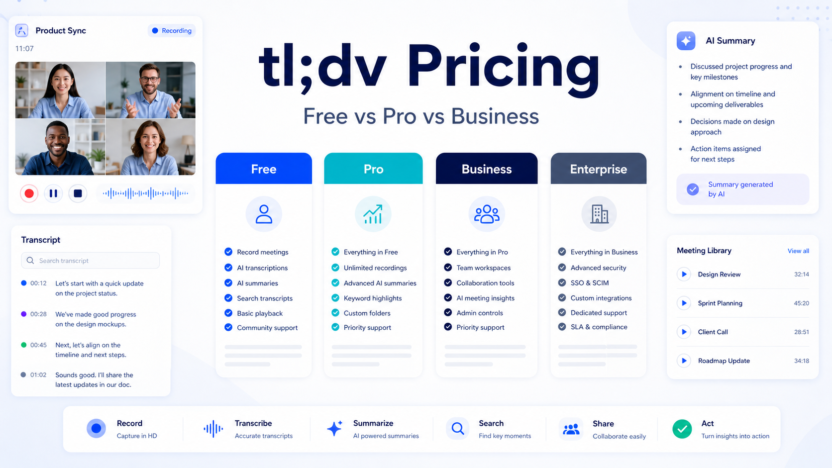
tl;dv pricing is best understood by matching the plan to meeting volume and sales-intelligence needs. Free is useful for trying AI meeting notes. Pro is better for individuals and small teams that need more productive summaries and workflows. Business is for teams that need stronger sales or customer-facing meeting intelligence. Enterprise is for larger organizations with custom requirements.
Best For
- Teams comparing tl;dv plans
- Sales and customer success teams
- Remote teams that need meeting memory
Not Best For
- Teams that never record meetings
- Buyers needing legal-grade transcription
- Companies without recording consent policies
Comparison Table
| Plan | Best Fit | Buying Note |
|---|---|---|
| Free | Testing meeting notes | Good starting point |
| Pro | Regular individual or small-team use | Compare summary and workflow needs |
| Business | Sales and customer teams | Better fit for team intelligence |
| Enterprise | Custom requirements | For security, support, and procurement needs |
Key Features To Evaluate
- Meeting recording
- Transcription
- AI summaries
- Multi-meeting insights
- CRM or workflow support
- Team controls
Real Use Cases
A sales rep can summarize discovery calls and create follow-up notes. A customer success team can preserve onboarding details, renewal risks, and support escalations. A product manager can review user interviews and find repeated themes. A founder can keep partner and hiring conversations searchable.
Pricing
Pricing last checked on July 10, 2026. Official pricing/source pages used: tl;dv pricing, tl;dv.
tl;dv's official pricing page presents a Free starting point, paid plan comparison, and an annual-plan promotion. This article treats exact plan selection as a workflow decision: meeting volume, team collaboration, CRM needs, and sales-intelligence depth matter more than the label alone.
Pros and Cons
| Pros | Cons |
|---|---|
| Free starting point lowers risk | Paid plan fit depends on meeting volume |
| Good for remote meeting memory | Summaries still need review |
| Useful for sales and CS workflows | Not a complete CRM |
Alternatives
| Tool | Best For | Main Strength | Limitation |
|---|---|---|---|
| Fireflies.ai | Team meeting library | Searchable meeting notes | May be broader than needed |
| Fathom | Simple summaries | Low-friction adoption | Less deep team intelligence |
| Otter.ai | Transcription-first teams | Searchable transcripts | Not sales coaching |
| Avoma | Sales meetings | Conversation intelligence | More setup |
Practical Buying Advice
The safest way to choose around tl;dv pricing is to define the workflow before comparing features. Write down the source of work, the owner, the output, and the destination. For sales prospecting, that might mean a list enters the tool, records are enriched, a rep reviews the results, and qualified leads move to a CRM. For onboarding, that might mean a new customer receives a welcome sequence, a checklist, a knowledge base path, and a human handoff when questions become sensitive.
Small teams should avoid buying software because a demo looks powerful. The real test is whether the tool makes one weekly process easier. If it saves ten minutes once, it may be nice to have. If it saves time every day, improves follow-up quality, and makes records easier to trust, it becomes much easier to justify.
Setup Checklist
| Setup Area | What To Decide | Why It Matters |
|---|---|---|
| Owner | Who reviews AI output | Prevents unreviewed summaries, leads, or messages from creating mistakes |
| Source | Which calls, records, forms, or accounts enter the workflow | Keeps the process focused |
| Destination | CRM, email, Slack, help desk, spreadsheet, or project tool | Turns AI output into action |
| Review rule | Which fields or messages require human approval | Protects customer-facing communication |
| Metric | What improvement proves value | Keeps the buying decision grounded |
What To Watch During a Trial
During a trial, use real work rather than perfect sample data. A prospecting tool should handle ordinary lead lists, incomplete account data, exclusions, and CRM handoff. A meeting or onboarding tool should handle normal calls, unclear requests, billing questions, and internal follow-up. If the tool only looks good with clean demo inputs, the team may struggle after purchase.
Do not judge only the interface. Judge how much cleanup is required after the AI produces output. If the team must rewrite every summary, fix every record, or manually rebuild every workflow, the software may be shifting work rather than removing it.
Data Quality and Review Rules
AI tools can assist research, enrichment, summaries, and drafts, but they should not invent facts. If a company size, customer detail, pricing limit, or buying signal is unknown, keep it unknown until a reliable source supports it. This is especially important for outbound personalization and customer-facing onboarding messages.
Teams should also document what not to automate. Sensitive account issues, legal questions, HR topics, medical data, and financial disputes may need stricter review or no automation at all.
Internal Reading Path
For related DailyTimesPro guides, read Best AI CRM Tools for Small Business, AI Sales Follow-Up Workflow, and How to Use AI for Lead Qualification. These articles help connect tool selection to the larger operating workflow.
Final Recommendation
Choose the tool that best supports the workflow your team can maintain this month. Start small, review the output, and expand only after the team proves the process is reliable. The best AI tool is not the one with the longest feature list. It is the one that improves a real process without adding confusion.
FAQs
Is this type of AI tool useful for small businesses?
Yes, when the team has a repeatable workflow and a clear owner for reviewing output.
Can AI replace a sales or support team member?
No. It can reduce research and drafting work, but decisions, customer communication, and sensitive follow-up still need human judgment.
What should teams evaluate first?
Start with workflow fit, data quality, pricing clarity, integrations, admin controls, and whether the output moves into the CRM, email, help desk, or project tool.
Should AI-generated outreach or summaries be sent without review?
No. Customer-facing messages, onboarding notes, sales claims, and account details should be reviewed before sending.
What is the biggest mistake buyers make?
Buying the tool before defining the process. A smaller tool with a clear workflow usually beats a powerful tool nobody uses.
How long should a team trial the tool?
Use at least a few normal work cycles, not just one polished demo. Test with ordinary calls, lead lists, onboarding tasks, or CRM handoffs.
Do integrations matter?
Yes. Calendar, CRM, email, Slack, help desk, and spreadsheet integrations often decide whether the tool becomes part of daily work.
How should value be measured?
Measure saved research time, faster follow-up, cleaner handoffs, better records, and fewer missed tasks.
Are pricing details always simple?
No. Some vendors use seats, credits, usage limits, or custom enterprise terms. This article uses official vendor sources where pricing is discussed.
What is the safest buying path?
Start narrow, validate one workflow, assign a human owner, then upgrade or expand only after the team proves the process works.
Additional Buyer Notes
For tl;dv pricing, the buying decision should be tied to a specific weekly workflow. Ask who owns the output, where it goes next, and what would make the team stop using the tool. If the answer is unclear, the team should simplify the process before paying for more capacity. A focused workflow with review rules is more valuable than a broad stack of features that nobody maintains.
Additional Buyer Notes
For tl;dv pricing, the buying decision should be tied to a specific weekly workflow. Ask who owns the output, where it goes next, and what would make the team stop using the tool. If the answer is unclear, the team should simplify the process before paying for more capacity. A focused workflow with review rules is more valuable than a broad stack of features that nobody maintains.
Additional Buyer Notes
For tl;dv pricing, the buying decision should be tied to a specific weekly workflow. Ask who owns the output, where it goes next, and what would make the team stop using the tool. If the answer is unclear, the team should simplify the process before paying for more capacity. A focused workflow with review rules is more valuable than a broad stack of features that nobody maintains.
Additional Buyer Notes
For tl;dv pricing, the buying decision should be tied to a specific weekly workflow. Ask who owns the output, where it goes next, and what would make the team stop using the tool. If the answer is unclear, the team should simplify the process before paying for more capacity. A focused workflow with review rules is more valuable than a broad stack of features that nobody maintains.
Additional Buyer Notes
For tl;dv pricing, the buying decision should be tied to a specific weekly workflow. Ask who owns the output, where it goes next, and what would make the team stop using the tool. If the answer is unclear, the team should simplify the process before paying for more capacity. A focused workflow with review rules is more valuable than a broad stack of features that nobody maintains.
Additional Buyer Notes
For tl;dv pricing, the buying decision should be tied to a specific weekly workflow. Ask who owns the output, where it goes next, and what would make the team stop using the tool. If the answer is unclear, the team should simplify the process before paying for more capacity. A focused workflow with review rules is more valuable than a broad stack of features that nobody maintains.
Additional Buyer Notes
For tl;dv pricing, the buying decision should be tied to a specific weekly workflow. Ask who owns the output, where it goes next, and what would make the team stop using the tool. If the answer is unclear, the team should simplify the process before paying for more capacity. A focused workflow with review rules is more valuable than a broad stack of features that nobody maintains.
Additional Buyer Notes
For tl;dv pricing, the buying decision should be tied to a specific weekly workflow. Ask who owns the output, where it goes next, and what would make the team stop using the tool. If the answer is unclear, the team should simplify the process before paying for more capacity. A focused workflow with review rules is more valuable than a broad stack of features that nobody maintains.
Additional Buyer Notes
For tl;dv pricing, the buying decision should be tied to a specific weekly workflow. Ask who owns the output, where it goes next, and what would make the team stop using the tool. If the answer is unclear, the team should simplify the process before paying for more capacity. A focused workflow with review rules is more valuable than a broad stack of features that nobody maintains.
Additional Buyer Notes
For tl;dv pricing, the buying decision should be tied to a specific weekly workflow. Ask who owns the output, where it goes next, and what would make the team stop using the tool. If the answer is unclear, the team should simplify the process before paying for more capacity. A focused workflow with review rules is more valuable than a broad stack of features that nobody maintains.
Additional Buyer Notes
For tl;dv pricing, the buying decision should be tied to a specific weekly workflow. Ask who owns the output, where it goes next, and what would make the team stop using the tool. If the answer is unclear, the team should simplify the process before paying for more capacity. A focused workflow with review rules is more valuable than a broad stack of features that nobody maintains.
Additional Buyer Notes
For tl;dv pricing, the buying decision should be tied to a specific weekly workflow. Ask who owns the output, where it goes next, and what would make the team stop using the tool. If the answer is unclear, the team should simplify the process before paying for more capacity. A focused workflow with review rules is more valuable than a broad stack of features that nobody maintains.
Additional Buyer Notes
For tl;dv pricing, the buying decision should be tied to a specific weekly workflow. Ask who owns the output, where it goes next, and what would make the team stop using the tool. If the answer is unclear, the team should simplify the process before paying for more capacity. A focused workflow with review rules is more valuable than a broad stack of features that nobody maintains.