Quick Verdict
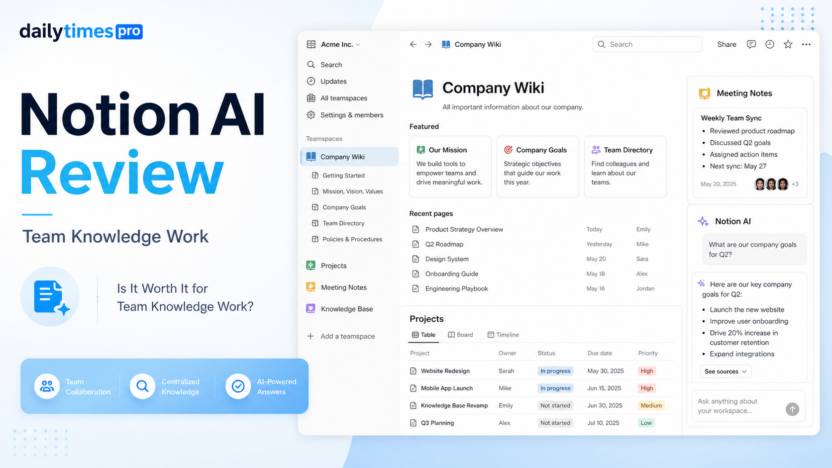
Notion AI is worth considering if your team's knowledge already lives in Notion or if you are standardizing docs, wikis, projects, notes, and lightweight databases in one workspace. Its value is strongest when it can answer questions from organized pages, help draft and edit documents, summarize meeting notes, and assist with database work. It is less compelling if your team keeps most knowledge in another system.
Pricing last checked on July 21, 2026. Pricing and plan details in this article are based on official sources: Notion pricing. Pricing may vary based on billing cycle, seat count, credits, usage, add-ons, region, and sales-led terms, so confirm current plan details from the linked official source before buying.
Related Dailytimespro reading:
- Best AI Project Management Tools
- Best AI Workflow Automation Tools
- Best AI Email Assistants
- Best AI Content Optimization Tools
Best For
Notion AI is best for small teams that manage SOPs, meeting notes, project briefs, content calendars, onboarding docs, product notes, and internal knowledge in Notion. It is especially useful when people waste time searching for answers across pages and databases.
Not Best For
It is not best for teams that need a dedicated help desk, CRM, code review tool, advanced BI platform, or heavy project management system. It also requires disciplined workspace organization; AI answers are less useful if the knowledge base is outdated or chaotic.
Our Evaluation Criteria
For this article, the practical evaluation is based on ease of setup, pricing clarity, AI quality, workflow fit, integrations, admin controls, collaboration features, output review, and value for money. The goal is not to crown a universal winner. The goal is to help a small business owner, team lead, marketer, operator, or founder decide whether the tool fits a real workflow.
The most important test is whether the software improves a repeated process without creating a second place where work gets stuck. A strong AI product should make the next human step clearer. It should summarize, draft, organize, transcribe, automate, or recommend in a way that can be reviewed. If the output is hard to verify, difficult to hand off, or separated from the team's existing stack, the practical value drops even when the demo looks impressive.
Key Features
- AI assistance for chat, writing, editing, autofill, translation, and workspace answers according to the official pricing page.
- Meeting notes, enterprise search, research mode, and custom agents appear in Notion's AI-related plan table and credit model.
- Free, Plus, Business, and Enterprise workspace plans with different collaboration and admin features.
- Custom Agents and Workers use Notion credits according to the official pricing page.
- Enterprise options include stronger controls and zero data retention with LLM providers for Enterprise plan workspaces.
Real Use Cases
Team wiki answers
A new employee can ask questions about internal policies, product notes, or process docs if those pages are current and permissioned correctly.
Meeting notes and follow-up
A team can summarize meetings, extract action items, and connect decisions back to project pages.
Content and campaign planning
A marketing team can draft briefs, organize ideas, maintain calendars, and use AI to summarize research notes before review.
Database autofill
A small operations team can use AI-supported fields to summarize records, create first-pass notes, or categorize information when source data is structured.
Pricing
| Plan or product | Official pricing signal | Buyer note |
|---|---|---|
| Free | $0 per seat per month on the official pricing page | Good for personal use or initial testing |
| Plus | $10 per seat per month on the official pricing page | Good for small teams needing more collaboration and file capacity |
| Business | $20 per seat per month on the official pricing page | Adds stronger team and admin features |
| Enterprise | Custom pricing | Use for advanced security, governance, and enterprise controls |
| Custom Agents | Free to try, then $10 per 1,000 monthly Notion credits according to the official pricing page | Relevant if autonomous agent workflows matter |
The safest way to read pricing is to estimate real monthly usage before comparing plans. For seat-based products, count the people who need to create, review, or manage work, not only the person testing the product. For credit-based products, estimate the number of AI actions, recordings, generations, meetings, automations, or database operations that will happen in a normal month. For custom enterprise plans, ask what is included in onboarding, support, security, admin controls, data retention, and overage handling.
Pros and Cons
Pros
- Strong fit when docs, databases, and knowledge already live in Notion.
- Useful for drafting, summarizing, workspace answers, and meeting-note workflows.
- Pricing page gives clear base plan rates and credit language for agent features.
- Can reduce searching and repeated internal questions when the workspace is clean.
Cons
- Value depends heavily on workspace organization and permissions.
- Not a replacement for dedicated systems like CRM, help desk, or BI tools.
- Some AI capabilities may be limited, plan-dependent, beta, or credit-based.
- Teams need rules for what information can be stored and summarized.
Comparison Table
| Tool | Best for | Main strength | Limitation |
|---|---|---|---|
| Notion AI | Knowledge work and docs | Answers, writing, notes, databases | Needs organized workspace |
| ClickUp Brain | Task-heavy workspaces | Tasks, docs, chat, agents | Broader work management system |
| Airtable AI | Structured records | Database-driven operations | Less wiki-focused |
| Google Workspace Gemini | Email and docs ecosystem | Works across Google apps | Less Notion-native |
Alternatives
| Alternative | Best for | Main strength | Limitation |
|---|---|---|---|
| ClickUp Brain | Task and project-heavy teams | AI across tasks, docs, and chat | Different workspace model |
| Airtable | Operational databases | Structured records and interfaces | Less natural for long-form docs |
| Confluence AI | Enterprise documentation | Strong team documentation heritage | May be heavier for small teams |
Practical Buying Guidance
Start with one use case, one owner, and one review rule. Write down where the work begins, what source material the AI can use, who approves the output, and where the approved result goes. This matters because many AI tools look useful in isolation but become weaker when they do not match the team's daily systems.
Small teams should also decide how much control they need. A solo creator may only need fast drafting, summaries, or video edits. A growing team may need shared workspaces, permissions, templates, analytics, admin controls, and clearer handoffs. A regulated or client-facing team may need stronger privacy language, data retention options, SSO, audit logs, or sales-led security review before adoption.
Another practical question is whether the tool saves time after review. AI output is rarely the final business result. It is usually a draft, summary, suggestion, transcript, report, or first pass. The buying decision should focus on whether the reviewed result is faster, clearer, and easier to trust than the current manual process.
Setup Checklist
| Setup area | What to decide |
|---|---|
| Workflow owner | Who configures the product, reviews early output, and decides whether to expand usage |
| Source material | Which videos, meetings, databases, tasks, docs, brand assets, or workspace records the tool can access |
| Approval rule | What can be published, sent, updated, or shared automatically and what needs human review |
| Integration path | Which tool receives the final approved output |
| Budget trigger | Which seats, credits, storage limits, media hours, task volume, or AI usage could increase cost |
| Risk control | What data should not be pasted, uploaded, recorded, summarized, or connected |
Common Mistakes to Avoid
Do not buy only because a feature sounds impressive. Translate each feature into a job: record a product demo, summarize a customer call, create a project update, organize a database, draft a support reply, or prepare a team knowledge page. If the feature does not connect to a job, it may not produce value.
Do not skip source quality. AI tools are only as useful as the material they receive. Messy tasks, unclear meeting agendas, unstructured databases, outdated knowledge pages, and inconsistent naming rules can create weak output. Clean the workflow enough that the AI has useful context.
Do not ignore adoption. If the team has to open another dashboard, copy information manually, or learn a process that is heavier than the old one, usage will fade. The strongest tools fit into the places where work already happens.
What a Good 30-Day Pilot Looks Like
A useful pilot for Notion AI review should be narrow enough to judge but real enough to matter. Choose one workflow that already happens every week. Do not start with a broad instruction such as "use AI more." Start with a specific job: summarize product demo videos, prepare async updates, organize work requests, clean up a database process, create team knowledge answers, or produce a customer-facing walkthrough. The narrower the workflow, the easier it is to see whether the tool improves the result.
During week one, focus on setup and source quality. Create the workspace, connect only the systems that are required, and define the examples the team will use for testing. If the tool uses videos, make sure the recordings have clear titles and a focused script. If the tool uses tasks or databases, clean up fields, owners, statuses, and naming rules. If the tool uses knowledge pages, update the pages that people actually rely on. AI output is much easier to trust when the input is organized.
During week two, focus on review quality. Ask the workflow owner to track which outputs were accepted, which needed edits, and which were not useful. This should be a practical log, not a complicated analytics project. The team needs to know whether the tool saves review time, reduces missed details, improves handoffs, or creates clearer next steps. If the output is fast but still requires heavy cleanup, the workflow needs refinement before a wider rollout.
During week three, focus on team behavior. Watch whether people naturally use the tool or work around it. Low adoption usually points to one of four problems: the tool is not connected to the main workflow, the output is not reliable enough, the review rule is unclear, or the cost feels hard to justify. Fix the workflow before adding more users. Expanding too early usually makes the process noisier.
During week four, make the buying decision. Compare the plan cost with the value of the repeated workflow. A good result is not only "the AI created something." A good result is that the reviewed output became easier to produce, easier to share, easier to search, or easier to act on. If the team can name that improvement clearly, the product is a stronger candidate for adoption.
Decision Scenarios
Choose this type of AI Productivity Tools product when the work is frequent, structured, and owned by a specific person or team. It is easier to justify a paid plan when the software helps with a process that happens every day or every week. Examples include recurring client updates, team reporting, customer onboarding, product demos, operations intake, project tracking, internal knowledge answers, and content production.
Wait before buying if the workflow is occasional, experimental, or politically unclear inside the team. If nobody owns the output, nobody reviews quality, and nobody decides where the result goes, the software will not fix the process. In that case, write the workflow first, test with a free plan or trial where available, and decide whether the tool belongs in the stack after the first few examples.
Avoid buying when the value depends on claims that cannot be checked. For a small business, the safest purchase is based on visible workflow improvements: fewer manual steps, clearer updates, faster edits, better summaries, cleaner handoffs, or less repeated searching. Be cautious with broad productivity promises that are not tied to an actual task your team performs.
Data, Permissions, and Review
Before connecting a product, decide what data can be used. Product videos, meeting recordings, customer notes, internal documents, task comments, and databases may contain sensitive information. Give the tool the smallest useful access during the pilot. If the team needs SSO, SCIM, audit logs, advanced admin controls, retention settings, or custom security terms, treat that as part of the pricing decision rather than an afterthought.
Set a review rule for every output. AI-generated summaries, titles, chapters, tasks, notes, database fields, scripts, and recommendations should be reviewed before they affect customers, contracts, billing, hiring, legal commitments, or public content. The review rule does not need to slow the team down. It simply makes clear who is accountable for the final result.
Finally, decide what should be documented after rollout. Keep a short note that explains the use case, owner, connected sources, approval rule, plan, and renewal trigger. This helps prevent subscription sprawl. If the tool stops being useful, the team can remove it because the original reason for buying it is documented.
Final Recommendation
Choose Notion AI if Notion is already becoming your team's source of truth. Clean up important pages, archive outdated docs, define owners, and pilot AI on meeting notes, onboarding, and internal questions before expanding.
FAQs
Is Notion AI good for small teams?
Yes, when the team's docs, notes, and databases are organized in Notion and people need faster answers or drafting help.
How much does Notion cost?
The official pricing page lists Free, Plus at $10 per seat/month, Business at $20 per seat/month, and custom Enterprise pricing. Agent features can use Notion credits.
Can Notion AI replace project management software?
Not always. It can support projects, but dedicated work management tools may be better for complex dependencies, reporting, and operations.
What should I fix before using Notion AI?
Update key pages, remove duplicates, define page owners, clean permissions, and make sure important information is easy to find.