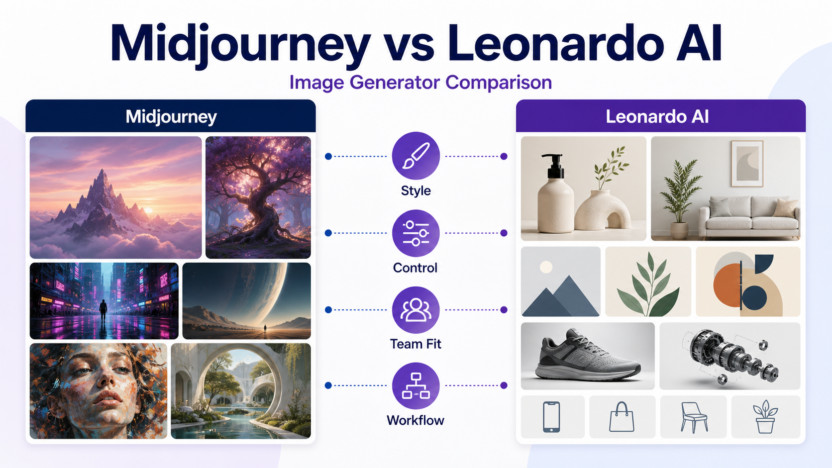
Midjourney and Leonardo AI are both popular AI image generation tools, but they fit different creative workflows. Midjourney is known for prompt-led creative exploration and polished visual style. Leonardo AI is positioned more like a broader creative production platform with image, video, design, tokens, private generations on paid plans, team plans, and API options.
This comparison is written for creators, marketers, small businesses, agencies, and design teams choosing between the two.
Quick Verdict
Choose Midjourney if your priority is high-quality creative exploration, mood boards, art direction, and prompt-led visuals. Choose Leonardo AI if your priority is production workflow, tokens, private generations on paid plans, model training, team options, and API paths.
Quick Comparison
| Category | Midjourney | Leonardo AI |
|---|---|---|
| Best for | Creative image exploration | Production-oriented creative workflows |
| Free plan | Not listed in official plan comparison | Free plan listed |
| Entry paid plan | Basic at $10/month | Essential at $12/month before tax |
| Higher tiers | Standard, Pro, Mega | Premium, Ultimate, Team, API |
| Privacy | Stealth Mode on Pro and Mega | Private creations on paid solo plans |
| Team/API path | Plan and terms dependent | Team and API plans listed |
| Workflow style | Prompt-led creative direction | Token-based production workspace |
Pricing last checked on June 23, 2026.
Midjourney Overview
Midjourney offers subscription tiers named Basic, Standard, Pro, and Mega. Its official plan comparison lists monthly prices of $10, $30, $60, and $120, with annual prices that reflect a 20% discount.
Midjourney is best for creative exploration: campaign mood boards, product concept visuals, editorial images, social creative, and brand inspiration. Its strengths are visual quality and creative direction. The tradeoff is that teams need a clear workflow for prompts, approvals, storage, licensing review, and final editing.
Leonardo AI Overview
Leonardo AI lists Free, Essential, Premium, Ultimate, Team, and API plan paths. Its official pricing page lists Essential at $12/month, Premium at $30/month, and Ultimate at $60/month before tax for solo users, with higher team and API options.
Leonardo AI is best when the team needs more structured asset production. Its pricing page references tokens, private generations on paid plans, personal AI models, simultaneous generation limits, queue limits, relaxed generation on selected models, team tokens, and API paths.
Best For
Choose Midjourney If
- You need strong creative exploration.
- You create mood boards, ad concepts, and editorial visuals.
- You prefer prompt-led image creation.
- You value polished art direction.
- You do not need a heavy production dashboard.
Choose Leonardo AI If
- You want token-based production planning.
- You need private generations on paid plans.
- You want model training or production controls.
- You are comparing team or API use.
- You need a broader creative platform beyond simple prompts.
Not Best For
Midjourney is not ideal when the team needs a conventional business dashboard, formal asset workflow, or API-first production. Leonardo AI is not ideal when the team only wants the simplest possible art-direction tool and does not want to manage tokens or production settings.
Pricing Comparison
| Plan Area | Midjourney | Leonardo AI |
|---|---|---|
| Free | Not listed in official plan comparison | Free at $0/month before tax |
| Entry paid | Basic $10/month | Essential $12/month before tax |
| Mid tier | Standard $30/month | Premium $30/month before tax |
| Higher solo tier | Pro $60/month, Mega $120/month | Ultimate $60/month before tax |
| Team/API | Terms and subscription dependent | Team and API plans listed |
Pricing last checked on June 23, 2026.
Real Use Cases
Marketing Concepts
A marketing team could use Midjourney to explore visual campaign directions and Leonardo AI to produce more controlled asset variations. The final creative should still be reviewed for brand fit and rights.
Social Content
Creators can use either tool to create non-branded visual ideas for posts, thumbnails, or campaign drafts. Avoid using generated images as factual product screenshots.
Product Mockups
Small businesses can create concept imagery for pitches, landing pages, and ads. The image should not misrepresent a real product feature or customer result.
Agency Workflows
Agencies should document prompt history, client approval, usage rights, and brand constraints. Using AI images for clients requires more process than using them for internal ideation.
Pros And Cons
Midjourney Pros
- Strong creative output and art-direction fit.
- Clear subscription tiers in official plan comparison.
- Useful for concept art, mood boards, and campaign visuals.
- Annual discount is documented in official plan information.
- Stealth Mode is listed for Pro and Mega plans.
Midjourney Cons
- No free plan is listed in the official plan comparison.
- Teams must manage workflow and approval outside the image generator.
- Pro or Mega may be needed for privacy-sensitive commercial contexts.
- Not ideal for teams needing API-style production workflows.
Leonardo AI Pros
- Free plan and multiple paid plan paths.
- Token, bank, private generation, model, team, and API details are visible on official pricing.
- Paid plans can fit creators, small businesses, and production teams.
- Team and API options are clearer on the pricing page.
Leonardo AI Cons
- Token and queue limits require planning.
- The broader feature set may feel heavier than a simple prompt tool.
- Some relaxed generation language applies only to selected models.
- Teams still need rights and review processes.
Final Recommendation
Choose Midjourney for creative exploration and visual polish. Choose Leonardo AI for structured production, private paid workflows, model options, team needs, and API paths. If your team creates client assets, test both with the same brief and compare usable outputs, revision speed, review process, and rights fit.
For related design coverage, see Canva AI vs Adobe Firefly and Gamma vs Canva AI.
FAQs
Is Midjourney better than Leonardo AI?
Midjourney is often a better fit for art direction and polished creative exploration, while Leonardo AI is stronger for users who want a broader production workspace with tokens, private generations on paid plans, model training, and team/API options.
Which is cheaper, Midjourney or Leonardo AI?
Midjourney's official plan comparison lists Basic at $10/month, Standard at $30/month, Pro at $60/month, and Mega at $120/month. Leonardo's official pricing lists Free, Essential at $12/month, Premium at $30/month, and Ultimate at $60/month before tax.
Does Midjourney have a free plan?
Midjourney's official plan comparison lists paid subscription tiers. Leonardo AI lists a Free plan with daily fast tokens.
Which is better for small businesses?
Leonardo AI may fit small businesses that need private generations, production controls, and team/API options. Midjourney may fit creative teams that prioritize artistic output and prompt-based exploration.
Which is better for marketing visuals?
Both can help with marketing concepts. Midjourney is strong for high-quality concept imagery, while Leonardo AI may be better when a team needs production controls and asset workflows.
Can I use images commercially?
Commercial use depends on the plan and terms. Midjourney's official plan article references usage rights and revenue-related plan requirements. Leonardo AI's official pricing FAQ describes ownership differences between paid and free users.
Which has better control?
Leonardo AI is generally positioned around more production controls, tokens, model options, and team/API paths. Midjourney remains strong for prompt-led creative direction.
Should agencies use both?
Some agencies may use both: Midjourney for concept exploration and Leonardo AI for production-oriented asset workflows. Most small teams should start with one and measure actual usage.
What alternatives should I compare?
Canva AI, Adobe Firefly, Ideogram, DALL-E through ChatGPT, and Stable Diffusion-based tools are common alternatives depending on workflow.
What should I test first?
Test brand-safe prompts, image consistency, editing controls, privacy needs, licensing terms, prompt workflow, and how many usable outputs your team gets from a normal project brief.
Practical Test Brief
Use the same creative brief in both tools. Ask for a product campaign concept, a social post background, a website hero visual, and a style-consistent variation. Compare prompt effort, number of usable outputs, privacy settings, editing controls, export workflow, and review time.
Rights And Review
AI image workflows need rights review. Check plan terms, privacy settings, client restrictions, and whether generated visuals could imply real product features, partnerships, or customer outcomes. For commercial work, keep prompt records and approval notes.
Workflow Comparison For Business Users
Midjourney and Leonardo AI can both create strong visuals, but they fit different operating styles. Midjourney is often better for fast creative exploration, mood boards, campaign directions, and visually polished concepts. Leonardo AI is often better when a team wants more production structure, token planning, private paid workflows, model-related options, team paths, or API-related planning.
A marketing team could use Midjourney to explore the creative direction for a campaign before asking a designer to refine final assets. A product team could use Leonardo AI to generate controlled variations for concept exploration. An agency could test both tools with the same client brief and compare how many outputs are usable after review.
Review Criteria
Compare the tools by prompt effort, number of usable outputs, revision process, privacy options, team controls, licensing fit, and how easily the output moves into the rest of the design workflow. A tool that creates beautiful images but creates confusion around rights, storage, or client approval may not be the best commercial choice.
Practical Recommendation
For pure creative direction, Midjourney is usually the simpler recommendation. For teams that care about production planning, private paid generations, token management, team use, and API paths, Leonardo AI deserves a closer look. For serious commercial work, test both using one real brief and record prompt history, usable output rate, revision time, and approval feedback.
How Teams Should Test Both Tools
A fair test should use the same brief, same brand constraints, and same success criteria. Ask both tools for a website hero direction, a social campaign visual, a product concept background, and several style variations. Then measure how many outputs are usable after review, how long revisions take, and whether the workflow fits the team's approval process.
Do not judge only the most impressive image. Judge consistency, control, privacy, export process, and how easy it is to reproduce a style. A small business may need predictable visuals more than one dramatic concept image. An agency may care more about client approval, prompt records, and rights review.
Commercial Use Considerations
For commercial use, teams should review each platform's current terms and plan details. Keep records of prompts, outputs, approvals, and where generated assets are used. Avoid generating visuals that imply real partnerships, real product screens, real customer outcomes, or factual claims unless those claims are true and approved.
Which One Should You Choose?
Choose Midjourney when the top priority is creative exploration and polished visual direction. Choose Leonardo AI when the team wants a broader production environment with token planning, private paid generations, model options, team paths, or API-related planning. If your work is client-facing, run a paid pilot before committing to either workflow.
Implementation Notes
Whichever tool you choose, create a small brand prompt guide. Include visual style, colors, subject rules, forbidden claims, output use cases, and approval steps. This helps team members avoid random prompts that produce inconsistent assets.
For client or commercial work, keep generated assets in organized folders with prompt notes and approval status. Do not treat AI images as finished just because they look polished. Review them for brand accuracy, legal risk, misleading product details, and suitability for the channel where they will appear.
Practical Recommendation For Small Businesses
If your business needs occasional creative direction, start with the simpler workflow and test whether the outputs help your campaigns. If you need repeatable production across many assets, compare controls, privacy options, and team workflow more seriously. The best tool is the one that helps the team produce approved visuals consistently, not the one that creates the flashiest sample image.
For agencies, the final decision should include client review speed. If clients approve Midjourney concepts faster, that matters. If Leonardo AI gives the team more control over production variations, that matters too. A fair test uses one real brief, one deadline, one approval path, and one final decision-maker.