Quick Verdict
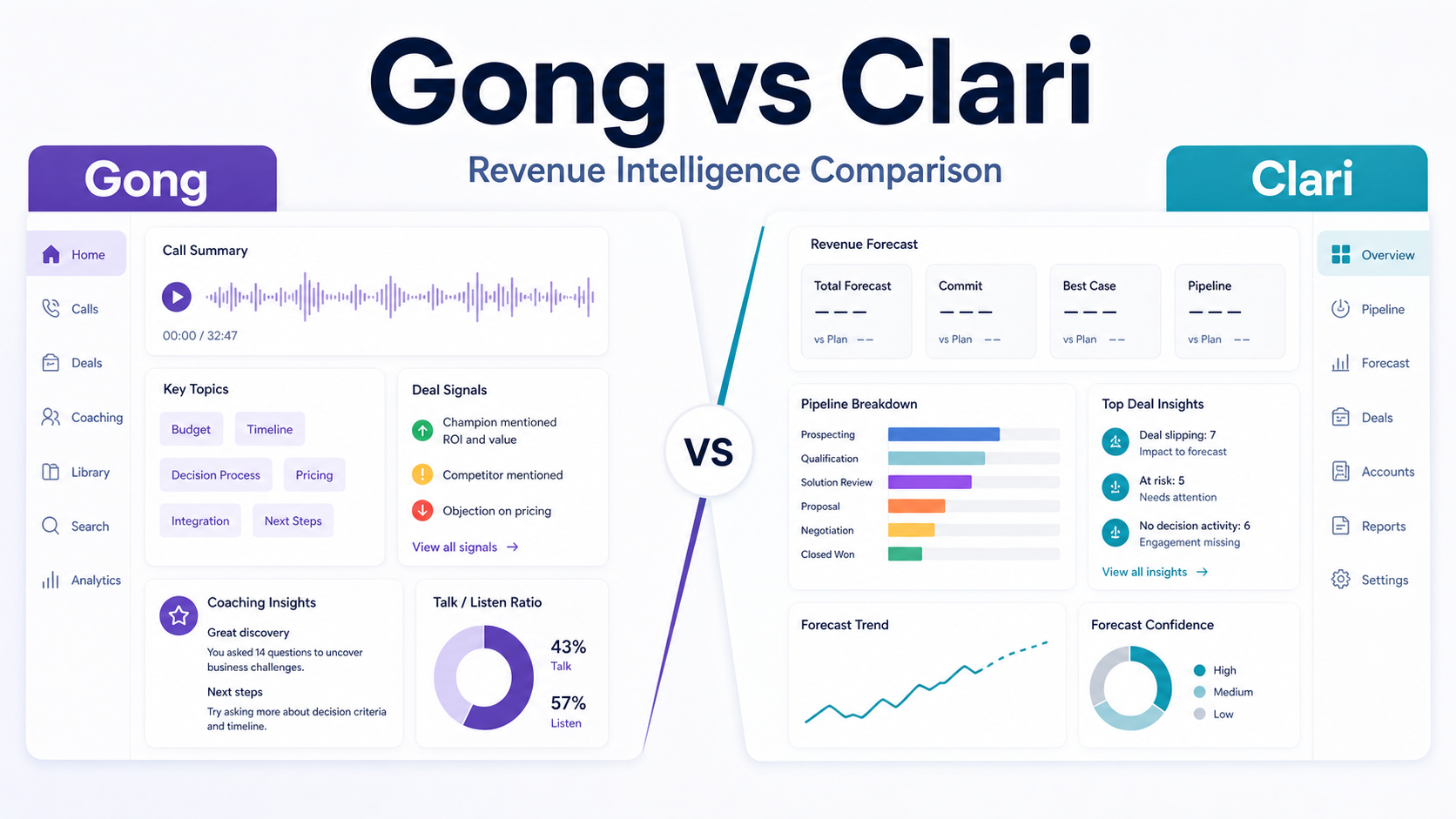
Choose Gong if your main need is conversation intelligence, sales call analysis, deal insights, and coaching from customer interactions. Choose Clari if your main need is revenue forecasting, pipeline inspection, revenue process visibility, and execution across the revenue team.
Both Gong and Clari are serious revenue platforms, not simple small-business CRM add-ons. The practical choice depends on where your revenue process is weakest: customer conversations or pipeline forecasting.
For smaller sales tooling context, see our Apollo.io Review and Clay vs Apollo articles.
Best For
| Platform | Best for | Main strength |
|---|---|---|
| Gong | Sales teams that need call insights and coaching | Conversation intelligence and deal visibility |
| Clari | Revenue teams focused on forecasting and pipeline execution | Forecasting, pipeline inspection, revenue process management |
Not Best For
Gong and Clari are not best for very small teams that only need basic CRM, email outreach, or a simple pipeline board. They are more appropriate when a sales organization has enough call volume, pipeline complexity, and management process to justify revenue intelligence software.
Main Difference
The simplest difference is this: Gong is usually more conversation-led, while Clari is more forecast-led. That does not mean Gong only does calls or Clari only does forecasts. It means the buying reason is different.
If managers need to understand what is happening in calls, why deals are moving, what objections come up, and how reps can improve, Gong is the more natural starting point. If leadership needs a cleaner revenue operating system with forecast discipline, pipeline inspection, and deal execution visibility, Clari is the more natural starting point.
Comparison Table
| Category | Gong | Clari |
|---|---|---|
| Primary use case | Conversation and revenue intelligence | Revenue forecasting and execution |
| Best buyer | Sales managers and revenue teams | Revenue leaders and operations teams |
| Conversation analysis | Strong fit | Not the primary buying reason |
| Forecast management | Available in broader revenue context | Core strength |
| Coaching use case | Strong fit | More indirect |
| Pipeline inspection | Deal and call informed | Core workflow |
| CRM dependency | Works around CRM data and sales activity | Works around CRM and revenue data |
| Small team fit | Better when call volume is meaningful | Better when pipeline process is mature |
| Pricing style | Vendor-led/custom | Vendor-led/custom |
| Main risk | Buying before coaching process is ready | Buying before forecast process is ready |
Gong Overview
Gong is best known for capturing and analyzing sales conversations. For sales managers, the value is that calls, emails, and deal signals can become coaching and deal-inspection inputs instead of scattered notes.
In a typical sales workflow, managers can review call themes, objections, competitor mentions, next steps, and deal risk signals. A rep can use insights to prepare follow-ups and improve discovery. The key is that the team must actually use the insights in coaching and pipeline review. Otherwise, the software becomes an expensive recording archive.
Clari Overview
Clari focuses on revenue process visibility. It helps revenue teams inspect pipeline, manage forecasts, and understand whether the team is on track. For sales operations and revenue leadership, Clari can become the operating layer around forecast calls and pipeline reviews.
In a typical revenue workflow, leadership can inspect committed deals, pipeline changes, forecast categories, coverage, and risks. The benefit is discipline: fewer surprises and clearer revenue process ownership.
Pricing
Pricing last checked on July 11, 2026. Pricing may vary by region, billing cycle, usage, seats, add-ons, or sales agreement when the vendor lists custom pricing. Gong and Clari generally use vendor-led pricing rather than simple public self-serve pricing tables. Buyers should use official sales or pricing pages and request current quotes based on team size, products, integrations, and implementation needs. Do not rely on third-party pricing guesses.
Practical Use Cases
Sales coaching
Gong is a better fit when managers need real examples from calls to coach discovery, objection handling, qualification, and next-step clarity.
Forecast inspection
Clari is a stronger fit when leadership needs a consistent forecast process with pipeline visibility and revenue accountability.
Deal risk review
Both platforms can support deal review, but from different angles. Gong brings conversation context. Clari brings forecast and pipeline context.
Revenue operations
Clari is especially relevant when revenue operations needs a shared process for forecast calls, pipeline hygiene, and execution tracking.
Pros and Cons
| Platform | Pros | Cons |
|---|---|---|
| Gong | Strong conversation intelligence, useful coaching context, deal insights from customer interactions | Needs meaningful call volume and management adoption |
| Clari | Strong forecast discipline, pipeline visibility, revenue process focus | Requires mature revenue operations and clean CRM process |
Which One Should You Choose?
Choose Gong if your managers ask, "What is actually happening in our customer conversations?" Choose Clari if leadership asks, "Can we trust this forecast and pipeline?" If both questions are urgent, your team may need to evaluate both, but the first purchase should match the more painful gap.
Alternatives
| Tool | Best for | Main strength | Limitation |
|---|---|---|---|
| Salesforce Sales Cloud | CRM foundation | CRM records and pipeline | Needs add-ons for deeper revenue intelligence |
| HubSpot Breeze | CRM-centered AI for smaller teams | Integrated customer platform | Less specialized for enterprise revenue intelligence |
| Apollo.io | Prospecting and engagement | Contact data and outreach | Not a revenue intelligence platform |
| Outreach | Sales engagement | Sequencing and rep workflow | Different category focus |
Final Recommendation
Gong and Clari solve different revenue problems. Gong is the better first choice for conversation intelligence and coaching. Clari is the better first choice for forecast management and revenue execution. Small teams should be careful: if the sales process is still simple, a cleaner CRM and better pipeline hygiene may create more value before either platform.
FAQs
Is Gong better than Clari?
Gong is better for conversation intelligence and coaching. Clari is better for forecasting and revenue process visibility.
Does Clari record sales calls?
Clari is not primarily bought as a call recording or conversation intelligence tool. Its core value is revenue forecasting and execution visibility.
Is pricing public?
Both vendors generally use quote-based pricing. Use official vendor contact or pricing pages for current quotes.
Which is better for small business?
Neither is usually the first tool for a very small team. Consider them when call volume, deal complexity, and revenue management process justify the investment.
Can Gong and Clari work together?
Some revenue teams may evaluate both categories, but the buying decision should start with the biggest problem: conversations or forecast discipline.
What should teams prepare before buying?
Prepare CRM hygiene, sales process definitions, forecast categories, manager coaching cadence, and integration requirements before demoing either platform.
Buying Scenario 1: Managers Need Better Call Coaching
If managers cannot tell why deals are stalling, what objections reps hear, or whether discovery is strong enough, Gong is usually the better first evaluation. The platform category is built around customer conversations and deal signals. The practical value comes when managers use insights in coaching, not just when calls are recorded.
Teams should define coaching routines before buying. For example, a manager might review two calls per rep each week, identify common objection patterns, and use those insights in pipeline reviews. Without a routine, conversation intelligence becomes another dashboard.
Buying Scenario 2: Leadership Needs Forecast Discipline
If the main issue is forecast confidence, pipeline risk, and revenue process visibility, Clari is usually the better first evaluation. The platform category is built around revenue execution and forecast management. The value depends on clean CRM data, defined forecast categories, and consistent sales process.
Revenue leaders should define what "commit", "best case", and "pipeline risk" mean before implementation. If teams use forecast categories inconsistently, software cannot create trust by itself.
Implementation Readiness Checklist
| Readiness area | Gong | Clari |
|---|---|---|
| CRM hygiene | Important | Critical |
| Call volume | Critical | Useful but not central |
| Manager coaching cadence | Critical | Useful |
| Forecast process | Useful | Critical |
| Revenue operations ownership | Useful | Critical |
| Rep adoption plan | Critical | Critical |
Risks and Limitations
The biggest Gong risk is buying conversation intelligence without manager adoption. Reps may record calls, but the organization may not change coaching behavior. The biggest Clari risk is buying forecast software before the team agrees on sales stages, forecast categories, and inspection habits.
Both tools can be overkill for small teams with simple pipelines. If the team is still struggling with CRM updates, lead qualification, or basic follow-up, fix those first. Our articles on {link("AI Lead Qualification")} and {link("Best AI Sales Prospecting Tools")} cover earlier-stage sales operations.
Final Decision Framework
Use Gong when the sales conversation is the source of truth you need to understand. Use Clari when pipeline and forecast discipline are the source of truth you need to manage. If both problems exist, start with the one causing the most missed revenue decisions.
Practical Decision Questions
Before choosing a tool or workflow, answer these questions in writing. Who owns the process? What information must be captured? Which step currently creates delay? Which fields or records must stay accurate? Which integrations are required on day one? Which outputs need human review before they reach a customer, vendor, or employee? These questions prevent the team from buying software for a vague problem.
Small teams should also decide what they will not automate. The highest-risk parts of the process should keep human review: legal terms, payment decisions, customer promises, pricing changes, security-sensitive data, and anything that could create financial or reputation risk. AI should reduce repetitive work, not remove accountability.
Rollout Plan for a Small Team
Start with one workflow, one owner, and one success measure. A practical rollout can be as simple as this:
| Week | Focus | Output |
|---|---|---|
| Week 1 | Map the current process | List steps, owners, tools, and failure points |
| Week 2 | Configure the first workflow | Build the smallest useful version |
| Week 3 | Run with real work | Compare results with the old process |
| Week 4 | Fix gaps | Adjust templates, permissions, fields, and handoffs |
| Month 2 | Expand carefully | Add one more use case only after the first works |
This slower rollout is usually better than a broad launch. It gives the team enough evidence to know whether the tool improves work or simply adds another place to update.
What to Review After 30 Days
After the first month, review adoption, time saved, quality of outputs, errors, exceptions, and whether employees trust the workflow. If people bypass the tool, find out why. The problem may be missing integrations, too many required fields, unclear ownership, or weak training.
Also review cost. AI and automation tools often look affordable at the first seat or starter plan, then become expensive when usage, add-ons, seats, or higher-tier features are required. The right question is not only monthly price. The right question is whether the workflow removes enough manual effort, rework, and missed follow-up to justify the operational cost.
Governance Notes
Every AI-assisted business workflow needs basic governance. Define who can change templates, who can approve outputs, who can invite users, who can export data, and who reviews sensitive information. This matters even for small teams because AI tools often touch customer records, internal tasks, meeting notes, invoices, contracts, or sales information.
Keep a simple review cadence. Once a month, check whether the workflow still reflects the way the team works. Remove unused automations, update stale templates, archive old projects, and review permission levels. A lightweight governance habit prevents the tool from becoming a confusing collection of old experiments.
Bottom Line for Small Businesses
The best tool is not always the tool with the most AI features. The best tool is the one that makes a specific workflow clearer, faster, and easier to review. If a feature does not improve ownership, quality, speed, or decision-making, treat it as optional. Start narrow, prove value, and expand only after the first workflow is reliable.
Red Flags Before You Buy
Pause the purchase if the team cannot describe the current workflow clearly, if the required integrations are unknown, if pricing depends on a sales quote that has not been reviewed, or if the tool will introduce sensitive data into a system without a permission plan. Also pause if the buyer is excited about AI outputs but has no plan for who reviews them.
Another red flag is unclear ownership. If everyone is responsible for follow-up, nobody is responsible. Assign one owner for the workflow, one owner for templates or configuration, and one owner for reviewing results after launch.
Leave a Reply