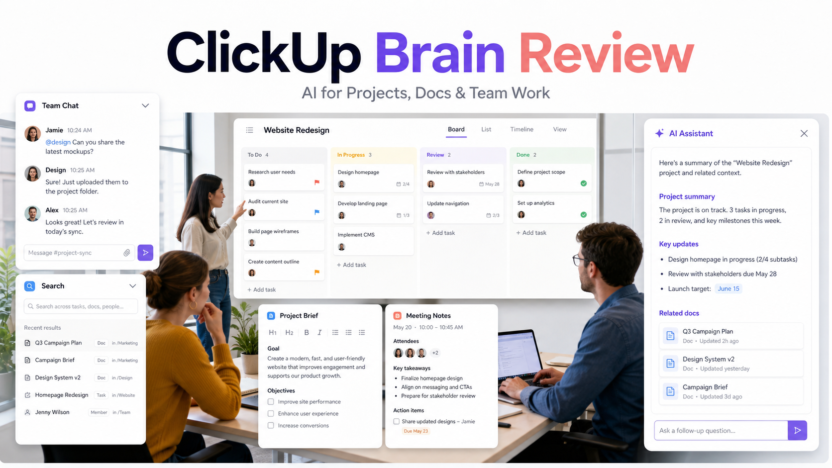
ClickUp Brain is most useful when a team already keeps tasks, documents, comments, goals, and project history in ClickUp. Its value comes from workspace context, not from being another general chatbot. A disorganized workspace will still produce weak answers, while a maintained workspace can make search, summaries, drafting, and project updates faster.
Quick Verdict
ClickUp Brain is worth piloting for teams committed to ClickUp that spend time searching work, summarizing updates, drafting project content, or turning meetings into actions. It is less compelling for teams with fragmented systems, weak task hygiene, strict requirements not confirmed by ClickUp documentation, or a preference for specialized AI tools.
Best For
- Established ClickUp workspaces with reliable tasks and docs.
- Project managers summarizing status and blockers.
- Teams that want AI close to work context.
- Organizations willing to govern credits and permissions.
Not Best For
- Teams that do not use ClickUp as a system of record.
- Projects with poor naming, ownership, or documentation.
- Buyers expecting autonomous, error-free project management.
- Teams unwilling to review generated tasks and summaries.
What This Article Evaluates
This review evaluates context access, search, drafting, task support, meeting-related features, pricing clarity, governance, and alternatives. It does not claim hands-on benchmark results. ClickUp states that access and limits can change, so current help and billing pages should be reviewed.
Our Evaluation Criteria
Workspace context
The central question is whether Brain can use the tasks, docs, comments, and other work a user is permitted to access.
Output usefulness
Summaries and drafts should reduce editing rather than produce polished-looking but inaccurate project statements.
Setup and adoption
AI does not repair unclear ownership, stale tasks, missing decisions, or inconsistent project structure.
Pricing clarity
ClickUp uses workspace billing plus optional AI-related add-ons and credits, so the full cost must be modeled.
Governance
Administrators need clear rules for permissions, sensitive data, agent actions, meeting content, and approval.
Value for money
The tool should save enough search, reporting, drafting, or meeting follow-up time to justify cost and review effort.
Key Features And Capabilities
Context-aware assistance
ClickUp describes Brain as available across the workspace and constrained by the items a user can access. That can help answer project questions when the underlying records are current.
Search and summaries
Teams can use AI to condense long task threads, documents, or updates. Review remains necessary because missing context can change the meaning of a summary.
Writing support
Brain can help draft project briefs, updates, comments, and structured content. Templates and examples improve consistency.
Meeting workflow
ClickUp offers an AI Notetaker add-on for recording, transcripts, summaries, and action items. Meeting consent and action-item verification remain operational responsibilities.
Agents and credits
ClickUp's Brain pricing page describes optional capabilities and Super Credits. Credit-based features should be monitored with real usage rather than assumed from a demo.
Real Use Cases
Weekly status reporting
A project manager can gather task changes, blockers, decisions, and upcoming work, then verify the draft against owners before sharing it.
Finding decisions
A team member can search workspace context for the latest approved requirement or decision instead of reading every thread.
Project kickoff
Brain can help turn an approved brief into a draft task structure, but owners, dates, dependencies, and acceptance criteria need review.
Meeting follow-up
A team can draft notes and action items, then require participants to confirm assignments and deadlines.
Internal documentation
Operations teams can turn repeated answers into maintained docs, provided the source process is stable and an owner updates it.
Comparison Table
| Option | Best For | Main Strength | Important Limitation |
|---|---|---|---|
| ClickUp Brain | Teams centered on ClickUp | Workspace-connected assistance | Depends on workspace quality |
| Notion AI | Docs and knowledge work | Writing and workspace knowledge | Project operations differ |
| Microsoft Copilot | Microsoft 365 organizations | Office and enterprise context | Licensing and setup complexity |
| ChatGPT Business | General team assistance | Flexible cross-functional use | Less native ClickUp context |
Pricing
ClickUp's official help center says Brain AI is purchased per workspace, the fee applies to workspace members, and current pricing is shown on the billing page and Brain pricing page. The public Brain pricing page lists optional items including AI Super Credits at $10 for 10,000 credits, Talk to Text at $9 per user per month, and AI Notetaker starting at $12 for 60 hours per month. These are add-on examples, not a complete workspace quote.
Pricing last checked on June 25, 2026. Pricing may vary by billing period, region, usage, seat count, credits, or add-ons. The official pricing pages linked in this article are the authority for a purchase decision.
Pros
- AI is close to project context.
- Can reduce search and reporting work.
- Supports writing and meeting-related workflows.
- Useful when ClickUp is already the team system.
Cons And Limitations
- Weak workspace hygiene limits answer quality.
- Add-ons and credits complicate cost comparison.
- Summaries and agent actions require review.
- It is not a substitute for project ownership.
Alternatives
Notion AI is a strong comparison for document-centered teams. Microsoft Copilot fits Microsoft 365 environments. ChatGPT Business offers broader general assistance. A specialized meeting assistant may be preferable if transcription and follow-up are the only requirements. Compare the workflow, not just the AI model.
A Practical Evaluation Workflow
Step 1: Choose one real workflow
Do not evaluate software with a vague demo. Select one recurring workflow with a clear owner, real inputs, a defined output, and a known review step. A narrow pilot exposes whether the product fits daily work better than a long feature tour.
Step 2: Record the current baseline
Before introducing the tool, record how long the workflow takes, where handoffs fail, which work is repeated, and what quality checks already exist. The baseline prevents a team from confusing novelty with measurable improvement.
Step 3: Use approved, low-risk data
Start with public, synthetic, or appropriately approved information. Confirm data retention, access controls, and account permissions before using confidential customer, employee, financial, legal, or product information.
Step 4: Review every output
Assign a human reviewer. Check factual accuracy, tone, completeness, permissions, links, calculations, and whether the result actually satisfies the original task. AI assistance should shorten work without removing accountability.
Step 5: Measure the full cost
Include subscription fees, seats, credits, setup, training, integrations, review time, and the cost of correcting errors. A lower advertised price can be less economical when the workflow requires more manual cleanup.
Step 6: Decide with written criteria
At the end of the pilot, score workflow fit, output quality, ease of adoption, administration, pricing clarity, integration effort, and risk. Keep the decision record so the team can review it when plans or requirements change.
Security, Governance, And Quality Control
Start with least-privilege access, approved source data, named owners, and a written human-review rule. Confirm retention, training-data, export, deletion, and administrator controls from current vendor documentation. Never paste confidential data into a tool merely because the interface is convenient.
How To Measure Value
Measure completion time, editing time, handoff errors, adoption, administrator work, and the cost of corrections. Record the baseline before the pilot. A useful product should improve a real workflow without creating an unmanageable review or credit burden.
Common Buying Mistakes
- Choosing from a feature list without testing the real workflow.
- Ignoring permissions, data quality, and human review.
- Comparing prices without seats, credits, add-ons, and implementation.
- Treating generated output as verified fact.
- Rolling out to the whole company before a controlled pilot.
Detailed Decision Checklist
Before selecting ClickUp Brain Review: Is It Worth It for Project Teams?, write down the exact workflow that needs improvement. Name the person who starts the work, the information the tool receives, the output it should produce, the person who reviews that output, and the system where the approved result is stored. This prevents a purchase from becoming an open-ended experiment with no owner.
Check data readiness next. List the documents, CRM records, meeting content, contact data, task history, writing samples, or knowledge sources the workflow depends on. Mark which information is public, internal, confidential, regulated, outdated, duplicated, or missing. AI features cannot compensate for contradictory records or unclear permission boundaries. Cleaning the source material may create more value than adding another subscription.
Review the human handoff in detail. Define which actions the software may assist with, which actions need explicit approval, and which requests must always go to a qualified person. Customer complaints, employment matters, legal interpretations, financial commitments, security incidents, account exceptions, and public claims normally need a clear escalation route. A useful workflow makes that route visible instead of hiding uncertainty behind a confident answer.
Model the full cost for twelve months. Include the base subscription, members, contact or usage growth, credits, recordings, storage, integrations, implementation, training, administrator time, and periodic quality review. Add a reasonable allowance for correcting mistakes and maintaining documentation. Compare that number with the value of time saved, errors avoided, faster response, or work that becomes possible. Do not assume every automated action creates equal value.
Finally, confirm exit options. Determine how the team can export content, contacts, transcripts, tasks, documents, or configuration if the product no longer fits. Record who owns the account and billing relationship. A responsible software decision includes both adoption and a practical way to leave.
30-Day Rollout Plan
Week 1: Prepare
Choose a bounded use case and collect the approved inputs. Document current steps, time, common errors, and escalation points. Configure the smallest necessary group of users. Review authentication, roles, integrations, retention, and billing controls. Create a short acceptance checklist that defines what a usable output looks like.
Week 2: Run In Parallel
Use the new workflow alongside the existing process. Do not remove the old control before the team understands failure modes. Review every output and label the type of correction required: factual, contextual, formatting, tone, permission, missing information, or incorrect action. This produces evidence that is more useful than a general opinion about whether the AI feels impressive.
Week 3: Improve The System
Update source documents, templates, prompts, routing rules, naming conventions, or permissions based on observed problems. Remove steps that add no value. If users are bypassing the workflow, ask why before adding enforcement. The cause may be poor fit, unclear training, slow performance, missing integration, or a review process that is heavier than the original task.
Week 4: Decide
Compare the pilot with the baseline. Review time saved, correction rate, adoption, user confidence, administrator workload, and expected annual cost. Decide whether to expand, keep the workflow limited, change configuration, test an alternative, or stop. Write down the decision and assumptions. Revisit it when pricing, product capabilities, data requirements, or business volume changes.
Quality Review Questions
Use these questions during the pilot:
- Does the output answer the real task, or only produce plausible language?
- Can a reviewer trace important claims to an approved source?
- Are names, dates, prices, links, assignments, and calculations correct?
- Does the workflow expose uncertainty and provide a human escalation path?
- Can administrators see who has access and what the tool is doing?
- Are users saving time after review, or only moving work to a different step?
- Does the pricing model remain predictable at the expected volume?
- Can the result be exported and used in the team's system of record?
If the team cannot answer these questions, it is too early for a broad rollout. A smaller scope with clearer controls is usually more productive than adding more features.
Final Recommendation
Pilot ClickUp Brain if ClickUp already contains trustworthy work context. Use one project with defined documents, tasks, owners, and reporting. Do not buy it to solve poor project discipline. The strongest case is time saved finding, summarizing, and drafting from maintained workspace data.
Frequently Asked Questions
Is ClickUp Brain free?
ClickUp provides trials of select features. Official help says paid plans can purchase Brain AI add-ons after the trial.
How is ClickUp Brain priced?
Pricing can include workspace-level access, add-ons, and credits. Review the official Brain page and your billing page.
Can it manage projects automatically?
It can assist with project work, but humans should approve scope, ownership, dates, dependencies, and changes.
Does it respect permissions?
ClickUp says users can use Brain in locations and items they can access. Administrators should still test roles and sensitive workflows.
Is it better than ChatGPT?
It can be better for ClickUp context. ChatGPT Business may be more flexible for general work outside ClickUp.
Who should avoid it?
Teams without maintained ClickUp data or a clear AI use case should avoid adding cost until the workflow is ready.
Related Dailytimespro Guides
Compare our Notion AI vs ClickUp AI guide, AI project management workflow, and ChatGPT Business vs Microsoft Copilot.