Quick Verdict
Tidio is worth considering if your small business wants live chat, basic help desk workflows, automation, and an AI customer service agent in one platform. Its strongest fit is ecommerce and service businesses that get repeated questions about orders, shipping, returns, product details, appointments, pricing, and basic troubleshooting.
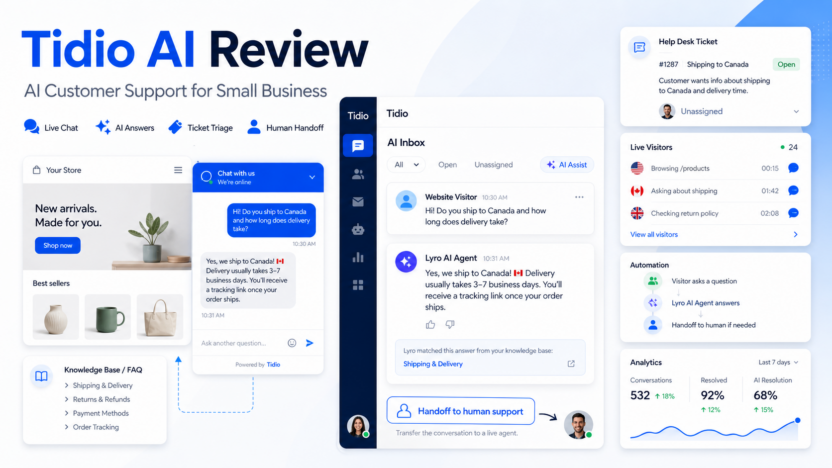
Tidio’s AI agent, Lyro, is designed to answer repetitive customer questions using your business knowledge. The broader Tidio platform also includes live chat, ticketing, Flows automation, visitor tracking, analytics, and support inbox features. That combination makes it more practical for a small team than a standalone chatbot that only answers FAQs.
Tidio is not the best fit if you need a deep enterprise help desk, complex IT service management, or a fully custom support platform. It is also not ideal if your support process requires highly regulated advice, financial decisions, medical guidance, or complex account-specific troubleshooting without human review.
Best For and Not Best For
| Best for | Not best for |
|---|---|
| Ecommerce stores that need live chat and AI answers | Large enterprises needing advanced service operations |
| Small support teams with repeated FAQ volume | Teams that want only a cheap static chatbot |
| Businesses that need human handoff after AI answers | Regulated workflows where every answer needs specialist review |
| Teams using chat for support and sales questions | Companies that already have a deeply configured help desk |
Our Evaluation Criteria
This Tidio review focuses on practical small-business criteria: ease of setup, AI answer workflow, human handoff, help desk usefulness, ecommerce fit, automation depth, pricing clarity, integrations, reporting, and value for money.
A good AI support tool should not just answer questions. It should help a real support team reduce repetitive conversations while keeping control of difficult cases. For small businesses, that means the tool needs to be understandable, affordable, and easy to connect to common website and ecommerce workflows.
Key Features
Tidio combines several support features under one product family. The official pricing page describes AI-powered plans that combine Lyro AI Agent, Tidio Help Desk, Flows automation, unified analytics, and reporting. It also describes a Lyro AI Agent only option for businesses that want to add an AI agent to Zendesk, Salesforce, or another help desk.
The main feature areas are:
| Feature | Practical value |
|---|---|
| Lyro AI Agent | Answers repetitive questions from business knowledge |
| Live chat | Lets human agents talk with website visitors in real time |
| Help desk and tickets | Organizes conversations that need follow-up |
| Flows automation | Creates proactive support and sales automations |
| Visitor tracking | Helps teams see who is browsing and what they may need |
| Analytics | Shows conversation and support activity trends |
| Integrations | Connects support with ecommerce and workflow tools |
For a small ecommerce store, that means a visitor can ask about shipping, returns, product availability, or payment options. Lyro can answer common questions, while a human agent can take over when the customer needs account-specific help. For a services business, Tidio can help with appointment questions, pricing questions, contact forms, lead capture, and basic onboarding.
Real Use Cases
In a typical small business workflow, Tidio can handle repeated customer questions before they become tickets. A store could train the AI agent on shipping policies, return windows, sizing guidance, payment methods, and order tracking instructions. The customer gets a faster answer, and the support team spends less time repeating the same information.
A SaaS team could use Tidio for onboarding support. New users often ask where to find features, how billing works, how to reset access, or how to connect integrations. Tidio can answer simple questions from the knowledge base and hand off complex account issues to a human.
A local service business could use Tidio to answer hours, booking, location, cancellation, and service-area questions. It can also route interested visitors to a contact form or a human support agent during business hours.
An ecommerce team could use Flows for proactive chat prompts. For example, if a visitor spends time on a pricing or product page, a flow can offer help. If the visitor asks a common question, the AI agent can answer it. If the question becomes sales-specific, a human can step in.
Pricing
Pricing last checked on July 22, 2026.
Tidio’s official pricing page lists usage-based plans around billable conversations, Lyro AI conversations, and visitors reached with Flows. At the checked usage setting, the pricing page showed Starter at $24.17 per month with 100 billable conversations and a 7-day free trial. Growth started at $49.17 per month from 250 billable conversations. The page also says higher quota is available on Plus and Premium plans, and that businesses needing more than 2,000 billable conversations, 1,000 Lyro AI conversations, or 100,000 visitors reached with Flows should contact Tidio for a custom plan.
The same page separates a combined Lyro AI Agent plus Tidio Help Desk path from a Lyro AI Agent only path. That matters because a company that already uses another help desk may not need the full Tidio support workspace.
Small businesses should estimate three numbers before buying: monthly support conversations, expected AI-resolved conversations, and proactive automation visitors. Those usage inputs affect which plan makes sense.
Official source: Tidio pricing
Pros and Cons
| Pros | Cons |
|---|---|
| Combines AI agent, live chat, help desk, and automation | Pricing depends on conversation and AI usage levels |
| Strong fit for ecommerce support and website chat | Not as deep as enterprise help desk platforms |
| Human handoff makes it safer than unattended-only chatbots | Teams still need a good knowledge base for accurate answers |
| Flows can support both sales and support use cases | Usage limits should be checked before scaling |
| Can be used with other help desks through Lyro AI Agent only | Complex account-specific support still needs human review |
Alternatives to Tidio
| Alternative | Best for | Main strength | Limitation |
|---|---|---|---|
| Intercom Fin | SaaS and customer support teams | Strong AI support agent and messenger ecosystem | Can become expensive for small teams |
| Zendesk AI | Teams already using Zendesk | Mature help desk ecosystem | More complex than many small businesses need |
| Freshdesk Freddy AI | Support teams using Freshworks | Ticketing plus AI assistance | Best value depends on Freshworks setup |
| Crisp | Startups wanting shared inbox and chat | Simple company-workspace pricing model | AI depth varies by plan and setup |
Tidio’s advantage is simplicity for website chat and ecommerce support. Intercom and Zendesk may be stronger for larger support operations, but Tidio is easier to consider when a small business wants AI chat, live chat, tickets, and automation without rebuilding its entire support stack.
Final Recommendation
Tidio is a strong choice for small businesses that want to reduce repetitive support questions while keeping human support available. It is especially useful for ecommerce stores, local service businesses, online education providers, SaaS teams, and small teams that need chat-based customer support.
The main buying caution is usage. Before upgrading, estimate how many conversations you handle each month and how many you want Lyro to automate. If your support volume is modest, Tidio can be a practical and affordable step up from basic website chat. If your support process is already complex, compare it with Intercom, Zendesk, Freshdesk, and Crisp before committing.
For related customer support buying guides, see our articles on best AI customer support tools, Intercom alternatives, Zendesk AI review, and AI customer support workflow.
FAQs
What is Tidio used for?
Tidio is used for live chat, customer messaging, help desk conversations, website chat automation, and AI-powered customer support.
What is Lyro AI Agent?
Lyro is Tidio’s AI customer service agent. It is designed to answer repetitive customer questions using business knowledge and route harder cases to human support.
Is Tidio good for ecommerce?
Yes. Tidio is a strong fit for ecommerce stores that need help with shipping questions, returns, product questions, order status guidance, and lead capture.
Does Tidio replace human support agents?
No. It can reduce repetitive questions, but human agents are still needed for account-specific issues, complaints, refunds, complex troubleshooting, and sensitive cases.
How much does Tidio cost?
At the checked usage setting on July 22, 2026, Tidio listed Starter at $24.17 per month and Growth starting at $49.17 per month, with pricing affected by conversations, Lyro AI conversations, Flows visitors, and higher-volume plans.
Can Tidio work with another help desk?
Tidio’s pricing page describes a Lyro AI Agent only option that can add an AI agent to Zendesk, Salesforce, or another help desk.
Is Tidio better than Intercom?
Tidio is usually easier for small website and ecommerce support teams. Intercom is stronger for larger SaaS support operations with deeper customer messaging needs.
What should I prepare before using Tidio AI?
Prepare your FAQs, shipping and return policies, product information, billing rules, contact process, escalation rules, and examples of questions that need human handoff.
Does Tidio include analytics?
Yes. Tidio’s pricing page references unified analytics and reporting as part of its AI-powered plans.
Who should avoid Tidio?
Teams that need enterprise service management, strict regulated workflows, or a deeply customized support backend may need a heavier platform.