Quick Answer
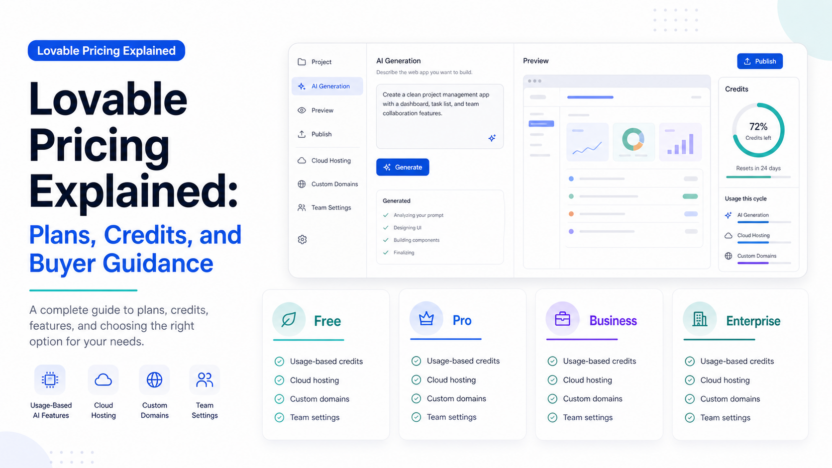
Lovable pricing is best understood as credit-based app-building capacity, not a normal per-seat SaaS subscription. The Free plan is useful for trying the product and building small public experiments. Pro is the practical starting point for solo builders, founders, and small teams that want private projects, custom domains, code editing, and enough credits to build real prototypes. Business is for teams that need governance features such as role-based access, SSO, priority support, security center features, and more workspace controls. Enterprise is for large organizations that need volume-based credit pricing, advanced governance, dedicated support, and account-specific terms.
Pricing last checked on August 23, 2026. Lovable's official documentation lists Pro tiers starting at 100 monthly credits for $25 monthly or $250 annually, shown as $21 per month when billed annually. Business tiers start at 100 monthly credits for $50 monthly or $500 annually, shown as $42 per month when billed annually. The Free plan includes 5 daily build credits capped at 30 per calendar month, plus monthly Cloud and AI grants. Enterprise pricing is volume-based and handled through account-specific terms.
The important buyer question is not only "How much does Lovable cost?" It is "How quickly will my projects consume credits?" Lovable uses credits for build messages, Cloud hosting/backend usage, and AI features inside deployed apps. That means a simple landing page prototype and a production-style app with authentication, database logic, integrations, generated images, and AI features can have very different cost profiles.
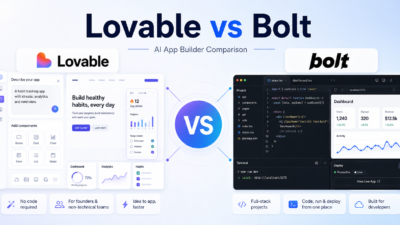
Related Dailytimespro reading: Lovable vs Bolt, Best Lovable Alternatives, v0 vs Bolt.new, and Bolt.new Review.
Best For
Lovable is best for founders, product managers, marketers, designers, and small teams that want to turn plain-language prompts into web apps quickly. It is especially useful for prototypes, internal tools, landing pages, MVPs, dashboards, and simple SaaS workflows where speed matters more than starting from a blank codebase.
A founder could use Lovable to validate an app idea before hiring a developer. A marketing team could build a campaign microsite or lead-capture tool. A product manager could turn a workflow idea into a clickable prototype. A small business owner could build an internal dashboard or intake form without writing the first version manually.
Not Best For
Lovable is not the best fit when your team needs fully predictable flat-rate pricing, a mature engineering workflow from day one, or strict control over every technical decision. It can generate and edit web apps quickly, but credit usage depends on what you ask it to do. If a project needs many rounds of debugging, complex integrations, advanced backend behavior, or ongoing production engineering, costs can become harder to estimate than a fixed subscription tool.
It is also not a replacement for engineering review in sensitive applications. Lovable can accelerate development, but teams should still review generated code, security settings, authentication behavior, data handling, and deployment configuration before using a project in production.
Our Evaluation Criteria
This pricing guide evaluates Lovable through practical buying criteria: plan clarity, credit model, free-plan usefulness, build capacity, collaboration features, deployment controls, governance features, support, cost predictability, and value for money.
The goal is not to treat the cheapest plan as the best plan. The right plan depends on what you are building, how many people share the workspace, how often you need to iterate, whether you need custom domains, whether the Lovable badge matters, and whether your team needs security and governance controls.
How Lovable Credits Work
Lovable uses credits as the unit for usage across a workspace. According to Lovable's official pricing and documentation, credits can cover three major categories: build usage, Cloud usage, and AI gateway usage.
Build usage means sending messages to Lovable to plan, generate, edit, or update an app. Cloud usage means hosting your app and running Lovable's built-in backend, including database, network, storage, edge functions, and realtime usage. AI gateway usage means AI features used inside deployed apps, such as calls your app makes to AI models.
This matters because the plan price is only one part of the buying decision. A workspace with several people can share one subscription because Lovable says plans are priced by credits rather than seats. But if everyone builds actively from the same workspace, those shared credits can be consumed faster.
Lovable also explains that daily build credits and monthly Cloud or AI grants are usage-specific grants. Those grants refresh on their own schedules and do not roll over in the same way as paid plan credits. After usage-specific grants are used, eligible usage can draw from general credits.
Lovable Pricing Plans
| Plan | Official pricing detail | Best fit |
|---|---|---|
| Free | 5 daily build credits, capped at 30 per calendar month; monthly Cloud and AI grants | Testing Lovable and small experiments |
| Pro 100 credits | $25 monthly or $250 annually, shown as $21/month annually | Solo builders and small teams building real prototypes |
| Business 100 credits | $50 monthly or $500 annually, shown as $42/month annually | Teams needing governance, SSO, role controls, and priority support |
| Enterprise | Volume-based credit pricing | Larger organizations with custom requirements |
Pricing last checked on August 23, 2026. Pricing may vary based on plan, credits, billing cycle, usage, top-ups, Cloud usage, AI gateway usage, region, or enterprise terms. Use Lovable's official pricing and billing pages before purchase.
Pro Pricing Tiers
Lovable's official subscription documentation lists Pro as a flexible credit-tier plan. The entry tier is 100 monthly credits at $25 monthly or $250 annually, shown as $21 per month when billed annually. Higher Pro tiers include 200, 400, 800, 1,200, 2,000, 3,000, 4,000, 5,000, 7,500, and 10,000 monthly credit options.
Pro is the default practical choice for an individual or small team that wants to build beyond a free trial. It unlocks features such as code editing, custom domains, design systems, email support, and removing the Lovable badge. Pro also supports credit rollovers, on-demand credit top-ups, auto top-up, and per-member monthly credit limits.
Choose Pro if you are building a real MVP, a client prototype, a custom internal tool, or a small app that needs custom domain support. Avoid Pro if you need SSO, role-based access, priority support, or a security center. Those requirements point toward Business or Enterprise.
Business Pricing Tiers
Lovable's official subscription documentation lists Business tiers starting at 100 monthly credits for $50 monthly or $500 annually, shown as $42 per month when billed annually. Higher Business tiers scale up through larger monthly credit allocations.
Business adds controls that matter for teams and departments. The official plan comparison includes role-based access, single sign-on, security center, security insights, design templates, personal projects within a workspace, internal publishing, and priority support. That makes Business more relevant when Lovable is being used by a team rather than one builder.
Choose Business if the team has multiple users, business-sensitive projects, security expectations, and shared workspace governance needs. Do not choose Business only because it sounds more professional. If one person is building a prototype, Pro may be enough.
Enterprise Pricing
Enterprise is for larger organizations that need flexibility, scale, and governance. Lovable's documentation describes Enterprise subscription credits as volume-based and notes that enterprise terms vary by contract. Enterprise features include deeper governance controls such as SCIM, audit logs, scheduled security scans, publishing controls, sharing controls, dedicated support, onboarding services, and custom connector support.
Enterprise should be evaluated through a procurement process. It is relevant when a company wants Lovable available to many users, needs account-level governance, wants custom security controls, or has centralized billing and compliance requirements.
Real Use Cases
MVP prototyping
In a typical startup workflow, Lovable can help a founder move from idea to working prototype faster. The founder describes the app, reviews the generated interface, asks for changes, and uses credits as the project evolves. Pro is usually the first paid plan to consider because the Free plan is intentionally limited.
Internal tools
An operations team could use Lovable to build intake forms, dashboards, approval workflows, or small internal apps. The buyer should estimate how many projects the team plans to maintain and how much iteration each project will need. Business may be a better fit if many team members need access controls and workspace governance.
Landing pages and campaign apps
A marketing team could use Lovable to create landing pages, calculators, lead-capture forms, and lightweight interactive tools. Costs depend on how much generation, editing, Cloud usage, and AI app functionality the project requires.
Client prototypes
Agencies and freelancers can use Lovable to create client demos quickly. The important pricing risk is shared credit usage. If several client projects live in one workspace, project owners should set per-member credit limits and monitor usage before credits run out mid-build.
AI-powered app features
Lovable can support AI features inside deployed apps through AI gateway usage. That is useful for apps with built-in AI functionality, but it also adds another usage dimension. A team should test AI feature usage carefully before promising a fixed operating cost to customers.
Pros
- Free plan exists for trying Lovable before paying.
- Pro and Business have published credit-tier pricing.
- Plans are credit-based rather than seat-based, so unlimited workspace members can collaborate.
- Pro includes useful builder features such as custom domains, code editing, design systems, email support, and badge removal.
- Business adds team controls such as role-based access, SSO, security center features, and priority support.
- Credits can support building, Cloud usage, and AI features from one balance.
Cons
- Credit usage can be harder to predict than a normal fixed-seat SaaS subscription.
- The Free plan is limited and not realistic for serious app building.
- Complex builds, repeated fixes, generated images, backend work, hosting, and AI app features can consume credits faster.
- Enterprise pricing is not public plan-table pricing.
- Production apps still need human review for security, performance, data handling, and maintainability.
Lovable Alternatives
| Tool | Best for | Main strength | Limitation |
|---|---|---|---|
| Lovable | Prompt-to-app building for web apps and prototypes | Fast natural-language app generation | Credit usage can be variable |
| Bolt.new | Browser-based AI app building and coding workflows | Fast prototyping with code visibility | Can still require technical review |
| v0 | UI generation and frontend scaffolding | Strong UI/component generation | Not a full replacement for full-stack product work |
| Bubble | No-code app building with mature visual tooling | More traditional no-code control | Less AI-native in the initial build flow |
| Softr | Business apps and portals on top of data sources | Easier operational app setup | Less flexible for custom full-stack generation |
If you want the fastest AI-first path from prompt to web app, Lovable belongs on the shortlist. If you want deeper code-level development in the browser, compare Bolt.new. If your main need is UI generation, compare v0. If you want a mature no-code app builder, compare Bubble or Softr.
Final Recommendation
Choose Free only for learning Lovable and testing small ideas. Choose Pro if you are a solo builder, founder, freelancer, or small team creating real prototypes, MVPs, or small apps. Choose Business if multiple team members need governance, security controls, role-based access, SSO, and priority support. Choose Enterprise only when scale, compliance, centralized control, and volume-based credit terms matter.
The safest buying approach is to start with the smallest paid plan that supports the workflow you need, build one representative project, review credit usage, and then upgrade only when the team understands its real consumption pattern. Lovable can be a strong value when it replaces weeks of early prototyping work, but it should be managed like a usage-based product rather than a flat unlimited builder.
FAQs
How much does Lovable cost?
Lovable has a Free plan. Official documentation lists Pro from $25 monthly or $250 annually for 100 monthly credits, and Business from $50 monthly or $500 annually for 100 monthly credits. Enterprise uses volume-based pricing.
Does Lovable have a free plan?
Yes. Lovable's Free plan includes 5 daily build credits capped at 30 per calendar month, plus monthly Cloud and AI grants. It is useful for trying the platform, but serious projects usually need a paid plan.
What is a Lovable credit?
A credit is Lovable's usage unit for building apps, hosting apps through Cloud, and powering AI features inside deployed apps. Credit consumption depends on the feature and task complexity.
Is Lovable priced per seat?
Lovable says plans are priced by credits, not by seats. Workspaces can include unlimited members, but more active users can consume the shared credit balance faster.
Which Lovable plan is best for founders?
Pro is usually the best starting point for founders building MVPs or prototypes because it adds real builder capacity, custom domains, code editing, and badge removal without Business-level governance cost.
Which Lovable plan is best for teams?
Business is better for teams that need role-based access, SSO, security center features, priority support, internal publishing, and stronger workspace controls.
Do Lovable credits roll over?
Lovable documentation says credit rollovers are available on Pro and Business, while daily build credit grants expire at the end of each day. Rollover behavior and expiry depend on credit type and billing cycle.
Can Lovable become expensive?
Yes, if a workspace builds many projects, repeats complex edits, runs hosted apps with significant usage, or adds AI features inside deployed apps. Buyers should monitor credit usage and set member limits where relevant.