
Quick verdict
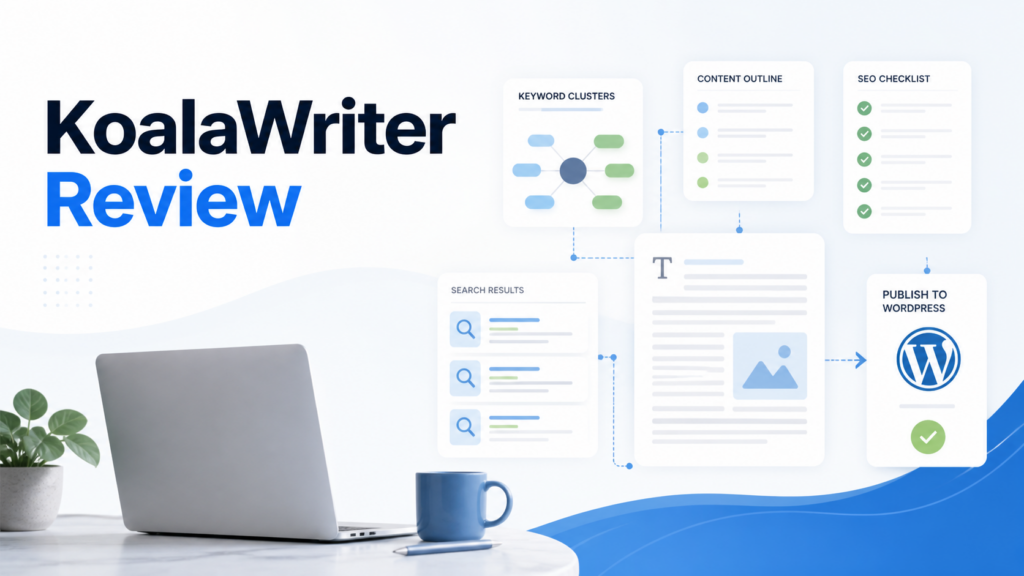
KoalaWriter is worth considering if your main goal is to produce SEO-focused blog drafts faster, especially for small businesses, affiliate publishers, content site owners, and agencies that already have a review process. It is built around long-form SEO content rather than general copywriting alone, so the workflow makes the most sense when you need article briefs, SERP-aware drafts, internal linking, and WordPress publishing support in one place.
The important caveat is that KoalaWriter should not replace editorial judgment. A business still needs a person to review facts, tune examples, add product experience where available, align the article with brand voice, and remove anything that feels too generic. Used that way, KoalaWriter can reduce the blank-page stage of SEO blogging. Used without review, it can still produce content that needs tightening before it is ready for readers.
Best for
KoalaWriter is best for teams that publish informational, comparison, affiliate, and SEO blog content on a regular schedule. It fits bloggers, niche site operators, small agencies, ecommerce content teams, and SaaS marketers who want a structured first draft rather than a general chat-style response. The official site positions KoalaWriter around SEO-optimized content creation, real-time SERP analysis, internal linking, and WordPress publishing, which makes it most relevant to content teams that care about search workflows.
It is also a practical option for solo operators who want a repeatable content process without building every brief manually. If you already have keyword ideas and a content calendar, KoalaWriter can help turn those topics into article drafts that a human editor can improve.
Not best for
KoalaWriter is not the best fit if you mainly need brand campaigns, creative ad concepts, sales emails, landing page copy, or deeply original thought leadership. General AI writing tools and human strategists are often better for those jobs because they are less tied to SEO article structure.
It is also not ideal for teams that want to publish without review. SEO articles often include product claims, pricing notes, comparisons, and recommendations. Those areas require source checks and editorial responsibility. KoalaWriter can help produce the draft, but the publisher remains responsible for accuracy and usefulness.
What is KoalaWriter?
KoalaWriter is an AI writing tool from Koala that focuses on SEO blog posts and long-form articles. The product is part of the broader Koala platform, which also includes KoalaChat. According to Koala's official website, KoalaWriter is designed for SEO content creation and includes features such as real-time SERP analysis, automatic internal linking, and one-click WordPress publishing.
That positioning matters because many AI writing tools are broad by design. They can help with emails, brainstorming, outlines, and short-form copy. KoalaWriter is more specific. Its value is in giving publishers a workflow for articles that need a title, outline, keyword context, competitive search awareness, and publishing handoff.
For a small business owner, the simplest way to think about KoalaWriter is this: it helps create a structured article draft from a topic or keyword, then supports the steps that usually come after drafting, including SEO structure and WordPress publishing. The draft still needs editing, but the workflow can save time compared with starting from a blank document.
Our evaluation criteria
This review uses practical criteria a small business or content team would use before adding KoalaWriter to its publishing process.
| Criteria | What we looked for |
|---|---|
| Ease of use | Whether the workflow is clear enough for a non-technical content manager |
| Setup | How quickly a team can move from keyword idea to article draft |
| Pricing clarity | Whether official pricing explains plans, word allowances, and usage limits |
| AI quality | Whether the tool is positioned for long-form SEO drafts rather than only short copy |
| SEO workflow | Support for SERP analysis, outlines, keywords, and content structure |
| WordPress workflow | Whether publishing support reduces manual copy-paste work |
| Internal linking | Whether the tool can help connect related articles on a content site |
| Editorial control | Whether a human editor can shape the draft before publishing |
| Value for money | Whether the plan structure fits regular content production needs |
Key features
SEO blog post generation
KoalaWriter's core feature is AI-assisted long-form blog writing. The tool is designed to help create SEO-oriented articles from topics and keywords. For a small business blog, this can be useful when the team has a list of articles to publish but limited writing capacity.
A typical workflow might start with a keyword such as "best AI writing tools for small business" or "KoalaWriter review." Instead of building the outline from scratch, the writer can use KoalaWriter to generate an article structure and first draft. The editor then checks sources, improves the introduction, adds decision guidance, and trims any sections that do not help the reader.
SERP-aware content planning
Koala's official site references real-time SERP analysis. In practical terms, that means the tool is built to consider what search results already cover, instead of treating the article as an isolated writing task. This is useful for SEO content because many weak articles fail not because they are short, but because they miss the questions users expect answered.
For example, a review article should usually cover pricing, best-fit users, limitations, alternatives, and a final recommendation. A best-tools article should compare use cases and tradeoffs, not only list features. SERP-aware planning can help a publisher include the right sections earlier in the process.
Internal linking support
Koala also highlights automatic internal linking. For a growing software review site, internal links are not a minor detail. They help readers move from one decision page to another and help search engines understand the relationship between articles.
A site covering AI software could link a KoalaWriter review to related guides such as best AI writing tools for marketing teams, best AI content optimization tools, Surfer SEO vs Frase, and an AI SEO content brief workflow. The stronger the internal linking discipline, the easier it is for readers to compare related tools.
WordPress publishing workflow
The official Koala site mentions one-click WordPress publishing. This matters for teams that publish frequently. Copying Markdown or HTML into WordPress, fixing headings, adding links, and formatting tables can take longer than expected. A publishing integration can reduce friction, especially for high-volume editorial calendars.
That said, publishing integration should come after review, not before it. The best workflow is draft, edit, verify, optimize, then publish. If a team sends unreviewed drafts directly to WordPress, it risks thin recommendations and avoidable errors.
Bulk article creation
Koala's pricing page references faster bulk article creation on higher plans. Bulk drafting can be useful for agencies, affiliate publishers, and content site operators with a large keyword backlog. It is less useful for businesses that publish only one or two highly tailored posts each month.
Bulk generation should be used carefully. The right approach is to batch similar operational tasks, such as first drafts or outlines, while keeping editorial review individual. A content team should still check whether each article has a clear angle, accurate claims, natural internal links, and useful buying guidance.
Real use cases
SEO blog production for small businesses
In a typical small business workflow, a marketing manager may have a simple content calendar but no full-time writer. KoalaWriter can help turn approved topics into drafts, allowing the manager to spend more time on review and less time on initial structure.
For example, a small SaaS company could create articles around product education, comparisons, and how-to content. KoalaWriter can help draft the article, while the team adds screenshots from its own product, customer-facing details, and accurate positioning.
Affiliate and review content
A content site that publishes software reviews often needs repeatable sections: quick verdict, pricing, alternatives, pros and cons, and final recommendation. KoalaWriter fits that format well because it is focused on long-form SEO articles.
The publisher still needs to verify every important claim. Pricing should come from official pricing pages. Feature claims should come from official product pages or support documents. If the article includes personal testing, that testing must actually happen.
Content refresh workflows
KoalaWriter can also support content refreshes. A team could take an older article, identify missing sections, and create a revised draft that covers current search intent more completely. This is useful when an older article ranks poorly because it lacks pricing guidance, alternatives, FAQs, or a clear recommendation.
For more process detail, DailyTimesPro's guide on how to use AI for content refreshes is a good related read.
Agency content operations
Small agencies can use KoalaWriter to speed up first drafts for client blogs, especially when the agency already has a quality-control process. The agency can define topics, generate drafts, then assign editors to improve voice, accuracy, and client-specific context.
This works best when the agency treats KoalaWriter as a production assistant. It should not be used as a substitute for client knowledge, positioning work, or final editorial approval.
WordPress-heavy publishing teams
If a team publishes directly to WordPress, KoalaWriter's WordPress workflow can be useful. The benefit is less about writing alone and more about reducing handoff friction. A draft that moves cleanly into WordPress can save time for teams publishing several articles each week.
KoalaWriter pricing
Pricing last checked on August 28, 2026.
Koala's official pricing page lists plans based on monthly usage allowances for KoalaWriter words and KoalaChat messages. The pricing page states that Koala starts at $9 per month, with the entry tier including 15,000 KoalaWriter words per month. It also lists larger monthly plans including Boost at $99, Growth at $179, Elite at $350, Advanced at $500, Scale I at $750, Scale II at $1,250, and Scale III at $2,000.
The same official pricing page indicates that word usage can depend on the AI model selected. Higher-end models can consume word allowances differently than lighter models. That means buyers should evaluate both the monthly price and the expected output volume for their preferred model.
| Plan | Official monthly price shown | KoalaWriter allowance shown |
|---|---|---|
| Entry tier | Starts at $9/month | 15,000 words/month |
| Boost | $99/month | 250,000 words/month |
| Growth | $179/month | 500,000 words/month |
| Elite | $350/month | 1,000,000 words/month |
| Advanced | $500/month | 1,500,000 words/month |
| Scale I | $750/month | 2,500,000 words/month |
| Scale II | $1,250/month | 5,000,000 words/month |
| Scale III | $2,000/month | 10,000,000 words/month |
The practical buying question is not only "Which plan is cheapest?" It is "How many reviewed articles can your team actually publish each month?" A low-cost plan can be enough for occasional drafting. Higher plans only make sense when a team has the editorial capacity to review, improve, and publish the volume it generates.
Source: Koala official pricing.
Pros and cons
| Pros | Cons |
|---|---|
| Built specifically for SEO blog content | Not ideal for brand-heavy creative copy |
| Official site highlights SERP analysis | Drafts still require human editing and source checks |
| Supports internal linking workflows | High-volume plans only make sense with editorial capacity |
| WordPress publishing support can reduce handoff work | Pricing value depends on word usage and model choices |
| Useful for content sites, agencies, and affiliate publishers | Not a replacement for product expertise or original experience |
KoalaWriter alternatives
KoalaWriter competes with both AI writing tools and SEO content platforms. The best alternative depends on what problem you are trying to solve.
| Tool | Best for | Main strength | Limitation |
|---|---|---|---|
| KoalaWriter | SEO blog drafts and content site workflows | Article-focused workflow with WordPress and internal linking support | Needs editorial review for accuracy and originality |
| Jasper | Brand and marketing copy teams | Broader marketing content workflows | May be more tool than a simple SEO blog team needs |
| Writesonic | AI writing plus SEO content features | Flexible content creation across formats | Output still needs review and differentiation |
| Surfer SEO | Content optimization and on-page guidance | Strong optimization workflow | More focused on optimization than full publishing flow |
| Frase | Briefs, outlines, and content optimization | Helpful research and structure support | Final draft quality depends on writer/editor input |
| ChatGPT or Claude | Flexible writing, ideation, and editing | Useful for custom workflows and editorial refinement | Requires more manual SEO structure and publishing setup |
If your main need is a dedicated SEO article workflow, KoalaWriter is more focused than a general AI assistant. If your main need is brand voice, campaign copy, or cross-channel marketing assets, Jasper or Writesonic may be a better fit. If your main gap is optimization rather than drafting, compare KoalaWriter with tools such as Surfer SEO and Frase.
Final recommendation
KoalaWriter is a strong fit for publishers who need consistent SEO blog drafts and already understand that AI writing needs human review. Its best use is not to publish untouched articles. Its best use is to speed up the first 60 percent of the process: outline, draft, structure, and prepare a post for review.
For small businesses, KoalaWriter is most useful when paired with a clear editorial checklist. Every article should answer the search intent, cite official sources for pricing and product claims, include relevant alternatives, add internal links, and give readers a clear recommendation. When that process is in place, KoalaWriter can be a practical way to scale blog production without losing control of quality.
FAQs
Is KoalaWriter good for SEO blog posts?
Yes, KoalaWriter is built for SEO-focused long-form content. Its official site emphasizes SEO content creation, SERP analysis, internal linking, and WordPress publishing. It is best used as a drafting and workflow tool, with human review before publishing.
Can KoalaWriter publish to WordPress?
Koala's official site references one-click WordPress publishing. This can reduce manual formatting and copy-paste work for teams that publish regularly in WordPress.
How much does KoalaWriter cost?
Koala's official pricing page states that plans start at $9 per month and lists higher-volume plans up to Scale III at $2,000 per month. Pricing last checked on August 28, 2026.
Is KoalaWriter better than Jasper?
KoalaWriter is more focused on SEO blog production. Jasper is broader and often better suited to brand and marketing copy workflows. The better choice depends on whether your main need is SEO articles or wider marketing content.
Is KoalaWriter better than Surfer SEO?
They solve different problems. KoalaWriter is focused on AI article drafting and publishing workflow. Surfer SEO is commonly used for content optimization. Some teams may compare both if they want SEO articles, but the decision depends on whether drafting or optimization is the bigger gap.
Who should use KoalaWriter?
KoalaWriter is a good fit for bloggers, affiliate publishers, small agencies, SaaS marketers, and content site owners who publish SEO articles regularly and have an editorial review process.
Should small businesses use KoalaWriter without an editor?
No. A small business can use KoalaWriter to speed up drafts, but someone should still check accuracy, pricing, links, examples, and the final recommendation before publishing.
Does KoalaWriter replace keyword research?
Not fully. It can support SEO article creation, but teams still need to choose topics carefully, avoid duplicate angles, and decide which keywords are worth targeting based on their audience and business goals.
What is the best KoalaWriter alternative?
For brand marketing copy, Jasper is a strong alternative. For SEO optimization, Surfer SEO or Frase may be better. For flexible drafting and editing, ChatGPT or Claude can work well if the team builds its own SEO workflow.
Is KoalaWriter worth it?
KoalaWriter is worth it if you publish SEO blog content often enough to benefit from a dedicated article workflow. It is less compelling if you only need occasional creative copy, one-off brainstorming, or highly original expert commentary.




One response to “KoalaWriter Review: Is It Worth It for SEO Blog Posts?”
[…] your team is mainly evaluating AI writing workflows, the KoalaWriter review gives a better view of a dedicated SEO writing tool. Taskade is broader and is more about managing […]