
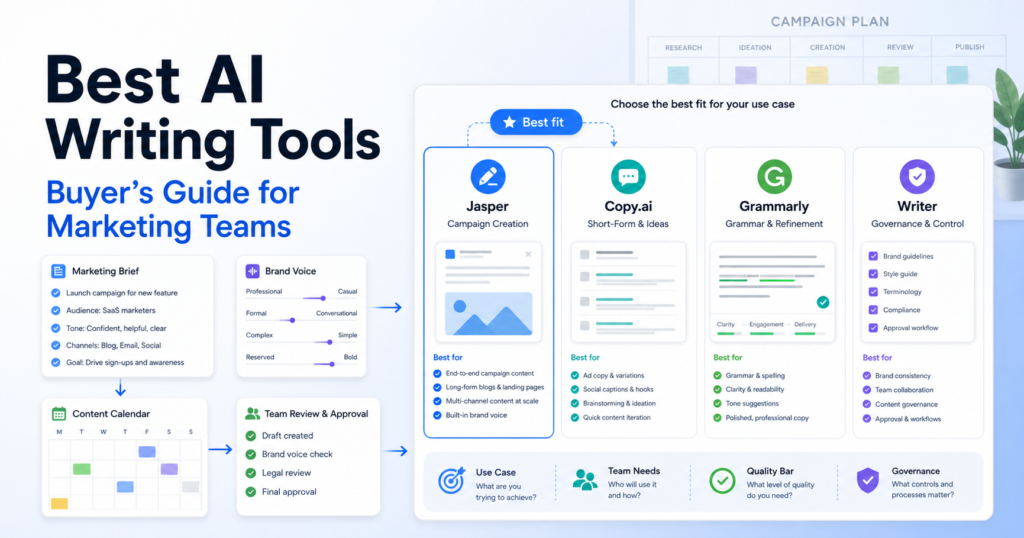
The best AI writing tool for a marketing team depends on the work it must support. Shortlist Jasper for campaign drafting with brand context, Copy.ai for shared chat or repeatable go-to-market workflows, and Grammarly for editing and consistency across writers. Then compare the actual plan’s seats, collaboration controls, billing commitment, and review process. A product’s entry price rarely describes every team capability.
This guide compares those three options for marketing production. The recommendations are based on their documented capabilities and purchasing constraints, rather than a claimed hands-on ranking. Prices and plan details were checked on October 12, 2026; checkout currency, eligibility, taxes, and negotiated terms can change the bill.
Choose by the work your team needs to improve
| Primary need | Option to evaluate | Purchasing question |
|---|---|---|
| Turn an approved campaign brief into several coordinated assets | Jasper | Does the team require Business collaboration rather than a single-user Pro subscription? |
| Give a small group a shared AI chat subscription | Copy.ai Chat | Are its five seats enough, and is chat the actual requirement? |
| Run a repeatable sequence of research, drafting, and system actions | Copy.ai workflow plans | What does a representative run consume, including corrections and reruns? |
| Edit writing in the team’s existing working environment | Grammarly | Are paid writing features sufficient, or are Enterprise access controls required? |
Start with a recent campaign that required extensive revisions. Was the problem an incomplete brief, inconsistent terminology, slow drafting, or repeated transfers between systems? Buying an automation plan will not resolve missing product facts. Likewise, a grammar assistant cannot decide which offer or audience the campaign should target.
Jasper: campaign creation with a separate team-plan decision
Jasper’s pricing page lists Pro at $69 per month, or $59 per month with yearly billing. Pro includes one seat, Canvas, core marketing agents, two Brand Voices, five Knowledge assets, and three Audiences. Business has custom pricing and adds broader customisation, Grid, custom agents, API access, and governance.
The comparison matrix distinguishes Pro’s single user from Business collaboration. Document collaboration, roles and permissions, SSO, and SCIM are Business features. Do not assume buying Pro gives a whole department a shared governed workspace. Request a Business quote that names the users, workflow requirements, and access controls you need.
Evaluate Jasper when a campaign owner needs to reuse approved positioning across a landing page, launch email, and social copy. Give the pilot a fixed brief and the same source material for every asset. Check whether product names, eligibility conditions, and offer details survive the transformation. Brand context can guide generation; the reviewer still has to verify the resulting claims.
A useful rejection test is an unsupported promise. If a draft adds a guaranteed outcome that is absent from the brief, record the failure and correct the process. Fluent wording is not evidence that the campaign is ready to publish.
Copy.ai: distinguish five-seat chat from workflow automation
Copy.ai’s published plans list Chat with five seats, unlimited chat words, and unlimited chat projects for $29 billed monthly or $288 billed yearly, equivalent to $24 per month. Growth lists 75 seats and 20,000 monthly workflow credits for $12,000 billed yearly. Expansion lists 150 seats and 45,000 credits for $24,000 yearly; Scale lists 200 seats and 75,000 credits for $36,000 yearly. Enterprise requires a quote.
Chat word allowance does not mean unlimited workflow runs. Copy.ai describes workflow credits as usage that varies with the actions and generated content; its run panel shows credits consumed. Measure a complete representative run before estimating volume.
Chat is worth evaluating when a small group needs ideas and draft variations without a large automation commitment. For workflows, map the actual sequence: receive an approved brief, gather permitted source material, draft specified assets, and route them for review. Identify which steps need system integrations and confirm those entitlements in the proposed plan.
Keep publication outside the first pilot. A workflow can repeat an inaccurate claim across many assets just as efficiently as a correct one. Add a review checkpoint before content reaches a CMS, advertising account, or mailing platform, and define who can release it.
Grammarly: editing, team consistency, and regional eligibility
Grammarly’s rendered US-dollar plan comparison lists Free with 100 monthly AI prompts, Pro with 2,000 prompts per member per month, and Enterprise with an unlimited prompt allowance. Pro adds sentence rewrites, tone adjustments, one style guide, one brand tone, and team analytics. Enterprise adds controls including SAML SSO, SCIM, custom roles, and data loss prevention. These controls are not all included in Pro.
Official Pro billing documentation gives $30 per member monthly, $60 per member quarterly, or $144 per member yearly, equivalent to $12 per month. Additional seats cost extra; Pro supports up to 149 seats. Five members therefore cost $720 per year at the documented annual USD rate, before applicable taxes, rather than $144 for the entire team.
Some visitors see Grammarly Plus, a regional plan whose availability depends on billing country and payment details. Its support prioritisation and eligibility differ. Compare the offer available to your organisation rather than converting a regional promotional-looking figure into a universal Pro price.
Evaluate Grammarly when writers already have useful drafts but repeatedly need terminology, tone, and sentence-level corrections. Test it in the applications your staff actually use. Have an editor decide whether a suggestion preserves technical meaning and the intended audience; automatically accepting every rewrite can weaken precise language.
Run a campaign pilot with observable acceptance criteria
Use one approved brief, a product fact sheet, a style guide, and examples you have permission to use. Include difficult details such as exclusions, regional availability, or a price with a billing term. Give each shortlisted tool the same assignment so differences in input quality do not decide the comparison.
| Check | What to record |
|---|---|
| Factual accuracy | Unsupported claims, missing conditions, and whether each important claim matches an approved source. |
| Brand fit | Terminology errors, unwanted tone, and revisions needed to match the supplied examples. |
| Useful output | Which assets an editor accepts and which must be rebuilt. |
| Total effort | Brief preparation, generation, checking, rewriting, and approval time. |
| Team operation | Who can view, edit, approve, export, and remove access. |
| Cost | Seats, annual commitment, measured usage, reruns, and integration requirements. |
Record observations rather than awarding a score for the longest response. A short draft that needs fewer substantive corrections may be more useful than several pages of polished but unsupported copy. Compare the complete production cycle with your current process; generation time alone leaves out editorial work.
For a workflow budget, use measured credits per representative run multiplied by expected runs, then allow for the reruns you observed. This is a planning calculation, not a guaranteed vendor capacity. Ask how limits, additional credits, renewal, and cancellation work before committing to annual billing.
Set review and data rules before rollout
Assign owners for the brief, factual review, brand review, and final release. Keep the source of each product claim with the working document. Check originality through editorial review and appropriate source comparison; a detection score alone does not establish authorship, accuracy, or permission to reuse material.
Confirm permitted data, retention, access, and contractual terms with the responsible team before uploading confidential plans or customer information. A feature labelled governance or security does not establish that every plan and configuration meets your organisation’s requirements. Use non-sensitive approved material while those questions remain unresolved.
Choose the smallest plan that passes the actual production requirements. Jasper deserves a pilot for coordinated campaign creation; Copy.ai needs separate chat and workflow purchasing decisions; Grammarly deserves a pilot for editing and consistency. Keep a named human release owner and review the decision again when usage, staffing, or plan terms change.




3 responses to “Best AI Writing Tools for Marketing Teams: Plans and Buying Guide”
[…] Grammarly vs QuillBot, best AI writing tools for marketing teams, and Copy.ai vs Jasper […]
[…] Best AI Writing Tools for Marketing Teams […]
[…] teams creating content beyond SEO pages, the best AI writing tools for marketing teams guide can help you compare writing-focused […]