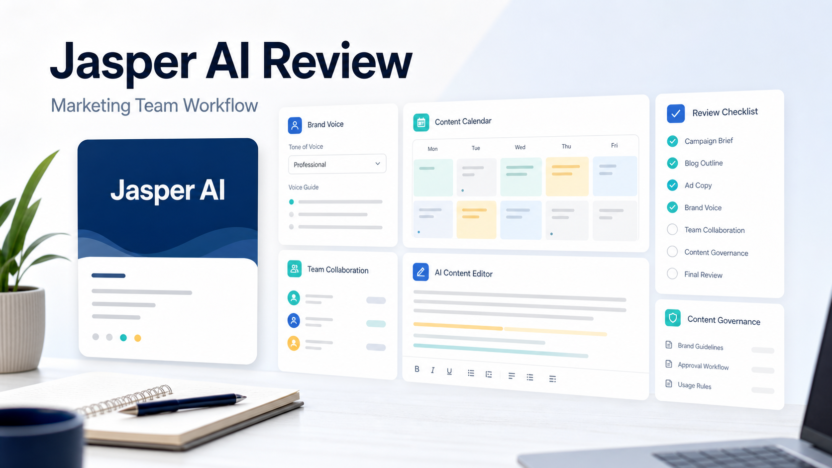
Jasper AI is no longer just a general AI writing assistant. Its official positioning is focused on marketing teams that need brand-aware content, campaign workflows, audience context, governed output, and team collaboration. That makes the buying decision different from choosing a simple chatbot.
This Jasper AI review is written for small businesses, agencies, and marketing teams deciding whether Jasper fits their content workflow.
Quick Verdict
Jasper is worth evaluating if your team needs marketing-specific workflows, brand voice controls, campaign content, and collaboration around content production. It is not the cheapest way to write a blog post, and it is not necessary for every solo creator. Its value is clearest when multiple people need to create on-brand marketing assets consistently.
Best For
- Marketing teams producing campaign briefs, landing pages, ads, emails, and content.
- Agencies managing different brand voices for clients.
- Teams that need brand governance rather than only fast drafting.
- Companies that want marketing-specific AI workflows instead of a blank chatbot.
Not Best For
- Casual users who only need occasional writing help.
- Teams with no review process for AI-generated content.
- Businesses looking for the lowest-cost writing assistant.
- Writers who only need grammar editing or rewriting.
Our Evaluation Criteria
We evaluate Jasper by marketing workflow fit, brand control, ease of setup, pricing clarity, collaboration, AI output usefulness, alternatives, and value for money. This review is based on official product and pricing information, not hands-on testing.
What Jasper AI Does
Jasper is built for marketing work. Its official pricing page describes the Canvas platform, essential agents, brand voices, knowledge assets, audiences, business customization, custom agents, Jasper Grid, API access, governance, and support differences across plans.
In a typical small business workflow, Jasper can help turn a campaign brief into ad variations, email copy, landing page sections, blog outlines, and social posts. The useful part is not only generating text. It is keeping content closer to the team's brand rules and campaign context.
Key Features
Brand Voice And Knowledge
Jasper's Pro plan includes smart customization with brand voices, knowledge assets, and audiences. This matters because generic AI writing often fails when the team needs consistent tone, approved positioning, and repeated messaging.
Marketing Agents
Jasper positions agents around marketing workflows. A small team could use these for briefs, campaign drafts, optimization tasks, translation, or research support. Human review is still required for claims, compliance, and customer-facing copy.
Campaign And Content Workflows
Jasper is stronger when used as a system for repeated marketing work, not a one-off prompt box. Teams can use it for landing pages, nurture sequences, product launches, ads, SEO drafts, and content refreshes.
Business Controls
The Business plan adds advanced agents, no-code app builder, Jasper Grid, unlimited IQ customization, API access, admin controls, groups, account management, and priority support according to Jasper's official pricing page.
Pricing
Jasper's official pricing page listed Pro at $69 per month per seat on monthly billing and $59 per month per seat on yearly billing. The Pro plan includes one seat, Canvas platform, essential agents, two Brand Voices, five Knowledge assets, and three Audiences. Jasper Business uses custom pricing and adds more advanced team and governance capabilities.
Pricing last checked on June 23, 2026.
Real Use Cases
Campaign Briefs
A SaaS team could use Jasper to turn product positioning into campaign briefs, email angles, ad concepts, and landing page copy. The marketing lead should still approve final claims.
Blog And SEO Drafting
Jasper can help with outlines, first drafts, title variations, and content repurposing. It should not replace keyword research, expert review, source verification, or editorial editing.
Ad Copy
Performance marketers can use Jasper to create ad variations for different audiences. The team should still check platform rules, offer accuracy, and brand claims.
Email Marketing
Jasper can help write nurture emails, product announcements, webinar follow-ups, and newsletter drafts. The best workflow uses Jasper for drafts and humans for final segmentation, timing, and approval.
Alternatives
| Tool | Best For | Main Strength | Limitation |
|---|---|---|---|
| Jasper | Marketing teams | Brand-aware campaign workflows | Higher cost than basic writing tools |
| Copy.ai | GTM workflows | Sales and marketing workflow support | Fit depends on team process |
| Writesonic | Content and SEO workflows | Broad writing and content features | May need more manual governance |
| ChatGPT Business | Flexible AI workspace | General research, writing, analysis | Less marketing-specific by default |
| Claude | Long-form writing and analysis | Strong drafting and reasoning | Not a marketing workflow platform by default |
Pros
- Stronger marketing focus than general writing tools.
- Brand voice and knowledge features support consistency.
- Business plan supports governance and team workflows.
- Useful for campaign content, ad variations, landing pages, emails, and content refreshes.
- Clearer fit for marketing teams than generic AI chat alone.
Cons
- Pro pricing may be high for casual users.
- Business pricing is custom, which requires a sales process.
- AI output still needs human review.
- Teams must invest time in brand setup and workflow discipline.
- It may be excessive if the team only needs occasional writing support.
Final Recommendation
Choose Jasper if your marketing team needs repeatable, brand-aware content workflows and is willing to maintain review standards. Avoid it if your needs are light, occasional, or already covered by a general AI workspace.
For related writing coverage, see our best AI writing tools for marketing teams and Copy AI vs Jasper AI comparison.
FAQs
Is Jasper AI worth it for marketing teams?
Jasper can be worth it when the team needs brand-aware marketing workflows, campaign content, collaboration, and governed content creation. It is less compelling for casual users who only need occasional generic writing help.
Does Jasper AI have a free trial?
Jasper's official pricing page shows a 7-day free trial for the Pro plan at the time checked.
How much does Jasper AI cost?
Jasper's official pricing page listed Pro at $59 per month per seat when billed yearly and $69 per month per seat on monthly billing. Business uses custom pricing. Pricing last checked on June 23, 2026.
Who is Jasper best for?
Jasper is best for marketing teams, content teams, performance marketers, brand teams, and agencies that need repeatable campaign content and brand controls.
Who should avoid Jasper?
Solo users with light writing needs, teams that do not need brand governance, and businesses that only want a basic chatbot may not need Jasper's marketing-specific platform.
What are Jasper alternatives?
Common alternatives include Copy.ai, Writesonic, ChatGPT Business, Claude, and Grammarly for specific writing or editing workflows.
Does Jasper replace a marketer?
No. Jasper can draft and repurpose content, but humans still need to set positioning, check facts, approve claims, and make final judgment.
Can Jasper help with SEO content?
Jasper can support content workflows, but SEO strategy still needs keyword research, source review, internal linking, and editorial judgment.
Is Jasper good for agencies?
It can be useful for agencies that need repeatable brand voices, campaign drafts, and client-specific workflows. Agencies should test brand setup and review workflow before buying broadly.
What should I test first?
Test campaign briefs, landing page copy, ad variations, brand voice behavior, approval workflow, and whether the output needs less editing than a general AI assistant.
How To Pilot Jasper
A good Jasper pilot should use real marketing work, not random prompt experiments. Choose one campaign brief, one blog outline, one landing page, one email sequence, and one ad set. Configure the brand voice and knowledge assets first, then compare Jasper outputs against your normal drafting workflow.
Review the output for accuracy, brand fit, repetition, claim risk, and editing time. If Jasper reduces the first-draft burden and keeps copy closer to approved positioning, it may justify the cost. If the team still rewrites everything from scratch, the setup or tool fit is weak.
Common Mistakes
The biggest mistake is treating Jasper as a replacement for strategy. The tool can draft, remix, and structure content, but it does not know your real offer, competitive positioning, legal constraints, or customer objections unless your team provides that context and reviews the result.
Workflow Fit For Marketing Teams
Jasper is strongest when a marketing team already has positioning, offers, audience notes, and brand rules. In that environment, Jasper can help create first drafts, campaign variants, repurposed content, and internal briefs. It is weaker when the user expects the tool to invent strategy from a one-line prompt. The practical value comes from structured inputs and human review.
A SaaS team could use Jasper to turn a product launch brief into a landing page draft, announcement email, sales enablement summary, and LinkedIn post variants. An agency could use it to keep client tone more consistent across blog outlines, ad copy, and campaign briefs. A solo founder could use it to move from rough notes to cleaner drafts faster, but still needs to check every factual claim.
Editing And Governance
Teams should decide who owns the final copy before using Jasper at scale. AI copy can sound polished while hiding weak claims, repeated phrasing, or unsupported benefits. A good workflow routes drafts through subject-matter review, compliance review when needed, and final brand review. This is especially important for pricing pages, product comparisons, regulated categories, and customer-facing claims.
Value For Money
Jasper makes the most sense when content volume is high enough to justify paid seats and setup time. If your team only writes occasional emails, a general AI assistant may be enough. If your team produces campaigns, landing pages, newsletters, social posts, and blog drafts every week, Jasper's brand and knowledge features become more relevant. The buying decision should compare subscription cost against editing time saved and consistency gained.
Setup Checklist Before You Buy
Before paying for Jasper, prepare the inputs that make the tool useful. Document your brand voice, target audience, product positioning, approved claims, competitor notes, offer details, and content review rules. Add examples of writing that the team considers on-brand. Decide which content types Jasper will support: blog drafts, email sequences, ad variants, social posts, landing pages, or sales enablement copy.
The setup checklist matters because most poor AI writing comes from weak context. If a team gives Jasper vague instructions, the output will feel generic. If the team gives it approved positioning and clear constraints, the output has a better chance of becoming a useful first draft.
Where Jasper Fits In The Content Process
A realistic content process has several stages: brief, draft, edit, fact review, SEO review, approval, and publication. Jasper can help with brief expansion, draft creation, angle generation, and repurposing. It should not own the factual review, final recommendation, legal claims, or product accuracy. Those steps need human review.
For small teams, the best operating model is to use Jasper for speed and structure, then assign a human editor to improve judgment, examples, and specificity. That keeps the team from publishing polished but shallow copy.
Who Should Skip Jasper
Skip Jasper if your team does not publish marketing content often, does not have documented positioning, or wants a low-cost general assistant for occasional writing. Also skip it if the team expects AI to replace product knowledge. Jasper is a marketing workflow tool, not a complete strategy department.
Practical Implementation Notes
If Jasper is adopted, start with a narrow workflow instead of rolling it out to every content task. A good first workflow is one monthly campaign: the team provides the brief, Jasper drafts the supporting assets, and an editor reviews everything for accuracy and brand fit. This creates a measurable process without overcommitting.
Track three simple outcomes: whether first drafts are faster, whether editing time is lower, and whether final copy is more consistent with brand guidance. If those outcomes are not visible after a pilot, the team should improve its source briefs before expanding seats.