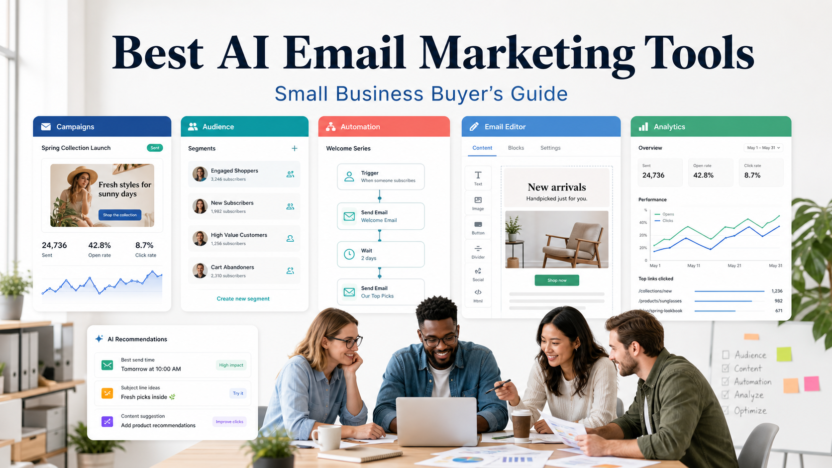
Small businesses usually need more than an AI subject-line generator. They need a reliable system for collecting consent, organizing contacts, building campaigns, automating follow-up, measuring results, and handing qualified leads to sales or service. The best choice depends on the workflow around the email, not the number of AI labels on a pricing page.
Quick Verdict
Mailchimp is a broad starting point for businesses that want email, forms, journeys, and familiar campaign tools. Brevo is attractive when email and transactional communication need to live together. ActiveCampaign is stronger for behavior-based automation and lead nurturing. Kit is designed around creator newsletters and digital products. HubSpot is the better fit when email must connect directly to CRM, sales, service, and reporting. No option is automatically best for every small business.
Best For
- Small businesses building newsletters, lead-nurture sequences, welcome campaigns, and customer updates.
- Marketing teams that need segmentation, reusable templates, automation, reporting, and consent management.
- Creators and service businesses that need forms, landing pages, and email delivery in one workflow.
- Teams willing to maintain clean contact data and review AI-generated copy before sending.
Not Best For
- Businesses planning to send unsolicited bulk email or use purchased contact lists.
- Teams that need a full sales CRM but are only evaluating newsletter features.
- Organizations that cannot maintain consent records, suppression lists, and sender-domain configuration.
- Businesses expecting AI to replace offer strategy, customer knowledge, or final editorial review.
What This Article Evaluates
This guide evaluates workflow fit, automation depth, contact management, AI assistance, reporting, integrations, pricing clarity, and operational burden. It does not claim inbox placement guarantees or invent campaign performance. Deliverability depends on sender reputation, consent, content, list hygiene, domain configuration, and recipient behavior.
Our Evaluation Criteria
Campaign creation
The editor should make it practical to create, review, test, and reuse email content without locking the team into fragile layouts.
Automation
Useful automation should connect triggers, conditions, delays, messages, tags, and handoffs in a way a small team can understand and maintain.
Segmentation
The platform should make it possible to target customers by consent, behavior, lifecycle, interests, purchases, or other legitimate first-party data.
AI quality
AI should help with drafts, variations, summaries, or workflow setup while leaving claims, tone, compliance, and final approval with a human.
Pricing clarity
Buyers need to understand whether cost is driven by contacts, sends, users, features, credits, or a combination of those factors.
Integrations and reporting
The tool should connect with the forms, commerce, CRM, scheduling, or analytics systems that the business actually uses.
Key Features And Capabilities
Mailchimp
Mailchimp combines email campaigns, audience tools, templates, forms, customer journeys, reporting, and AI-assisted marketing features. It is a reasonable generalist option, but businesses should model how contact count and feature tiers affect the bill.
Brevo
Brevo combines marketing email with transactional messaging, automation, contact management, and sales-related capabilities. It can suit businesses that need both campaigns and operational messages, provided they separate promotional consent from transactional communication.
ActiveCampaign
ActiveCampaign emphasizes automation, lifecycle messaging, segmentation, and CRM-connected follow-up. It is valuable when customer behavior should trigger different paths, but the automation map needs an owner and documentation.
Kit
Kit focuses on creators, newsletters, forms, visual automations, audience tagging, and selling digital products or subscriptions. It is less suitable when a company needs a broad service CRM or complex multi-department administration.
HubSpot
HubSpot connects marketing email to CRM records, forms, sales activity, service context, automation, and reporting. That unified view can be useful, though total cost and administration can grow as the company adopts more hubs and advanced tiers.
Real Use Cases
New lead welcome
A service business can send a useful welcome sequence after a visitor submits a form, explain what happens next, route high-intent inquiries, and stop the sequence when a person books a call.
Ecommerce follow-up
A store can segment customers by legitimate purchase or browsing signals, send product education, request feedback, and avoid repeatedly promoting products a customer already bought.
Creator newsletter
A creator can publish a regular newsletter, tag subscribers by interests, deliver lead magnets, and introduce paid products without maintaining a separate marketing stack.
Customer onboarding
A SaaS or membership business can send setup guidance, role-specific education, reminders, and a clear human-support path when a customer becomes stuck.
Re-engagement
A team can identify inactive subscribers, ask whether they still want messages, reduce unnecessary sending, and protect list quality rather than chasing a larger but disengaged audience.
Comparison Table
| Option | Best For | Main Strength | Important Limitation |
|---|---|---|---|
| Mailchimp | General small-business marketing | Broad campaign and audience workflow | Costs and limits require plan modeling |
| Brevo | Email plus transactional communication | Multi-channel communication workflow | Feature depth varies by plan |
| ActiveCampaign | Behavior-based nurturing | Automation and segmentation | More setup and governance |
| Kit | Creators and newsletters | Audience and creator workflow | Less suited to broad CRM operations |
| HubSpot | CRM-connected marketing | Unified customer context | Can become expensive and complex |
Pricing
Pricing is based on each vendor's official pricing page. Mailchimp, Brevo, ActiveCampaign, Kit, and HubSpot use different combinations of contacts, sends, users, features, billing periods, and product tiers. Because a single starting number would hide those differences, buyers should calculate cost with their real contact count, expected send volume, required automation, and number of users. Free or entry plans can be useful for validation, but advanced automation, reporting, CRM, or team controls may require paid tiers.
Pricing last checked on June 25, 2026. Pricing may vary by billing period, region, usage, seat count, credits, or add-ons. The official pricing pages linked in this article are the authority for a purchase decision.
Pros
- A mature category with options for simple newsletters and advanced lifecycle automation.
- AI assistance can reduce first-draft and campaign-setup time.
- Forms, segmentation, reusable content, and reporting can live in one system.
- Several tools can connect email activity with ecommerce or CRM records.
Cons And Limitations
- Pricing models are difficult to compare directly.
- Poor contact hygiene and consent practices can undermine any platform.
- Complex automations become hard to maintain without naming rules and ownership.
- AI-generated copy can introduce weak claims, repetition, or the wrong tone.
Alternatives
Businesses that only need transactional delivery should evaluate a dedicated transactional email provider rather than a full marketing suite. Teams already standardized on a CRM should first test its native email tools. A simple newsletter service may be more economical for a small publication, while a customer-data platform may be necessary for complex multi-product segmentation.
A Practical Evaluation Workflow
Step 1: Choose one real workflow
Do not evaluate software with a vague demo. Select one recurring workflow with a clear owner, real inputs, a defined output, and a known review step. A narrow pilot exposes whether the product fits daily work better than a long feature tour.
Step 2: Record the current baseline
Before introducing the tool, record how long the workflow takes, where handoffs fail, which work is repeated, and what quality checks already exist. The baseline prevents a team from confusing novelty with measurable improvement.
Step 3: Use approved, low-risk data
Start with public, synthetic, or appropriately approved information. Confirm data retention, access controls, and account permissions before using confidential customer, employee, financial, legal, or product information.
Step 4: Review every output
Assign a human reviewer. Check factual accuracy, tone, completeness, permissions, links, calculations, and whether the result actually satisfies the original task. AI assistance should shorten work without removing accountability.
Step 5: Measure the full cost
Include subscription fees, seats, credits, setup, training, integrations, review time, and the cost of correcting errors. A lower advertised price can be less economical when the workflow requires more manual cleanup.
Step 6: Decide with written criteria
At the end of the pilot, score workflow fit, output quality, ease of adoption, administration, pricing clarity, integration effort, and risk. Keep the decision record so the team can review it when plans or requirements change.
Security, Governance, And Quality Control
Use role-based access, multifactor authentication, documented consent sources, suppression lists, and an approval process for high-impact campaigns. Keep a record of who can export contacts, change sending domains, modify automation, or publish messages. Review AI-assisted text for accuracy, privacy, discrimination, regulated claims, and unsubscribe requirements.
How To Measure Value
Measure time saved in campaign production, automation maintenance, lead response, and reporting. Also track list growth quality, unsubscribe patterns, complaint rates, conversions tied to a defined offer, and the number of manual handoffs removed. Avoid judging the platform on opens alone because privacy features can make that metric unreliable.
Common Buying Mistakes
- Buying advanced automation before mapping the customer journey.
- Importing low-quality contacts to make the audience look larger.
- Comparing entry prices without modeling contacts, sends, seats, and add-ons.
- Allowing AI to publish claims or promotions without human approval.
- Building many automations without documentation, naming standards, or an owner.
Detailed Decision Checklist
Before selecting Best AI Email Marketing Tools for Small Business, write down the exact workflow that needs improvement. Name the person who starts the work, the information the tool receives, the output it should produce, the person who reviews that output, and the system where the approved result is stored. This prevents a purchase from becoming an open-ended experiment with no owner.
Check data readiness next. List the documents, CRM records, meeting content, contact data, task history, writing samples, or knowledge sources the workflow depends on. Mark which information is public, internal, confidential, regulated, outdated, duplicated, or missing. AI features cannot compensate for contradictory records or unclear permission boundaries. Cleaning the source material may create more value than adding another subscription.
Review the human handoff in detail. Define which actions the software may assist with, which actions need explicit approval, and which requests must always go to a qualified person. Customer complaints, employment matters, legal interpretations, financial commitments, security incidents, account exceptions, and public claims normally need a clear escalation route. A useful workflow makes that route visible instead of hiding uncertainty behind a confident answer.
Model the full cost for twelve months. Include the base subscription, members, contact or usage growth, credits, recordings, storage, integrations, implementation, training, administrator time, and periodic quality review. Add a reasonable allowance for correcting mistakes and maintaining documentation. Compare that number with the value of time saved, errors avoided, faster response, or work that becomes possible. Do not assume every automated action creates equal value.
Finally, confirm exit options. Determine how the team can export content, contacts, transcripts, tasks, documents, or configuration if the product no longer fits. Record who owns the account and billing relationship. A responsible software decision includes both adoption and a practical way to leave.
30-Day Rollout Plan
Week 1: Prepare
Choose a bounded use case and collect the approved inputs. Document current steps, time, common errors, and escalation points. Configure the smallest necessary group of users. Review authentication, roles, integrations, retention, and billing controls. Create a short acceptance checklist that defines what a usable output looks like.
Week 2: Run In Parallel
Use the new workflow alongside the existing process. Do not remove the old control before the team understands failure modes. Review every output and label the type of correction required: factual, contextual, formatting, tone, permission, missing information, or incorrect action. This produces evidence that is more useful than a general opinion about whether the AI feels impressive.
Week 3: Improve The System
Update source documents, templates, prompts, routing rules, naming conventions, or permissions based on observed problems. Remove steps that add no value. If users are bypassing the workflow, ask why before adding enforcement. The cause may be poor fit, unclear training, slow performance, missing integration, or a review process that is heavier than the original task.
Week 4: Decide
Compare the pilot with the baseline. Review time saved, correction rate, adoption, user confidence, administrator workload, and expected annual cost. Decide whether to expand, keep the workflow limited, change configuration, test an alternative, or stop. Write down the decision and assumptions. Revisit it when pricing, product capabilities, data requirements, or business volume changes.
Quality Review Questions
Use these questions during the pilot:
- Does the output answer the real task, or only produce plausible language?
- Can a reviewer trace important claims to an approved source?
- Are names, dates, prices, links, assignments, and calculations correct?
- Does the workflow expose uncertainty and provide a human escalation path?
- Can administrators see who has access and what the tool is doing?
- Are users saving time after review, or only moving work to a different step?
- Does the pricing model remain predictable at the expected volume?
- Can the result be exported and used in the team's system of record?
If the team cannot answer these questions, it is too early for a broad rollout. A smaller scope with clearer controls is usually more productive than adding more features.
Final Recommendation
Choose Mailchimp for a broad, familiar starting point; Brevo for combined marketing and transactional communication; ActiveCampaign for deeper behavior-based automation; Kit for creator-led newsletters and products; or HubSpot when CRM context is the central requirement. Run one welcome or nurture sequence end to end before committing to a long contract.
Frequently Asked Questions
What is the best AI email marketing tool for a small business?
The answer depends on workflow fit. Mailchimp is a broad generalist, Brevo combines communication channels, ActiveCampaign emphasizes automation, Kit serves creators, and HubSpot connects email to CRM.
Can AI write complete email campaigns?
It can help draft and vary copy, but a person should verify the offer, facts, tone, links, audience, and compliance before sending.
Do I need a CRM for email marketing?
Not always. A newsletter business may not. A sales-led business benefits when email activity and lead status share reliable customer records.
How should I compare pricing?
Use your real contact count, monthly sends, users, automation needs, and required integrations. Read the official pricing and limit pages.
Can these tools guarantee deliverability?
No. Deliverability depends on consent, sender reputation, list hygiene, authentication, content, and recipient engagement.
Is a free plan enough?
It can be enough to validate forms, templates, and basic sending. Advanced automation, reporting, team access, or higher volumes usually require paid plans.
Related Dailytimespro Guides
See our AI marketing workflow for small business, AI sales follow-up workflow, and AI email response workflow.