The best AI brand voice tools do more than copy a few adjectives into a prompt. They turn approved examples, terminology, tone rules, audience context, and style guidance into controls that writers can use repeatedly. For marketing teams, that distinction matters: faster content is useful only when emails, landing pages, ads, support messages, and social posts still sound like the same company.
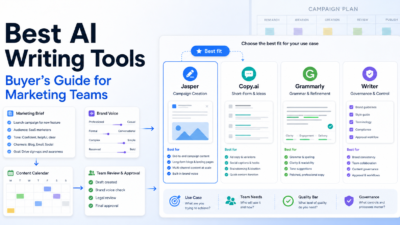
Quick answer: Jasper is the best fit for marketing teams that want generation built around reusable brand voices. WRITER is the strongest option for enterprise teams that need style rules, terminology, governance, and brand controls applied across AI workflows. Grammarly is best for real-time tone and style guidance where employees already write. Copy.ai is useful for smaller go-to-market teams that want multi-model chat plus repeatable content workflows. Acrolinx is best for large organizations focused on content standards, terminology, and compliance at scale.
No tool can define your brand for you. Start with an approved voice system: audience, positioning, tone traits, examples, prohibited claims, preferred terminology, and channel-specific rules. The software should operationalize that system, not replace it.
Best AI Brand Voice Tools at a Glance
| Tool | Best for | Main strength | Main limitation |
|---|---|---|---|
| Jasper | Marketing content generation | Reusable brand voices tied to marketing creation | Advanced team requirements may push buyers to custom-priced Business |
| WRITER | Enterprise brand governance | Voice, style guides, terms, knowledge, and workflow controls | Enterprise orientation can be more than a small team needs |
| Grammarly | Real-time writing guidance | Tone and style feedback across everyday writing surfaces | More focused on guidance and revision than campaign production |
| Copy.ai | Small GTM teams and workflows | Multi-model chat and workflow automation | Brand governance is less central than in dedicated enterprise platforms |
| Acrolinx | Large regulated content operations | Standards, terminology, clarity, and content governance | Pricing and implementation require sales engagement |
Pricing was last checked on September 27, 2026, from official product and pricing pages. Some vendors use custom pricing or regional pricing, so teams should request a current quote and confirm exactly which brand controls are included.
Who Should Use an AI Brand Voice Tool?
These tools are most useful when several people or systems create customer-facing content. A solo founder with ten pages may manage consistency through a short prompt and careful editing. A growing company with marketers, sales representatives, support agents, freelancers, agencies, and AI workflows needs reusable controls.
Good use cases include:
- A marketing team producing blog posts, email campaigns, landing pages, and social content.
- A SaaS company enforcing product names, capitalization, technical terms, and positioning.
- An agency maintaining different voices for several clients.
- A regulated organization checking prohibited phrases and required terminology.
- A global team adapting one brand voice to different channels and audiences.
These platforms are not a substitute for legal review, product verification, or original strategic thinking. They are also a poor investment if the company has not agreed on its own voice. Software cannot reliably enforce rules that leadership has never defined.
Our Evaluation Criteria
We evaluated the tools against practical brand-governance requirements.
1. Voice creation: whether a team can build a voice from examples, descriptions, or approved content. 2. Style enforcement: control over terminology, tone, mechanics, and writing rules. 3. Generation quality: ability to produce useful first drafts in the approved voice. 4. Editing coverage: where guidance appears, including browsers, documents, email, and platform editors. 5. Team governance: roles, shared profiles, permissions, approvals, and centralized administration. 6. Knowledge grounding: ability to connect product information and approved sources to outputs. 7. Workflow fit: support for repeatable marketing deliverables rather than one-off prompts. 8. Pricing clarity and value: how easily a buyer can understand the plan required for brand controls.
This is a source-based buyer's guide. Output quality varies with the examples, rules, knowledge, prompts, model, content type, and editorial review process used by each team.
1. Jasper: Best for Marketing Content Generation
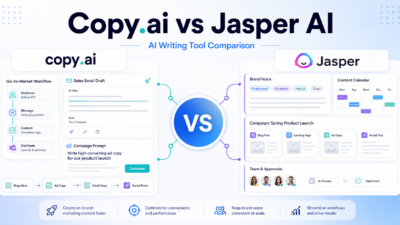
Jasper is built around marketing production, and Brand Voice is one of its clearest differentiators. According to Jasper's official help documentation, users can upload text, files, or URLs as examples. Jasper analyzes the tone, style, and characteristics, then creates a reusable voice that can be previewed on formats such as blog posts, LinkedIn posts, and product descriptions.
That workflow suits a marketing team that already has strong examples but does not want every writer to construct a long voice prompt. Jasper can connect the voice with knowledge about products and audiences, then use it across campaign-oriented creation.
Practical use cases
- Generate landing-page variations that preserve approved positioning.
- Draft product descriptions for several categories without changing terminology.
- Create email and social variants from one campaign brief.
- Give freelancers a controlled starting point for brand-aligned drafts.
- Maintain separate voices for multiple brands or business units, depending on plan limits.
Pricing
Jasper Pro is listed at $59 per month when billed yearly or $69 per month when billed monthly. The official pricing page describes Business as custom-priced and intended for teams needing more control, security, training, support, and personalized AI features.
Pros
- Marketing-focused generation rather than general writing assistance alone.
- Brand Voice can learn from approved examples and be previewed before use.
- Supports campaign, audience, and knowledge context.
- Useful for teams producing many content formats.
Cons
- Pro pricing is higher than basic writing assistants.
- Business pricing requires a sales conversation.
- Strong voice settings still require factual and editorial review.
Best choice when: the primary goal is generating on-brand marketing drafts at higher volume.
2. WRITER: Best for Enterprise Brand Governance
WRITER treats brand consistency as a platform layer. Its official documentation describes voice profiles, style guides, terminology, data grounding, and playbooks that can apply company standards to generated deliverables. A style guide can include punctuation, headline case, inclusive language, active voice, preferred forms, and custom writing rules. Teams can connect a style guide to a voice so WRITER Agent and custom agents apply those standards to outputs.
This is useful for organizations where brand voice is linked to compliance, terminology, product accuracy, and operating controls. WRITER also supports team and organization profiles, which can help departments express the same company differently without becoming inconsistent.
Practical use cases
- Enforce exact product naming across marketing, sales, and support.
- Apply a regulated terminology list before drafts reach reviewers.
- Give separate departments controlled voice profiles.
- Ground campaign drafts in approved company knowledge.
- Turn an expert's content process into a repeatable playbook.
Pricing
WRITER's official plans page offers a 14-day Starter trial with no card required and lists Enterprise as contact sales. The page emphasizes that Enterprise supports broad governance, departmental voice profiles, advanced approvals, connectors, observability, and administration. Because a public fixed Enterprise price is not provided, organizations should request a quote based on seats, usage, services, and deployment requirements.
Pros
- Detailed style, terminology, and voice governance.
- Brand rules can be connected directly to AI-generated outputs.
- Strong roles, knowledge, connector, and enterprise control story.
- Suits multi-department and regulated environments.
Cons
- May be too complex for a small marketing team.
- Enterprise cost is not publicly fixed.
- Successful deployment requires governance ownership and configuration work.
Best choice when: brand consistency must be centrally governed across teams and AI workflows.
3. Grammarly: Best for Real-Time Writing Guidance
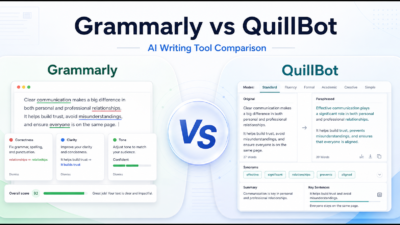
Grammarly approaches brand voice through in-context assistance. Its official support pages say brand tones let an organization mark tones as on-brand or off-brand and provide real-time feedback while people write. Style rules can reinforce terminology and writing standards across everyday work.
This makes Grammarly a good choice when the problem is not only generating marketing content. Sales emails, support replies, proposals, documents, and internal communications can all drift away from the brand. Grammarly helps writers adjust language inside the tools they already use.
Practical use cases
- Guide sales representatives toward an approved professional tone.
- Flag off-brand language in customer support messages.
- Enforce capitalization and terminology in documents and emails.
- Help distributed contributors follow one style guide.
- Review AI-generated drafts from other tools before publication.
Pricing
Grammarly notes that pricing can vary by region and plan configuration. Its support materials identify brand tones across Pro, Plus, Business, and Enterprise contexts, while enterprise purchasing may require direct sales contact. For a full plan breakdown, read our Grammarly pricing guide. Confirm the current per-user cost and required brand features on Grammarly's official checkout or sales page.
Pros
- Real-time feedback where employees write.
- Useful beyond marketing-generation workflows.
- Supports tone profiles and style rules.
- Easier adoption for teams already using Grammarly.
Cons
- Not a complete campaign-generation and orchestration platform.
- Suggestions still require writer judgment.
- Plan names, regional pricing, and feature packaging should be verified carefully.
Best choice when: the company wants employees to receive brand guidance during everyday writing.
4. Copy.ai: Best for Small Go-to-Market Teams
Copy.ai combines chat, model access, projects, and workflow automation. Its official pricing page positions the self-serve Chat plan for small teams, with five seats, unlimited chat words and projects, and access to models from OpenAI, Anthropic, and Google. Growth and Enterprise add workflow capacity and implementation support.
Copy.ai is useful when a go-to-market team wants to build repeatable processes around research, outreach, content, and sales enablement. Brand voice can be part of those prompts and workflows, although buyers seeking the deepest terminology governance may prefer WRITER or Acrolinx.
Practical use cases
- Standardize outreach sequences for different buyer roles.
- Turn a product brief into email, landing-page, and social drafts.
- Create repeatable GTM workflows that use approved messaging.
- Share projects and prompts across a small team.
Pricing
The official Copy.ai pricing page lists Chat at $29 per month billed monthly, or $24 per month billed annually at $288. Growth is listed at $1,000 per month billed annually at $12,000, with 75 seats and workflow credits. Enterprise is custom-priced.
Pros
- Five-seat Chat plan can be economical for a small team.
- Multi-model access supports different tasks.
- Workflow options extend beyond document editing.
- Strong fit for revenue and GTM use cases.
Cons
- Brand governance is not as specialized as dedicated enterprise systems.
- Large jump from Chat to Growth pricing.
- Teams must build disciplined prompts and review steps.
Best choice when: a small GTM team wants shared AI chat and repeatable workflows with brand instructions.
5. Acrolinx: Best for Large Content Standards Programs
Acrolinx focuses on content quality and governance for large organizations. Its official materials emphasize alignment with company style, voice, tone, terminology, clarity, and standards across human- and AI-generated content. This is valuable for technical documentation, regulated content, support knowledge, and enterprise marketing libraries where inconsistency creates operational risk.
Acrolinx is less about generating a quick social caption and more about making a large content operation conform to defined standards. The product is therefore best evaluated as a governance investment rather than a basic AI writer.
Practical use cases
- Check technical documentation against approved terminology.
- Apply language standards across a global content organization.
- Govern AI-generated drafts before they enter publishing systems.
- Detect style and clarity problems across large libraries.
- Support regulated review requirements with consistent rules.
Pricing
Acrolinx uses a sales-led pricing model rather than publishing a simple self-serve monthly price. Teams should request a quote and clarify implementation services, integrations, user scope, content volume, governance requirements, and support.
Pros
- Deep focus on standards, terminology, voice, and quality.
- Designed for enterprise-scale content operations.
- Relevant to technical and regulated content, not only marketing copy.
- Can support governance of both human and AI-generated material.
Cons
- No simple public price for quick comparison.
- Implementation is heavier than a self-serve writing tool.
- Excessive for small teams with limited content volume.
Best choice when: content standards and terminology must be enforced across a large organization.
Pricing Comparison
| Tool | Public pricing checked | Buying note |
|---|---|---|
| Jasper | Pro: $59/month annual or $69 monthly; Business custom | Verify brand voice counts, seats, and advanced controls |
| WRITER | Starter trial; Enterprise contact sales | Request a quote for governance, users, usage, and services |
| Grammarly | Regional and plan-dependent | Confirm the plan that includes required tone and style controls |
| Copy.ai | Chat: $29 monthly or $24 annual; Growth: $1,000/month annual | Compare workflow credits and seat requirements |
| Acrolinx | Contact sales | Scope implementation, integrations, content volume, and support |
Pricing may vary by billing cycle, region, seats, usage, add-ons, service package, or negotiated contract. Use official pricing pages or a written sales quote before purchasing.
How to Choose the Right Tool
Choose based on the point where voice breaks down.
- If writers need better first drafts, start with Jasper.
- If teams need central rules and governed AI workflows, evaluate WRITER.
- If employees need live guidance inside everyday writing, choose Grammarly.
- If a small revenue team needs shared chat and GTM workflows, consider Copy.ai.
- If a large organization needs standards across a content estate, evaluate Acrolinx.
Before a trial, prepare ten representative content samples, an approved terminology list, five prohibited phrases, audience notes, and channel-specific examples. Test the same tasks in each tool: landing page, sales email, support reply, product description, and social post. Score factual accuracy, terminology, tone, editing time, and reviewer corrections. The winner is the tool that reduces review effort while preserving the company's meaning.
For broader writing options, see our guide to the best AI writing tools for marketing teams. Teams comparing campaign platforms can read Jasper vs Writesonic and our Jasper AI review. Revenue teams considering alternatives should review the best Copy.ai alternatives.
Final Recommendation
Jasper is the most practical starting point for a marketing team whose main goal is generating brand-aligned campaigns. WRITER is the stronger strategic choice for an enterprise that needs brand rules, knowledge, workflows, and governance in one platform. Grammarly is the easiest way to extend tone and style guidance into everyday writing. Copy.ai offers useful value for a small GTM team, while Acrolinx serves the most demanding content-standard programs.
Do not buy based on a polished demo alone. Import real examples, configure actual terminology, and measure the number of edits required before approval. Brand voice is not a preset. It is a system of choices, and the best tool is the one that helps your team apply those choices consistently without hiding mistakes.
FAQs
What is an AI brand voice tool?
It is software that uses approved examples, tone attributes, style rules, terminology, and context to generate or review writing against a company's voice.
Which AI tool is best for brand voice?
Jasper is a strong choice for marketing generation, WRITER for enterprise governance, Grammarly for live writing guidance, Copy.ai for small GTM workflows, and Acrolinx for large content standards programs.
Can AI learn a company's writing style?
Yes. Several tools analyze approved samples or descriptions to create reusable voice profiles. Teams still need to test those profiles across real content types and update them as the brand evolves.
Do brand voice tools replace a style guide?
No. They work best when they operationalize an approved style guide. Without clear rules and examples, generated content is likely to remain generic or inconsistent.
How should a team test brand voice software?
Use the same approved brief and source material in each product. Compare terminology accuracy, tone, prohibited language, factual errors, editing time, and reviewer corrections across several channels.
Are AI brand voice tools safe for regulated content?
They can support governance, but they do not replace legal, compliance, product, or medical review. Choose tools with suitable administration and audit controls, then keep accountable humans in the approval process.