Quick Verdict
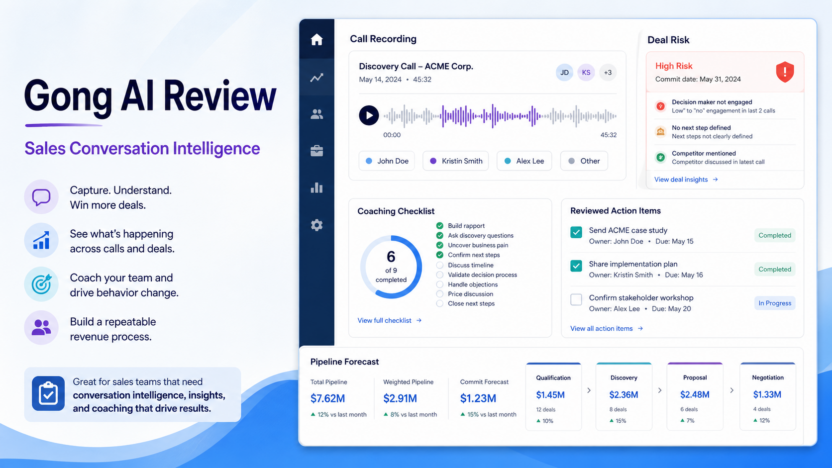
Gong AI is worth evaluating when a sales team already has meaningful call volume and needs better conversation intelligence, forecasting context, coaching notes, and deal visibility. It is not the lightest option for a tiny team that only wants meeting summaries.
This guide is written for small business owners, operators, marketing teams, sales leaders, support managers, and founders who need a practical buying decision. It focuses on workflow fit, pricing clarity, implementation effort, review controls, and the actual job the software needs to perform. Official product and pricing sources reviewed include Gong, Clari, Fireflies.ai, Fathom. Pricing last checked on July 29, 2026.
Related Dailytimespro reading:
- Best AI Work Management Tools
- Best AI Help Desk Tools
- Zapier AI Pricing
- AI Customer Churn Prediction
Best For
- sales teams with recurring discovery calls, demos, and renewals.
- managers who need coaching signals from conversations.
- revenue teams that want call, email, and deal context in one system.
Not Best For
- solo sellers that only need transcript notes.
- teams without clean CRM discipline.
- buyers who need transparent self-serve pricing before contacting sales.
Our Evaluation Criteria
We evaluated Gong AI review by ease of use, setup effort, pricing clarity, AI usefulness, integration fit, review controls, support workflow, value for money, and how well the tool supports a repeatable business process. A useful AI product is not simply the one with the longest feature list. It is the product that turns a real workflow into a cleaner process with less manual preparation and fewer handoff gaps.
For small businesses, the best evaluation starts with one repeated task. Define the input, expected output, reviewer, and destination system. Then compare each tool against that same workflow. This prevents a polished demo from hiding setup cost, unclear ownership, weak data, or a pricing model that does not match actual usage.
Quick Comparison
| Tool | Main strength | Limitation | Official pricing source |
|---|---|---|---|
| Gong | Deep revenue intelligence and conversation analysis | Sales-led pricing and implementation effort | https://www.gong.io/pricing/ |
| Clari | Revenue forecasting and pipeline inspection | May be broader than basic call review needs | https://www.clari.com/pricing/ |
| Fireflies.ai | Meeting transcription and summaries | Less revenue-specific than Gong | https://fireflies.ai/pricing |
| Fathom | Fast meeting summaries for individuals and teams | Not a full revenue intelligence platform | https://fathom.video/pricing |
Key Features To Compare
- Source inputs: CRM records, tickets, documents, calls, meetings, scripts, product data, or help-center content.
- AI output quality: summaries, recommendations, drafts, classifications, generated media, or workflow actions.
- Editing and review: how easily a human can check, approve, adjust, or reject the output.
- Integrations: whether the tool connects with the systems where the team already works.
- Admin controls: permissions, workspace management, data access, and audit visibility.
- Pricing model: seats, credits, minutes, tasks, contacts, conversations, or add-ons.
- Adoption fit: whether the team can use it weekly without heavy process change.
Product Notes
Gong
Gong is relevant because its official product material supports the workflow this article is evaluating. Its main strength is deep revenue intelligence and conversation analysis. The practical limitation is that sales-led pricing and implementation effort. Small teams should compare it with the same source material, the same review owner, and the same expected output before deciding.
Pricing source: Gong pricing.
Clari
Clari is relevant because its official product material supports the workflow this article is evaluating. Its main strength is revenue forecasting and pipeline inspection. The practical limitation is that may be broader than basic call review needs. Small teams should compare it with the same source material, the same review owner, and the same expected output before deciding.
Pricing source: Clari pricing.
Fireflies.ai
Fireflies.ai is relevant because its official product material supports the workflow this article is evaluating. Its main strength is meeting transcription and summaries. The practical limitation is that less revenue-specific than gong. Small teams should compare it with the same source material, the same review owner, and the same expected output before deciding.
Pricing source: Fireflies.ai pricing.
Fathom
Fathom is relevant because its official product material supports the workflow this article is evaluating. Its main strength is fast meeting summaries for individuals and teams. The practical limitation is that not a full revenue intelligence platform. Small teams should compare it with the same source material, the same review owner, and the same expected output before deciding.
Pricing source: Fathom pricing.
Real Use Cases
Coaching Sales Reps After Discovery Calls
In a typical small business workflow, coaching sales reps after discovery calls works best when the source material is clear, the expected output is defined, and a person owns final review. AI can reduce repeated preparation work, surface patterns, draft notes, organize next steps, and route tasks faster than a manual process. The team should still review customer-facing, employee-facing, financial, legal, or public outputs before relying on them. This balance is where practical AI software creates value: it makes responsible people faster while keeping accountability visible.
Reviewing Objections Across Lost Deals
In a typical small business workflow, reviewing objections across lost deals works best when the source material is clear, the expected output is defined, and a person owns final review. AI can reduce repeated preparation work, surface patterns, draft notes, organize next steps, and route tasks faster than a manual process. The team should still review customer-facing, employee-facing, financial, legal, or public outputs before relying on them. This balance is where practical AI software creates value: it makes responsible people faster while keeping accountability visible.
Summarizing Next Steps Into Crm Notes
In a typical small business workflow, summarizing next steps into CRM notes works best when the source material is clear, the expected output is defined, and a person owns final review. AI can reduce repeated preparation work, surface patterns, draft notes, organize next steps, and route tasks faster than a manual process. The team should still review customer-facing, employee-facing, financial, legal, or public outputs before relying on them. This balance is where practical AI software creates value: it makes responsible people faster while keeping accountability visible.
Spotting Deal Risk Before A Forecast Meeting
In a typical small business workflow, spotting deal risk before a forecast meeting works best when the source material is clear, the expected output is defined, and a person owns final review. AI can reduce repeated preparation work, surface patterns, draft notes, organize next steps, and route tasks faster than a manual process. The team should still review customer-facing, employee-facing, financial, legal, or public outputs before relying on them. This balance is where practical AI software creates value: it makes responsible people faster while keeping accountability visible.
Sharing Customer Language With Product Marketing
In a typical small business workflow, sharing customer language with product marketing works best when the source material is clear, the expected output is defined, and a person owns final review. AI can reduce repeated preparation work, surface patterns, draft notes, organize next steps, and route tasks faster than a manual process. The team should still review customer-facing, employee-facing, financial, legal, or public outputs before relying on them. This balance is where practical AI software creates value: it makes responsible people faster while keeping accountability visible.
Pricing
Gong publishes an official pricing page but generally requires a business conversation for exact pricing. Clari also uses official pricing/contact flows for many revenue teams, while Fireflies.ai and Fathom publish plan details for meeting-note workflows. Pricing last checked on July 29, 2026. Pricing may vary by seats, platform scope, call volume, integrations, data retention, and contract terms.
Pricing should be judged against the workflow you will actually run. Count seats, credits, minutes, messages, tasks, operations, projects, contacts, exports, or conversations where those factors apply. A cheaper entry plan can become expensive if the required feature sits in a higher tier. A more expensive plan can be justified only when the reviewed output saves real time, reduces support pressure, improves follow-up quality, or creates a business result the team can measure.
| Pricing factor | What to check | Why it matters |
|---|---|---|
| Seats | Number of users who need access | Seat-based pricing can grow quickly |
| Usage | Credits, tasks, minutes, messages, or operations | AI-heavy workflows can hit limits |
| Add-ons | AI agents, data packages, admin features, or automation credits | Key features may not be included in the base plan |
| Integrations | CRM, helpdesk, docs, meetings, publishing, or analytics tools | Premium integrations can change the real cost |
| Support level | Standard support, onboarding, or enterprise support | Implementation help can matter for small teams |
Pros
- Helps reduce repeated preparation work and manual handoffs.
- Makes process ownership clearer when inputs and reviewers are defined.
- Can improve consistency across sales, support, HR, marketing, operations, or content workflows.
- Gives teams a faster first draft, summary, recommendation, or routing decision.
- Works best when paired with official sources, internal policies, and responsible review.
Cons
- AI output still needs review before it affects customers, employees, public pages, contracts, billing, or strategic decisions.
- Pricing can be hard to compare when products use different seat, usage, credit, or add-on models.
- Setup effort can be larger than expected if source data is scattered or outdated.
- A tool may be excellent for one narrow workflow and weak as a general operating platform.
- Teams can overvalue demo quality and undervalue governance, maintenance, and adoption.
Alternatives
| Alternative | Best for | Main limitation |
|---|---|---|
| Gong | Deep revenue intelligence and conversation analysis | Sales-led pricing and implementation effort |
| Clari | Revenue forecasting and pipeline inspection | May be broader than basic call review needs |
| Fireflies.ai | Meeting transcription and summaries | Less revenue-specific than Gong |
| Fathom | Fast meeting summaries for individuals and teams | Not a full revenue intelligence platform |
Alternatives matter because most AI software decisions are workflow decisions. A product that looks weaker in a generic feature comparison may be stronger for a specific use case, existing stack, or team habit. Compare tools with the same example, the same source material, and the same approval standard.
Implementation Checklist
1. Define the workflow in one sentence. 2. List the source inputs the tool needs. 3. Decide who reviews or approves the output. 4. Review the current official pricing details and estimate realistic usage. 5. Run two or three representative examples if a trial is available. 6. Record what needs correction after AI prepares the output. 7. Compare two to four alternatives using the same scenario. 8. Choose the tool only if it saves time after review, not just before review.
Final Recommendation
Gong AI is worth evaluating when a sales team already has meaningful call volume and needs better conversation intelligence, forecasting context, coaching notes, and deal visibility. It is not the lightest option for a tiny team that only wants meeting summaries.
The practical buying rule is to start narrow. Pick the workflow that happens often, verify current pricing from official sources, make review ownership explicit, and expand only after the tool saves real time in reviewed work. AI tools are most valuable when they improve a process your team already understands.
FAQs
What is the quick answer?
Gong AI is worth evaluating when a sales team already has meaningful call volume and needs better conversation intelligence, forecasting context, coaching notes, and deal visibility. It is not the lightest option for a tiny team that only wants meeting summaries.
Who should use this type of tool?
Use it when the task happens often enough to justify setup and when a team member can own final review.
What should small businesses compare first?
Start with workflow fit, then pricing model, then integrations, then output quality after review.
Should AI output be published or sent without review?
No. Review customer-facing, employee-facing, financial, legal, public, or strategic outputs before using them.
How should pricing be evaluated?
Use official pricing pages and estimate real usage, including seats, credits, operations, minutes, projects, messages, channels, or add-ons where relevant.
What is a realistic first rollout?
Choose one repeated workflow, run a small set of representative examples, record corrections, then decide whether the saved time is meaningful.
What are the biggest mistakes?
The biggest mistakes are buying from demo quality alone, ignoring review ownership, skipping official pricing details, and using weak source data.
When should a team avoid it?
Avoid it when source data is unclear, privacy rules are unresolved, the workflow has no owner, or the output would create customer trust risk.
How many alternatives should be compared?
Two to four serious alternatives are usually enough for a useful buying decision.
What matters more than features?
Review controls, integration fit, pricing clarity, repeatability, and team ownership usually matter more than a long feature list.