Quick Answer
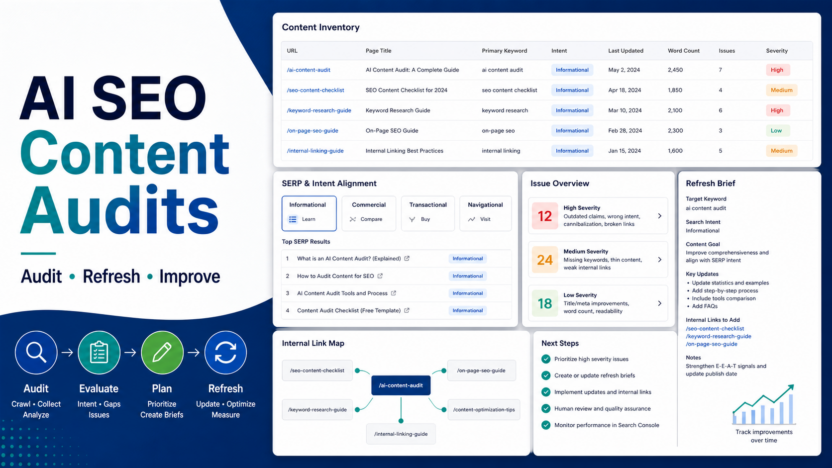
An AI SEO content audit uses AI tools to review existing pages for search intent, outdated information, missing sections, weak internal links, duplicate coverage, content decay, and refresh opportunities, while humans verify final recommendations. This article is written for small business teams that need a practical decision, not a broad AI overview. The safest way to evaluate this category is to define the workflow, compare a small shortlist, verify official pricing, and keep a human review step for anything customer-facing, revenue-sensitive, or technically risky.
Best For
SEO teams, content marketers, agencies, founders, and site owners who have existing content and need a practical process for deciding what to update first.
Not Best For
Teams looking for fully automatic SEO changes, sites with no access to performance data, or teams that will not verify AI recommendations before updating live pages.
Our Evaluation Criteria
| Criteria | What it means for this article |
|---|---|
| Workflow fit | Whether the tool solves the job readers actually need done. |
| Ease of setup | Whether a small team can start without a long implementation project. |
| AI quality | Whether AI output is useful after normal review, editing, and approval. |
| Pricing clarity | Whether official pricing pages give enough information for a sensible budget estimate. |
| Integrations | Whether the tool can fit common SaaS, support, marketing, coding, or SEO workflows. |
| Controls | Whether teams can review, approve, correct, and hand off work safely. |
| Value for money | Whether the tool saves enough time or reduces enough friction to justify the plan. |
Quick Comparison Table
| Tool | Best For | Main Strength | Limitation |
|---|---|---|---|
| Surfer | Content optimization | Content editor and SEO guidance workflows | Recommendations still need human judgment |
| Semrush | SEO research and tracking | Broad SEO toolkit and content workflows | Can be more platform than small teams need |
| ChatGPT | Audit summarization | Flexible analysis and brief drafting | Needs clean source data and verification |
| Google Search Console | Performance data | Official search performance signals | Does not write the audit for you |
| Screaming Frog | Site crawl exports | Technical crawl data | Requires SEO experience to interpret |
Official Sources Used
The article uses official product, pricing, or documentation pages for tool facts and pricing references:
How to Think About This Category
AI can speed up content audits by grouping pages, summarizing gaps, drafting refresh briefs, and spotting repeated issues. It should not replace judgment about search intent, factual accuracy, product claims, or user value.
A common mistake is choosing the tool with the longest feature list. A better method is to start with one workflow, write down the expected input, define the output a reviewer would accept, and compare tools against that scenario. This keeps the decision tied to real work instead of demo impressions.
For small teams, review capacity matters as much as AI quality. If the tool produces good drafts but the team has no one responsible for approval, the workflow can still create risk. The strongest setup assigns ownership: one person prepares the prompt or source material, one person checks the result, and one person decides whether the process is ready to repeat.
Key Features to Compare
The most useful features are not always the most visible. Look for features that remove friction from the specific job: source inputs, templates, workflow routing, team permissions, output editing, integrations, reporting, and escalation. AI assistance is valuable when it reduces blank-page work, catches gaps, or speeds up repeated decisions.
For AI SEO content audit, buyers should focus on five practical questions. First, does the tool support the work your team already does? Second, does it make review easier or harder? Third, is pricing clear enough for expected usage? Fourth, can the tool fit your existing stack? Fifth, what happens when the AI output is incomplete or wrong?
Tool-by-Tool Notes
Surfer
Surfer is included because it fits one important part of the SEO content audit software decision. Its strongest fit is content optimization. In a typical small business workflow, this matters because teams need a tool that helps real work move forward without making the review process harder.
Useful strengths include content editor and seo guidance workflows, practical team adoption, and enough structure for managers to compare output quality across repeated tasks. The limitation to watch is recommendations still need human judgment. That does not make the tool weak, but it does mean buyers should map it to one clear workflow before making it the default platform.
Semrush
Semrush is included because it fits one important part of the SEO content audit software decision. Its strongest fit is seo research and tracking. In a typical small business workflow, this matters because teams need a tool that helps real work move forward without making the review process harder.
Useful strengths include broad seo toolkit and content workflows, practical team adoption, and enough structure for managers to compare output quality across repeated tasks. The limitation to watch is can be more platform than small teams need. That does not make the tool weak, but it does mean buyers should map it to one clear workflow before making it the default platform.
ChatGPT
ChatGPT is included because it fits one important part of the SEO content audit software decision. Its strongest fit is audit summarization. In a typical small business workflow, this matters because teams need a tool that helps real work move forward without making the review process harder.
Useful strengths include flexible analysis and brief drafting, practical team adoption, and enough structure for managers to compare output quality across repeated tasks. The limitation to watch is needs clean source data and verification. That does not make the tool weak, but it does mean buyers should map it to one clear workflow before making it the default platform.
Google Search Console
Google Search Console is included because it fits one important part of the SEO content audit software decision. Its strongest fit is performance data. In a typical small business workflow, this matters because teams need a tool that helps real work move forward without making the review process harder.
Useful strengths include official search performance signals, practical team adoption, and enough structure for managers to compare output quality across repeated tasks. The limitation to watch is does not write the audit for you. That does not make the tool weak, but it does mean buyers should map it to one clear workflow before making it the default platform.
Screaming Frog
Screaming Frog is included because it fits one important part of the SEO content audit software decision. Its strongest fit is site crawl exports. In a typical small business workflow, this matters because teams need a tool that helps real work move forward without making the review process harder.
Useful strengths include technical crawl data, practical team adoption, and enough structure for managers to compare output quality across repeated tasks. The limitation to watch is requires seo experience to interpret. That does not make the tool weak, but it does mean buyers should map it to one clear workflow before making it the default platform.
Practical Use Cases
An agency could export pages from Search Console, group them by topic, identify thin sections, draft refresh briefs, and assign updates to writers. A SaaS team could use AI to compare help content against product changes and prioritize outdated articles.
In a typical small business workflow, the best use case starts narrow. A SaaS team might use the tool to improve onboarding, support, content refreshes, coding prototypes, or automation planning. An agency might use it to draft faster, compare options for clients, or prepare a repeatable checklist. A founder might use it to reduce manual work while keeping final decisions under human control.
The important point is that AI should support the workflow rather than own it. Use AI for drafts, summaries, first-pass classification, comparison tables, and suggestions. Keep humans in charge of policy, technical review, published claims, customer commitments, pricing interpretation, and final approval.
Pricing
Pricing last checked on July 24, 2026. Surfer, Semrush, and other SEO platforms publish official pricing pages. For audit workflows, compare project limits, tracked keywords, content editor usage, AI writing credits, team seats, and reporting needs.
When comparing plans, estimate the workflow you will actually run. Count users, projects, automation volume, support conversations, content volume, app-building attempts, or seats where relevant. A low entry price is less useful if the plan does not include the capability your team needs every week.
Pros
- Helps teams move from blank-page work to reviewed drafts faster.
- Makes repetitive decisions easier to structure.
- Can improve consistency when the team uses clear source material.
- Gives managers a better way to compare options by workflow fit.
- Works well when paired with a documented human review process.
Cons
- AI output still needs review before it reaches customers or production.
- Pricing may depend on usage, seats, projects, credits, or advanced features.
- Some tools are better for one workflow than for broad company-wide use.
- Teams can overvalue a polished demo and undervalue implementation effort.
- Integrations and governance needs may matter more than headline AI features.
Common Mistakes to Avoid
Do not evaluate tools with different sample tasks. Use the same scenario for every option, otherwise the comparison becomes unfair. Do not buy the broadest plan before the workflow is proven. Do not allow AI-generated support answers, product claims, pricing statements, or code changes to go live without review.
Another mistake is ignoring maintenance. AI workflows need updated source material, revised prompts, quality checks, and ownership. If nobody owns those pieces, the system becomes less reliable over time. A good tool should make maintenance visible, not hide it.
Implementation Checklist
1. Define the workflow in one sentence. 2. List the inputs the tool needs. 3. Decide who reviews the output. 4. Identify the official pricing plan that matches likely usage. 5. Run two or three realistic examples. 6. Record what had to be corrected. 7. Compare alternatives using the same criteria. 8. Choose the tool only if the reviewed output saves real time.
Which One Should You Choose?
Use AI for inventory cleanup, gap detection, brief drafting, and summarization. Keep humans responsible for source verification, keyword strategy, final edits, internal-link decisions, and publish approval.
If two tools look close, choose the one that your team can maintain. A slightly less powerful tool with cleaner setup, clearer pricing, and easier review can be a better business choice than a larger product that nobody uses consistently.
Alternatives
Useful alternatives depend on the job. For support workflows, compare help desk, knowledge base, and customer messaging tools. For coding, compare browser IDEs, AI code editors, and prototyping platforms. For SEO, compare audit platforms, optimization tools, and general AI assistants. For automation, compare task-based automation platforms with workflow builders that match your stack.
For related Dailytimespro context, see our AI customer support tools guide, Tidio AI review, AI workflow automation tools, Bolt.new review, Cursor pricing guide, and AI content optimization tools.
Final Recommendation
The best AI SEO audit workflow combines exported performance data, AI-assisted analysis, human editorial judgment, and a clear refresh queue. Do not let AI update pages blindly.
The practical buying rule is simple: start with the narrowest valuable workflow, use official pricing to estimate cost, and keep review responsibility explicit. If the tool saves time after review, it is worth deeper adoption. If it only looks impressive in a demo, keep it out of critical workflows until the team can prove repeatable value.
FAQs
What should small businesses compare first?
Start with workflow fit. A tool that solves one weekly task reliably is usually more valuable than a broader platform that creates more setup work than it removes.
Should AI output be used without review?
No. AI output should be reviewed before it affects customers, public content, production code, billing, legal language, or business-critical decisions.
How should pricing be evaluated?
Use official pricing pages and estimate real usage, including seats, credits, tasks, projects, conversations, or add-ons where those factors apply.
How many tools should a team test?
Two or three serious options are usually enough. Testing too many tools at once makes it harder to compare results cleanly.
What is the safest rollout plan?
Start with assisted drafting or internal recommendations, review every output, document corrections, and expand only after quality is consistent.
When should a team avoid this category?
Avoid it when the workflow is unclear, source data is poor, review ownership is missing, pricing is not understood, or the output would create customer trust or technical risk.
What matters more than AI features?
Review controls, integration fit, pricing clarity, repeatability, and human ownership usually matter more than a long list of AI features.
How often should the decision be revisited?
Review the tool after 30 days of real use. Keep it if it saves time after review and downgrade or replace it if usage is low or cleanup remains heavy.