Quick Answer
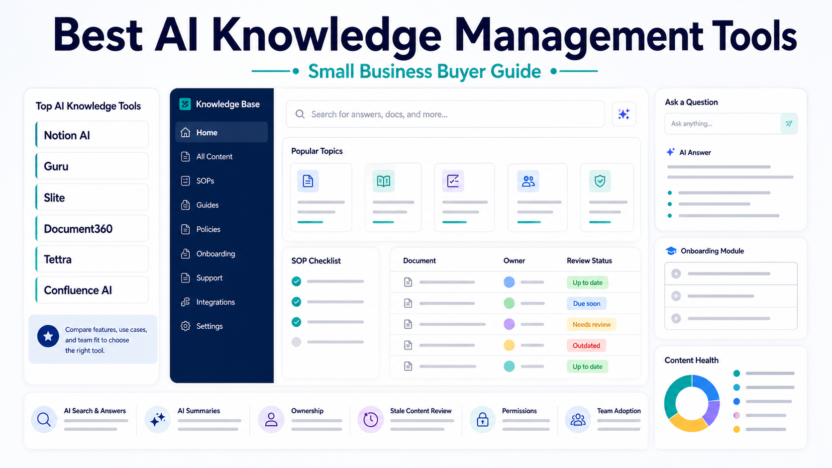
The best AI knowledge management tools for small business help teams capture, organize, search, summarize, and maintain company knowledge without letting documentation become stale. Notion AI is strong for flexible docs and team wikis, Guru is strong for verified internal answers, Slite is strong for lightweight team knowledge, Document360 is strong for customer-facing knowledge bases, Tettra is useful for internal Q&A and team knowledge, and Confluence AI fits teams already using Atlassian.
The right choice depends on whether your knowledge problem is internal docs, SOPs, support articles, onboarding, customer help content, or verified answer search. AI can help summarize and find knowledge, but someone still needs to own accuracy, review dates, permissions, and updates.
For process-specific documentation, see our Best AI SOP Software for Small Business guide. For onboarding knowledge workflows, see our NotebookLM employee onboarding guide.
Evaluation Criteria
| Criteria | Why it matters |
|---|---|
| Search and answers | Employees should find correct answers quickly. |
| AI summaries | Long docs should be easier to understand. |
| Ownership and verification | Knowledge needs review owners and update cycles. |
| Permissions | Internal, customer, and sensitive content need access control. |
| SOP support | Procedures should be clear and repeatable. |
| Adoption | The team must actually use the knowledge base. |
| Customer-facing options | Some businesses need public help centers. |
Quick Comparison
| Tool | Best for | Main strength | Limitation | Official source |
|---|---|---|---|---|
| Notion AI | Flexible team docs and wikis | Writing, summaries, notes, lightweight databases | Can become messy without structure | Notion |
| Guru | Verified internal answers | Knowledge verification and answer workflows | Best when teams commit to ownership | Guru |
| Slite | Lightweight internal knowledge | Simple team docs and async knowledge | Less suited to complex customer help centers | Slite |
| Document360 | Customer and support knowledge bases | Help center and documentation focus | More customer-support oriented | Document360 |
| Tettra | Internal Q&A and wiki | Team questions and knowledge capture | Fit depends on team habits | Tettra |
| Confluence AI | Atlassian teams | Strong fit for Jira/Atlassian environments | May feel heavy for very small teams | Confluence |
1. Notion AI
Notion AI is a strong fit for teams that want docs, wikis, notes, lightweight databases, and writing support in one place. It works well for founders, marketing teams, operations teams, and small businesses building an internal knowledge hub.
Use Notion AI for meeting notes, onboarding pages, project briefs, internal policies, research summaries, and lightweight SOPs. The main risk is structure. A Notion workspace can become messy if nobody owns naming, page hierarchy, and review cycles.
2. Guru
Guru focuses on trusted company knowledge and verified answers. It can be useful when employees ask repeated questions and need confidence that the answer is current.
Guru is a good fit for sales, support, and operations teams that rely on accurate internal answers. The tool is strongest when the business assigns owners to knowledge cards and maintains review workflows.
3. Slite
Slite is useful for lightweight team documentation, async updates, and internal knowledge. It fits small teams that want a simpler knowledge workspace without a heavy enterprise feel.
Use Slite for team handbooks, project notes, async updates, and internal docs. It is less ideal if the business needs a full customer-facing support knowledge base with advanced help center features.
4. Document360
Document360 is stronger for customer-facing knowledge bases, help centers, and support documentation. It is useful when customers need searchable help articles and support teams need a structured documentation workflow.
A SaaS company could use Document360 for product help docs, troubleshooting guides, release notes, and internal support references. It may be more than a small team needs if the goal is only an internal wiki.
5. Tettra
Tettra is built around internal team knowledge and Q&A. It can help teams collect repeated questions, organize answers, and reduce repeated interruptions.
Tettra is useful when employees ask the same operational questions often: where to find a policy, how to handle a support issue, which process to follow, or who owns a workflow.
6. Confluence AI
Confluence AI is most relevant for teams already using Atlassian products. It fits engineering, product, and operations teams that need structured documentation connected to Jira and other Atlassian workflows.
For very small teams, Confluence can feel heavier than Notion or Slite. For Atlassian-centered teams, it can be the natural documentation hub.
Practical Use Cases
Employee onboarding
A knowledge tool can store role guides, tool walkthroughs, policies, SOPs, and first-week tasks. AI can summarize long docs and answer common questions, but onboarding content still needs owners.
Customer support
Support teams need accurate answers for billing questions, onboarding support, ticket deflection, product troubleshooting, and human handoff. A knowledge base can reduce repeated support work if it stays current.
Sales enablement
Sales teams need pricing notes, objection handling, product positioning, approved messaging, and competitor context. Verification matters because outdated sales answers can create customer confusion.
Operations documentation
Operations teams can document procurement, refunds, onboarding, reporting, and internal approvals. For workflow examples, see our AI refund request workflow.
Common Mistakes
The first mistake is treating AI search as a substitute for ownership. AI can find and summarize content, but it cannot guarantee the source is current.
The second mistake is storing everything without structure. A good knowledge base needs categories, owners, review dates, and permissions.
The third mistake is mixing internal and customer-facing content without access control.
The fourth mistake is failing to remove outdated docs. Old information is worse than missing information because employees may trust it.
Final Recommendation
Choose Notion AI for flexible internal docs, Guru for verified internal answers, Slite for lightweight team knowledge, Document360 for customer support documentation, Tettra for Q&A-driven knowledge, and Confluence AI for Atlassian-centered teams. The best tool is the one your team will maintain, not only the one with the most AI features.
FAQs
What is an AI knowledge management tool?
It is software that helps teams store, search, summarize, and maintain company knowledge using AI-assisted features.
Which AI knowledge management tool is best for small business?
Notion AI, Guru, Slite, Document360, Tettra, and Confluence AI can all fit depending on whether the team needs docs, verified answers, customer support content, or Atlassian documentation.
Can AI keep a knowledge base accurate?
No. AI can help find and summarize knowledge, but humans need to own accuracy, review dates, and updates.
What is best for customer support?
Document360 is strong for customer-facing knowledge bases, while Guru can help support teams with verified internal answers.
What is best for internal docs?
Notion AI and Slite are strong for flexible internal documentation. Confluence AI is a good fit for Atlassian teams.
What is the biggest knowledge-base mistake?
The biggest mistake is letting content become stale. Every important page should have an owner and review cycle.