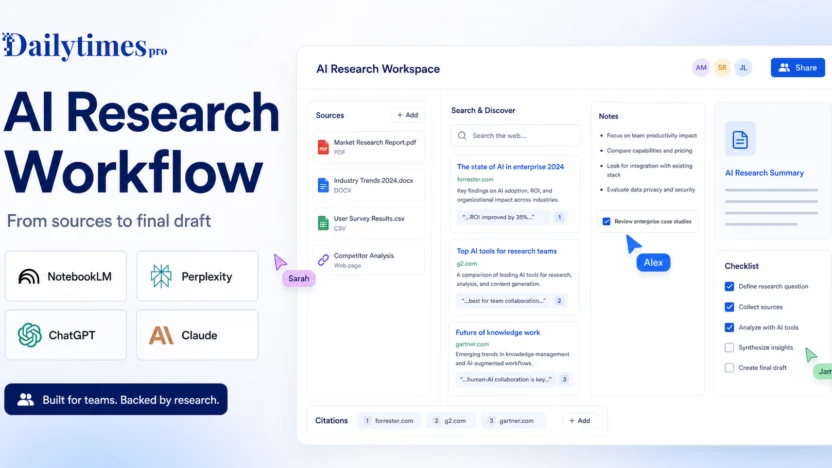
A strong AI research workflow is not about asking one chatbot for an answer and copying the result. For teams, the better approach is to separate the work into stages: collect trustworthy sources, explore the topic, summarize evidence, challenge weak points, draft the final asset, and review everything before publication.
That workflow matters because AI tools are good at different jobs. NotebookLM is useful when your team wants to work from uploaded sources. Perplexity is useful when you need web research with visible citations. ChatGPT is useful for turning messy notes into structured outlines, briefs, and drafts. Claude is useful for long-context review, synthesis, and careful rewriting. Used together, these tools can reduce research time without weakening editorial standards.
If you are choosing between research tools, our NotebookLM vs Perplexity comparison is a useful companion. This guide is different: it shows how to build a repeatable process around AI research tools instead of treating every research task as a one-off prompt.
Quick Workflow Summary
| Step | Goal | Best-fit AI role |
|---|---|---|
| 1. Define the question | Prevent vague research | Turn the topic into clear research questions |
| 2. Build the source set | Keep evidence organized | Collect official pages, documents, and notes |
| 3. Explore the web | Find gaps and current context | Use cited search and discovery tools |
| 4. Summarize sources | Reduce reading time | Extract themes, claims, and contradictions |
| 5. Create the outline | Shape the final asset | Build headings, argument flow, and audience angle |
| 6. Draft with controls | Write without losing accuracy | Use source notes and editorial rules |
| 7. Review and publish | Protect quality | Verify claims, links, tone, and missing context |
1. Define The Research Question First
Most weak AI research starts with a vague request. A prompt like “research this topic” gives the model too much freedom and too little direction. Before opening any AI tool, write one primary question and three to five supporting questions.
For example, instead of asking for “AI tools for sales teams,” define the research question as: “Which AI tools help small sales teams reduce manual follow-up work without adding a complex CRM migration?” That version gives the research a clearer audience, job, constraint, and buying context.
A good research brief should include:
- The audience you are writing for
- The decision they need to make
- The tools, categories, or workflows included
- The date sensitivity of the topic
- The type of final output needed
- Any sources that must be used or avoided
This step is where ChatGPT or Claude can help, but the human editor should own the final brief. AI can suggest angles; it should not decide the business objective alone.
2. Build A Source Set Before Drafting
The source set is the foundation of the whole workflow. Start with official websites, product pages, docs, pricing pages, help centers, changelogs, and public policy pages. For AI tools, that usually means checking the vendor’s own product information first.
Useful official starting points include NotebookLM, Perplexity, ChatGPT, and Claude. If the article involves buying decisions, include the official plan pages in the research folder as source material rather than relying on memory.
NotebookLM is especially useful at this stage because it is designed around source-grounded work. Add PDFs, notes, docs, web pages, or transcripts when the project needs a controlled knowledge base. Then use the tool to ask questions against those sources rather than against the open web.
3. Use Web Research For Discovery, Not Final Truth
Web research tools are excellent for discovery. They can uncover terminology, competitor pages, recent announcements, and gaps in your source set. Perplexity is useful here because it presents answers with cited sources, making it easier to inspect where a claim came from.
The mistake is treating the first AI answer as final truth. Instead, use web research to build a candidate list of sources. Then open the most important sources yourself, especially when the claim affects pricing, product limits, security, compliance, or availability.
This is also where a general assistant can help compare findings. For broader assistant selection, see our Claude vs ChatGPT comparison and Gemini vs ChatGPT comparison. Those articles help when the research workflow depends on the assistant your team already uses every day.
4. Summarize Each Source Into Evidence Notes
Once sources are collected, do not jump straight into drafting. Create evidence notes first. Each note should contain the source name, URL, what the source proves, what it does not prove, and any language that should be quoted or paraphrased carefully.
A practical evidence note can look like this:
- Source: official product page
- Claim supported: the tool supports a specific workflow or feature
- Claim not supported: exact plan limits or future roadmap
- Editorial use: explain the feature in plain language
- Risk: source is promotional, so avoid overclaiming
This keeps the final article from sounding like a stitched-together AI answer. It also makes QA easier because every important claim has a source trail.
Claude and ChatGPT are both useful for turning long source notes into clean summaries. Claude is often strong for long-context synthesis, while ChatGPT is flexible for outlines, rewriting, and transforming notes into different formats. The right choice depends on your team’s review habits and the type of source material.
5. Create A Decision-Focused Outline
A good research article should not simply list facts. It should help the reader make a decision or complete a task. After summarizing the sources, ask the AI to create an outline that answers the reader’s most likely next questions.
For a tool article, that may include:
- What the tool does
- Who it is best for
- When it is not a good fit
- How it compares with alternatives
- What workflow it supports
- What limitations buyers should notice
- Which sources support the article’s claims
For a guide or tutorial, the outline should focus more on sequence and outcomes. For a comparison, it should focus on decision criteria. For a listicle, it should focus on use cases and tool fit. This is how you avoid producing the same generic AI article again and again.
6. Draft With Source Boundaries
When drafting, tell the AI exactly what it can and cannot use. Give it the brief, the outline, the evidence notes, internal links, and editorial rules. Ask it to write from those materials rather than inventing missing details.
A good drafting instruction might say: “Use only the source notes below. Do not invent pricing, limits, benchmarks, test results, user numbers, or roadmap claims. If a point is not supported, omit it. Write for small business teams that need a practical decision-making workflow.”
This matters for trust. Readers can tell when an article is padded with vague claims. Strong AI-assisted writing still needs constraints, judgment, and a clear editorial standard.
If the research task involves meeting notes or team knowledge capture, our Otter.ai vs Fireflies.ai comparison is another useful internal reference because meetings often become part of the source library for later research.
7. Review Claims, Links, And Reader Value
The final review should be separate from drafting. Use AI to help inspect the article, but do not let AI be the only reviewer. Check whether every major claim is supported, whether external links point to official or authoritative sources, and whether internal links genuinely help the reader.
A strong QA pass should ask:
- Does the article answer the search intent?
- Are official sources linked where they matter?
- Are any prices, limits, or feature claims unsupported?
- Are internal links relevant and naturally placed?
- Does the article include enough practical detail?
- Does the introduction say something specific?
- Are FAQs useful rather than repetitive?
- Is the final recommendation clear?
This is where many AI articles fail. They look complete, but they do not help the reader act. The goal is not to publish more words. The goal is to publish a better decision path.
Recommended Tool Roles
NotebookLM
Use NotebookLM when the research depends on a defined source set. It is a strong fit for policy docs, course material, transcripts, PDFs, and internal notes. It helps teams ask questions against known material instead of mixing controlled sources with broad web assumptions.
Perplexity
Use Perplexity for discovery, web context, and source finding. It works well when the team needs to understand what is available online and then inspect cited pages. It is strongest when the reviewer follows the citations and validates key claims.
ChatGPT
Use ChatGPT for briefs, outlines, draft structure, rewriting, and formatting. It can turn evidence notes into article sections, social posts, checklists, and summaries. It is useful when the team needs flexible content transformation after research is complete.
Claude
Use Claude for long-context synthesis, careful rewriting, and review of dense material. It can be helpful when the team needs a second-pass editor that can hold a large amount of context and identify weak reasoning or unclear structure.
Common Mistakes To Avoid
The biggest mistake is asking one AI tool to do the whole job from a single prompt. That usually creates generic content with weak sourcing. Another mistake is adding source links after writing, which can lead to links that do not actually support the claims.
Avoid these habits:
- Starting with a broad prompt instead of a research brief
- Mixing official sources with random blog summaries without labeling them
- Asking AI to invent feature comparisons from memory
- Publishing pricing or plan details without a source trail
- Using citations as decoration instead of evidence
- Adding internal links only because SEO tools recommend them
- Skipping human review because the draft sounds fluent
Fluency is not the same as accuracy. A polished paragraph can still be unsupported.
Best AI Research Workflow Template
Use this repeatable template for team research projects:
1. Write the research question and audience. 2. Create a source folder with official pages, docs, notes, and transcripts. 3. Use Perplexity or another cited research tool to find additional source candidates. 4. Add the strongest sources to NotebookLM or a shared research document. 5. Summarize each source into evidence notes. 6. Use ChatGPT or Claude to create an outline from the notes. 7. Draft the article with strict source boundaries. 8. Add natural internal links only where they help the reader. 9. Review every important claim before publishing. 10. Save the final source list for future article updates.
Final Verdict
The best AI research workflow for teams is a layered process, not a single tool choice. Use NotebookLM for controlled source work, Perplexity for cited discovery, ChatGPT for structure and drafting, and Claude for synthesis and review. The combination works because each tool has a clear job.
If your team publishes research-based content, build the workflow before choosing the tool. A clear process will produce better articles than a powerful AI assistant used without source discipline.
FAQs
What is an AI research workflow?
An AI research workflow is a repeatable process for using AI tools to collect sources, summarize evidence, build outlines, draft content, and review claims before publication.
Which AI tool is best for source-based research?
NotebookLM is strong for source-based research because it is built around uploaded or selected materials. It works best when the team already has documents, notes, transcripts, or web sources to analyze.
Which AI tool is best for web research?
Perplexity is useful for web research because it surfaces answers with citations. The citations still need human review, especially for important product, pricing, legal, or technical claims.
Should teams use ChatGPT for research?
Yes, ChatGPT can help with research briefs, outlines, draft structure, rewriting, and content transformation. It should be used with source notes and clear boundaries for important research work.
Is Claude good for research articles?
Claude can be useful for long-context synthesis, careful rewriting, and reviewing dense source material. It is especially helpful when the research includes long notes or complex arguments.
Can AI replace human research review?
No. AI can speed up research and drafting, but a human editor should review claims, sources, links, tone, and final recommendations before publication.
How do you avoid fake AI research claims?
Use official sources, keep evidence notes, avoid unsupported details, and ask the AI to omit anything that is not backed by the supplied material.
Should every AI article include pricing?
Only include pricing when it is relevant to the article and confidently verified from official sources. Workflow articles may not need a pricing table if the reader is trying to improve a process rather than choose a paid plan.
How many internal links should a research article include?
Use internal links only where they help the reader continue the same decision path. Two to five relevant links are usually enough for a normal article.
What is the safest way to publish AI-assisted research?
Use AI for speed, but keep human control over source selection, claim verification, editorial judgment, and the final recommendation.