Quick Verdict
Scalenut is worth considering if your team wants one AI SEO workflow for keyword planning, article drafting, content optimization, AI visibility, traffic analysis, content audits, and internal linking. It is strongest for content marketers, SEO teams, agencies, founders, and small businesses that need repeatable SEO content production rather than a basic AI writer.
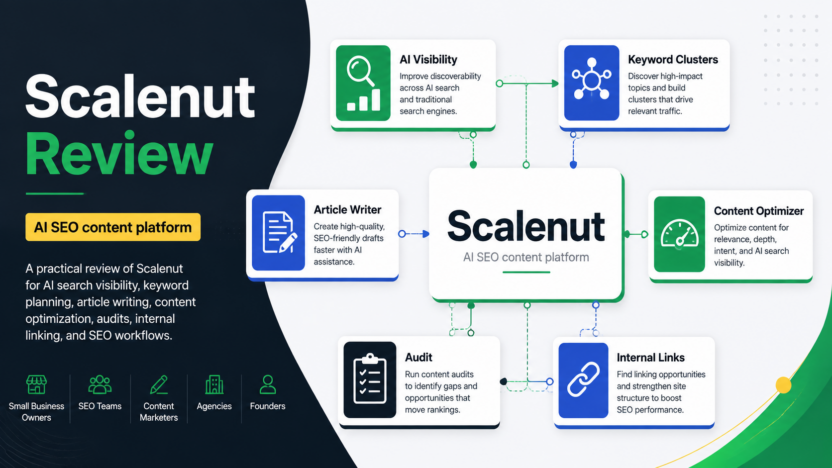
The core reason to consider Scalenut is workflow coverage. The official Scalenut site positions the product around AI search visibility, SEO content planning, content creation, content optimization, content audits, and internal linking. That makes it broader than a simple long-form writing tool. It is trying to support the full path from topic discovery to published content improvement.
Scalenut is not the best fit if you only need occasional short copy, social captions, or general brainstorming. It also is not a substitute for editorial judgment. AI can help with drafts and optimization, but a serious SEO program still needs positioning, real product expertise, source checking, internal links, and human editing.
Best For
Scalenut is best for teams that publish SEO content regularly and need a structured process. A small business could use it to find content opportunities, build keyword clusters, draft articles, optimize existing pages, and identify internal linking gaps. An agency could use it to manage repeatable content workflows across clients. A founder could use it to create a more disciplined content system before hiring a full SEO team.
It is especially useful when the team wants AI writing and SEO analysis in the same workflow. Some AI writing tools create drafts but leave optimization to another platform. Some SEO tools analyze content but do not provide a practical writing workflow. Scalenut sits in the middle.
If your main need is SEO blog drafting, our KoalaWriter review is a useful comparison point. If you are building a wider GTM content workflow, our Copy.ai alternatives for GTM teams guide covers a different part of the stack.
Not Best For
Scalenut is not ideal for teams that want a general-purpose writing assistant for every type of content. If your needs are mostly emails, sales scripts, internal memos, or ad variants, a broader AI writing tool may be simpler.
It may also be too much if your site only publishes a few articles per year. The value improves when a team has enough content volume to benefit from planning, optimization, audits, and internal linking. For a low-volume site, a simpler keyword tool plus careful manual writing may be enough.
Scalenut is also not a replacement for subject-matter expertise. For software reviews, comparisons, and technical guides, writers still need to verify product facts, pricing, limitations, and official sources. The tool can support the workflow, but it cannot responsibly invent expertise.
Our Evaluation Criteria
This review uses practical criteria for teams choosing an AI SEO content platform:
| Criteria | What Matters |
|---|---|
| Keyword planning | Whether the platform helps identify relevant topics and keyword clusters |
| Article workflow | Whether AI writing support helps create structured drafts without turning thin |
| Optimization depth | Whether content optimization supports intent, terms, structure, and quality |
| Existing content improvement | Whether audits and refresh workflows help improve already published pages |
| Internal linking | Whether the tool helps identify useful internal link opportunities |
| AI visibility | Whether the product addresses search visibility beyond traditional ranking workflows |
| Pricing clarity | Whether official plan details and limits are clear enough for buying decisions |
| Team value | Whether the platform can support repeatable content operations for small teams and agencies |
What Is Scalenut?
Scalenut is an AI SEO and content marketing platform. Its official site describes tools for AI visibility, keyword planning, article writing, content optimization, content audits, traffic analysis, and internal linking. That puts it in the category of AI SEO content platforms rather than simple text generators.
In practical terms, Scalenut helps teams answer questions such as:
| Content Question | How Scalenut Can Help |
|---|---|
| What should we write about? | Keyword planning and clustering can help organize content opportunities |
| How should the article be structured? | AI article workflows can help generate outlines and drafts |
| Is the content optimized? | Content optimization tools can help review coverage, relevance, and SEO signals |
| Which old pages need work? | Content audits and traffic analysis can help prioritize refreshes |
| Where should we add internal links? | Internal linking tools can help connect related content |
This makes Scalenut most useful for teams that want a repeatable content system. It is less useful when someone only needs a one-off paragraph or a short brainstorm.
Key Features
AI Visibility and GEO Direction
Scalenut's official site references AI visibility and tracking performance across AI search engines. This matters because content teams are no longer optimizing only for traditional blue-link rankings. They also need to think about answer engines, AI Overviews, and generative search systems.
For a small business, this does not mean chasing every AI mention. It means writing pages that clearly answer questions, explain entities, cite useful sources, and structure information in a way machines and humans can understand. Scalenut's positioning is aligned with that shift.
Keyword Planner and Topic Clusters
Scalenut includes keyword planning and clustering features according to its official site. This is useful because many teams publish isolated posts without a clear topical map. A keyword cluster workflow can help a team plan supporting articles around a larger SEO theme.
In a typical small business workflow, a software company could map terms around product category, use cases, alternatives, pricing, comparisons, and implementation. An agency could use clusters to plan content for multiple clients while avoiding random article selection.
AI Article Writer
Scalenut supports AI-assisted article writing. The value is not simply generating text. A useful AI SEO writer should help structure the draft around intent, sections, questions, and optimization needs.
For teams publishing software reviews, comparison posts, guides, and best-tools articles, Scalenut can help speed up first drafts. Human review is still required for facts, pricing, tool limitations, source links, examples, and final recommendations.
Content Optimizer
The content optimizer is one of the main reasons teams compare Scalenut with other SEO writing tools. Optimization helps writers see whether the content is covering relevant terms, questions, and structural expectations.
This is useful after the first draft. A team can compare the article against the target topic, improve missing sections, add stronger explanations, and remove weak filler. Optimization should not mean stuffing keywords. The better use is improving completeness and clarity.
Content Audits and Refreshes
Scalenut's official site references content audits and traffic analysis. These features matter because content marketing is not only about publishing new pages. Existing articles often need refreshing as product information, pricing, SERPs, and user intent change.
A practical workflow could start with a content audit, identify declining pages, check whether the article still answers the query, update outdated sections, add internal links, and improve the conclusion. This is often more valuable than writing another new article.
Internal Linking
Scalenut lists internal linking among its SEO workflow features. Internal links help search engines and readers understand how pages connect. For content-heavy sites, missing internal links can make useful articles harder to discover.
For a small business, internal linking should be natural. A review article can link to a related comparison, a category guide, or an alternatives article. A workflow article can link to tool reviews and implementation guides. The goal is helpful navigation, not link stuffing.
Scalenut Pricing
Pricing last checked on September 6, 2026.
Scalenut's official pricing page should be treated as the source of truth for current plan names, prices, and limits. At the time checked for this review, Scalenut publicly presented paid plan options for individual users, growing teams, and agencies, with plan differences based on usage, AI/SEO features, and team needs.
Because SaaS pricing pages can vary by billing cycle, promotion, seat count, and plan limits, the safest buying approach is to match your required workflow to the plan table before upgrading. The most important items to check are:
| Pricing Item | Why It Matters |
|---|---|
| Article or word limits | Determines how many SEO articles a team can produce each month |
| Keyword or topic research limits | Affects planning volume for clusters and campaigns |
| Content optimizer access | Important if optimization is the main reason for buying |
| Audit and traffic analysis access | Needed for refresh workflows and existing content improvement |
| AI visibility features | Relevant for teams targeting answer engines and AI search visibility |
| Team seats and collaboration | Important for agencies and content teams |
For most small teams, the best plan is the lowest tier that includes the specific workflow they will use every week. If your team only needs occasional article drafting, avoid overbuying. If your team manages SEO content across many pages or clients, prioritize optimization, audits, and collaboration limits.
Real Use Cases
SEO Blog Production
A small business can use Scalenut to plan and draft SEO blog posts around product categories, use cases, comparisons, and buyer questions. The workflow might begin with keyword clustering, move into article outlining, then continue through drafting, optimization, and internal linking.
Content Refreshes
An SEO team could use Scalenut to identify old pages that need updates. The team can refresh outdated sections, add missing topics, improve headings, update pricing references, and strengthen internal links. This is often a better use of AI SEO tooling than endlessly publishing new thin articles.
Agency Content Operations
Agencies can use Scalenut to create repeatable workflows for clients. A team can plan clusters, assign writers, draft articles, run optimization checks, and review internal link opportunities. The platform can help standardize the process, but agencies still need client-specific expertise.
AI Search Visibility Planning
Teams can use Scalenut's AI visibility positioning to think beyond classic keyword ranking. A content team could build pages with clearer entity definitions, direct answers, comparison tables, FAQs, source-backed claims, and practical recommendations.
Internal Linking Improvements
Sites with many articles can use internal linking workflows to connect related pages. For example, a review can link to a comparison article, a best-tools guide, or a practical workflow guide. Dailytimespro uses this same principle across related AI tool categories, such as our best AI agent platforms and Taskade AI review.
Software Review Content
For software review sites, Scalenut can support structure and optimization, but writers still need official sources. If your team publishes product reviews, every article should verify pricing, features, limitations, and alternatives from primary sources before publishing.
Pros and Cons
| Pros | Why It Matters |
|---|---|
| Covers multiple SEO content stages | Helps teams plan, write, optimize, audit, and link content in one workflow |
| Built for SEO content, not only generic writing | Better fit for search-focused articles and content operations |
| Keyword clustering supports topical planning | Reduces random publishing and helps build content depth |
| Content optimizer can improve drafts | Useful for identifying missing sections and weak topical coverage |
| Audit and refresh workflows support existing pages | Helps teams improve old content rather than only publishing new posts |
| AI visibility direction matches current search changes | Useful for teams thinking about answer engines and generative search |
| Cons | Why It Matters |
|---|---|
| Pricing and limits need careful review | Plan fit depends on usage, team size, and required features |
| Not a substitute for expert review | Facts, pricing, source links, and final recommendations still need human verification |
| May be too much for low-volume sites | The value improves when teams publish or refresh content consistently |
| SEO tools can encourage over-optimization | Teams should improve helpfulness, not stuff related terms |
| Not built for every writing use case | General email, ad, and sales copy workflows may need a broader AI writing tool |
Scalenut vs Alternatives
| Tool | Best For | Main Strength | Limitation |
|---|---|---|---|
| Scalenut | AI SEO planning, writing, optimization, audits, and internal linking | Broad SEO content workflow in one platform | Requires careful editing and plan-limit review |
| Surfer SEO | Content optimization and SERP-based writing guidance | Strong optimization workflow | Writing and broader content operations may require other tools |
| Frase | Content briefs, optimization, and SEO writing | Useful research and brief-building workflow | Teams should compare plan limits and workflow fit |
| Clearscope | Content optimization for quality-focused teams | Strong semantic optimization positioning | Often best for teams with existing writing process |
| KoalaWriter | SEO article drafting | Fast AI SEO draft generation | Less focused on audits and full content operations |
For readers comparing focused AI SEO writing tools, the KoalaWriter review gives a useful contrast. If your content program also relies on video explainers, our Guidde review covers a different content documentation workflow.
What Most Teams Should Watch Before Choosing Scalenut
The most important buying question is whether your team needs an SEO content workflow or just an AI writer. If you only need occasional text generation, Scalenut may be more platform than necessary. If you need planning, drafting, optimization, audits, and internal links, the broader workflow is the point.
Teams should also avoid treating optimization scores as the final goal. A high score is not the same as a useful article. The article still needs a real answer, accurate facts, current pricing when relevant, original guidance, and a clear recommendation.
Before buying, define one content workflow:
| Workflow Step | Decision to Define |
|---|---|
| Topic selection | Which cluster or buyer problem are you targeting? |
| Keyword planning | Which primary keyword and supporting questions matter? |
| Drafting | Who reviews the AI-generated outline and body? |
| Optimization | What missing sections genuinely improve the article? |
| Source checking | Which official sources support product and pricing claims? |
| Internal linking | Which related pages help the reader continue? |
| Refresh cycle | When will the article be updated after publishing? |
If your team can answer those questions, Scalenut can support a disciplined content process. If not, start with a smaller workflow before scaling production.
Final Recommendation
Scalenut is a strong option for teams that want AI-assisted SEO content operations rather than a generic writing assistant. It is best for content marketers, agencies, founders, and SEO teams that need keyword planning, article workflows, optimization, audits, AI visibility, and internal linking support.
Choose Scalenut if your team publishes or refreshes content regularly and wants a more structured process. Consider a simpler tool if you only need occasional writing help or if your site does not have enough content volume to justify an SEO platform.
The safest way to evaluate Scalenut is to run one real content workflow: choose a cluster, draft one article, optimize it, add internal links, verify sources, and plan a refresh. If that process saves time while improving quality, Scalenut is worth deeper evaluation.
FAQs
Is Scalenut an AI writing tool?
Yes, but it is more specific than a general AI writer. Scalenut is positioned as an AI SEO and content platform with keyword planning, article writing, content optimization, audits, AI visibility, and internal linking workflows.
What is Scalenut best used for?
Scalenut is best used for SEO content planning, article drafting, content optimization, content refreshes, audits, and internal linking. It fits teams that publish or update search-focused articles regularly.
Does Scalenut help with AI search visibility?
Scalenut's official site references AI visibility and tracking performance across AI search engines. This can help teams think about content structure for answer engines and generative search, not only traditional rankings.
Is Scalenut good for agencies?
Scalenut can be useful for agencies that manage repeatable SEO content workflows. Agencies can use it for planning clusters, drafting articles, optimizing content, and reviewing internal links, while still applying client-specific expertise.
Can Scalenut replace an SEO expert?
No. Scalenut can support SEO workflows, but it cannot replace expert judgment. Teams still need strategy, source verification, product knowledge, editorial review, and quality control before publishing.
How should small businesses use Scalenut?
Small businesses should start with one focused content cluster. Use Scalenut to plan topics, draft an article, optimize the content, add useful internal links, and refresh the page later based on performance.
What are Scalenut's main limitations?
The main limitations are plan-fit complexity, the need for human review, and the risk of over-optimization. Teams should use the tool to improve useful content, not to create generic articles around every keyword.
Who should choose Scalenut?
Choose Scalenut if your team needs a repeatable AI SEO content workflow for planning, writing, optimizing, auditing, and internally linking search-focused content. It is strongest for teams with consistent content volume.