Quick Verdict
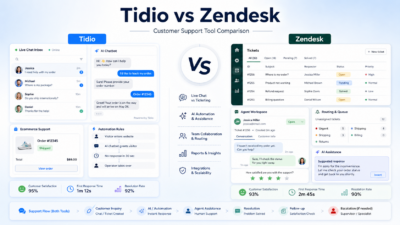
The best AI help desk tool for a small business is the one that matches support volume, channel mix, and review tolerance. Zendesk is strongest for structured ticketing and larger support operations. Intercom is strong for conversational support and AI-agent outcomes. Freshdesk is practical for teams that want traditional help desk features with AI add-ons. Tidio is attractive for smaller ecommerce and website chat teams that want live chat plus AI assistance without adopting a heavier enterprise support stack.
Pricing last checked on July 25, 2026. Pricing details below are based on official vendor sources: Zendesk pricing, Intercom pricing, Freshdesk pricing, Tidio pricing. Before purchase, review the vendor's current plan table, billing cycle, usage terms, and add-on language because SaaS plans can vary by account, region, workspace size, and contract terms.
Related Dailytimespro reading:
- Best AI Knowledge Base Tools
- Zendesk AI Review
- Intercom Fin Review
- Best AI Customer Onboarding Tools
Best For
Small businesses that handle repeated customer questions, billing inquiries, onboarding issues, order status requests, product setup questions, and support routing. These tools are especially useful when a small team wants faster first responses, better self-service, and cleaner human handoffs.
Not Best For
Teams with very low support volume, teams that need only a shared email inbox, or businesses that cannot keep a knowledge base current. AI help desk tools depend on accurate help content and clear escalation rules.
Our Evaluation Criteria
This article evaluates the topic through practical small-business criteria: ease of setup, pricing clarity, AI output quality, workflow fit, integrations, handoff quality, admin controls, support readiness, and value for money. The goal is not to pick a universal winner. The goal is to help a business owner, operator, marketer, sales lead, support manager, creator, or founder choose a tool that fits a real workflow.
The strongest products are easy to explain internally. A team should be able to say what the tool reads, what it creates, who reviews it, and where the approved result goes. If those steps are vague, the software may still be good, but the implementation is not ready.
Key Features
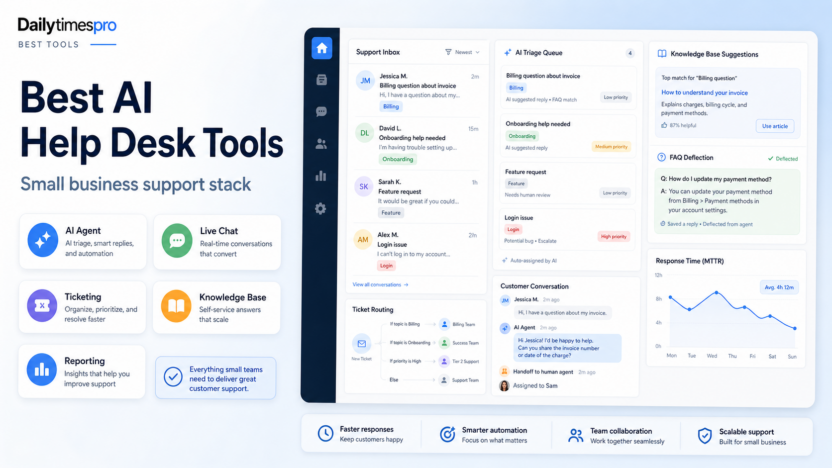
- AI agents or AI reply assistance for common customer questions.
- Ticket routing, prioritization, tags, and escalation paths.
- Knowledge base suggestions for self-service and answer drafting.
- Live chat, email, messaging, or omnichannel support depending on product.
- Analytics for response time, resolution rate, volume, and team performance.
- Human handoff controls so sensitive or complex cases reach the right person.
Real Use Cases
FAQ deflection
A small ecommerce store can use AI to answer delivery, return, tracking, product availability, and payment questions from approved help content. The value is highest when the answer is repetitive and low risk.
Billing questions
A SaaS team can route billing questions by account status, subscription type, or invoice issue. AI can draft the first response while a human checks anything involving refunds, contract terms, or account changes.
Onboarding support
A customer success team can turn setup guides into suggested answers for new users. This helps customers get through account setup, integrations, profile settings, and first workflow creation without waiting for a live agent.
Ticket deflection
A support manager can use self-service articles and AI suggestions to reduce repetitive tickets. The key is maintaining a strong knowledge base so the AI has reliable material to use.
Human handoff
A help desk can send urgent, emotional, billing-sensitive, technical, or account-specific requests to a human agent. Good AI support should make handoff clearer, not hide difficult cases.
Pricing
| Plan or product | Official pricing signal | Buyer note |
|---|---|---|
| Zendesk Support Team | $19 per agent per month when paid yearly | Entry point for structured ticketing teams |
| Zendesk Suite Team | $55 per agent per month when paid yearly | Adds broader omnichannel support suite capability |
| Zendesk Copilot | $50 per agent per month when paid yearly | AI add-on for teams that need agent assistance |
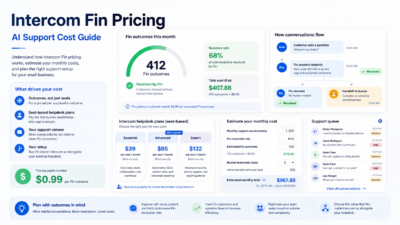
| Intercom Fin AI Agent | $0.99 per resolved outcome | Useful when outcome-based AI support economics fit the team |
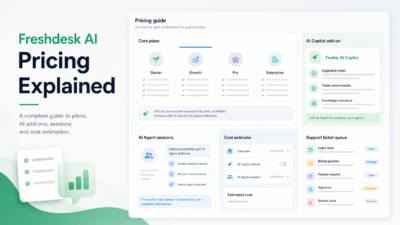
| Freshdesk Freddy AI Copilot | $29 per agent per month | AI add-on for Freshdesk teams |
| Tidio Plus | Starts at $300 per month plus usage according to Tidio pricing | Better fit for teams that need live chat, automation, and AI support capacity |
When comparing pricing, estimate normal monthly usage rather than only the first user account. For seat-based products, count the people who create, approve, manage, or depend on the work. For usage-based products, estimate the number of conversations, sessions, AI actions, recordings, credits, or media minutes. For custom enterprise options, ask what is included in onboarding, admin controls, support, security, retention, and overage handling.
Pros and Cons
Pros
- Can reduce repetitive support load when help content is accurate.
- Improves response speed for common questions.
- Creates better routing and visibility than scattered inboxes.
- Supports small teams that need coverage without hiring immediately.
Cons
- Requires updated help content and clear escalation rules.
- AI add-ons can raise the monthly cost quickly.
- Complex billing, account, legal, or technical questions still need human review.
- Some products are heavier than a very small team needs.
Comparison Table
| Tool | Best for | Main strength | Limitation |
|---|---|---|---|
| Zendesk | Structured support teams | Ticketing, routing, reporting, scale | Can feel heavy for very small teams |
| Intercom | Conversational support | AI agent outcomes and chat-first workflows | Outcome pricing needs volume planning |
| Freshdesk | Traditional help desk teams | Familiar ticketing with AI add-ons | AI features can require add-on budget |
| Tidio | Small ecommerce and website chat | Live chat plus AI assistance | Less suited to complex enterprise support |
Alternatives
| Alternative | Best for | Main strength | Limitation |
|---|---|---|---|
| Help Scout | Simple shared inbox support | Clean customer support workflow | Less enterprise support depth |
| Gorgias | Ecommerce support | Strong commerce integrations | Best fit depends on ecommerce stack |
| Front | Collaborative inbox teams | Shared inbox and workflow collaboration | Not a pure AI help desk |
Practical Buying Guidance
The right choice depends on the workflow that already exists inside the business. A small team should define the job first, then choose software. For best AI help desk tools, the practical question is whether the product reduces repeated manual work without making review harder. If the team saves a few minutes but creates confusion about ownership, permissions, or accuracy, the workflow needs more design before a paid rollout.
Start with one process that happens every week. Assign one owner, write down the input material, decide where the output goes, and define who reviews it. This simple setup prevents a common mistake: buying a tool because the demo looks strong while the actual team process remains unclear. AI features are most useful when they support a repeated step such as summarizing, routing, drafting, organizing, editing, answering, or handing work to the next person.
Small businesses should also watch the cost model. Some products are priced by seat, some by usage, some by credits, some by outcomes, and some by custom sales terms. A low entry price can still become expensive if the active user count, automation volume, media minutes, AI credits, or customer conversation volume grows quickly. Estimate normal monthly usage before comparing plans.
Finally, keep human review in the process. AI output may be useful as a first pass, summary, draft, classification, or recommendation, but the business is still responsible for the final customer-facing answer, published content, CRM update, support decision, or public claim. The best setup is not fully hands-off. It is a clear workflow where AI makes the next human step faster and easier to trust.
Setup Checklist
| Setup area | What to decide |
|---|---|
| Workflow owner | Who configures the tool and judges whether the output is useful |
| Source material | Which calls, tickets, pages, databases, videos, or customer records the tool can use |
| Review rule | What must be approved before it reaches a customer, prospect, or public page |
| Integration path | Which help desk, CRM, CMS, website builder, editor, or workspace receives the final output |
| Cost trigger | Which seats, credits, outcomes, sessions, or usage levels may change monthly cost |
| Data control | Which private information should stay out of the workflow |
30-Day Pilot Plan
During week one, configure the smallest useful workflow. Use real internal examples, but avoid sensitive customer details unless the team has a clear permission rule. The goal is to understand setup effort, not to automate every edge case.
During week two, compare output quality. Track which summaries, drafts, replies, recommendations, or interface outputs are accepted, edited, or rejected. The log should be simple. The point is to see whether the product makes normal work faster after review.
During week three, test collaboration. Invite the people who will actually depend on the workflow. Watch whether they use the tool naturally, ignore it, or create manual workarounds. Adoption issues usually reveal a process problem before they reveal a software problem.
During week four, make a renewal decision. Keep the tool if the team can name a clear improvement: faster responses, cleaner notes, better handoffs, clearer pages, shorter editing cycles, or fewer repeated questions. Pause expansion if the value is still vague.
Common Mistakes to Avoid
1. Buying AI support before updating the knowledge base. 2. Letting AI answer account-specific billing questions without review. 3. Comparing only entry prices while ignoring AI add-ons and usage. 4. Choosing a complex enterprise platform when a focused chat or inbox tool is enough. 5. Skipping handoff rules for urgent, angry, or sensitive customer requests.
Practical Implementation Examples
In a typical small business workflow, the first implementation should be narrow and measurable. For a support topic, that could mean routing billing questions, delivery questions, onboarding issues, and product setup questions into clear queues. For a meeting or sales topic, it could mean turning each call into a summary, next-step list, CRM note, and follow-up draft. For a website or video topic, it could mean using AI to create the first version, then assigning a human editor to check messaging, accuracy, brand fit, and publish readiness.
A SaaS team could use the same pattern with a weekly operating rhythm. On Monday, the workflow owner reviews the examples from the previous week. On Tuesday and Wednesday, the team uses the tool on real work. On Thursday, the owner checks where the output helped and where it caused extra editing. On Friday, the team decides whether to adjust prompts, templates, knowledge base articles, integration settings, or review rules. This keeps the pilot grounded in work the team already does.
The most useful signal is not whether the tool creates a polished-looking output once. The useful signal is whether the reviewed output becomes easier to produce again next week. If the team can repeat the workflow with less confusion, fewer missed details, and clearer ownership, the tool is moving in the right direction. If every output needs heavy rewriting or manual cleanup, the team should improve the source material, narrow the use case, or consider a different product category.
Before expanding, document the workflow in a short internal note. Include the owner, connected tools, accepted use cases, review rule, plan cost, renewal date, and stop conditions. Stop conditions matter because they protect the business from subscription sprawl. If the product is not used for the selected workflow, if output quality does not improve after cleanup, or if the monthly cost rises faster than value, the team should pause and reassess.
How to Judge Results After the Pilot
Judge the product by the quality of the finished workflow, not by the novelty of the AI feature. A good result should be visible in ordinary work: fewer repeated questions, faster follow-ups, clearer notes, cleaner handoffs, better drafts, shorter editing cycles, or more consistent support decisions. The team should be able to point to examples that were reviewed and used, not only examples that looked impressive during setup.
It is also useful to compare the tool against the old process. If the old process required copying notes into a CRM, manually tagging support tickets, rewriting meeting summaries, editing video by timeline, or rebuilding landing page drafts from scratch, measure whether the new workflow removes steps after review. If the tool only moves work from one dashboard to another, the value is weaker.
For small teams, the best buying decision is usually conservative. Keep the tool when it improves a repeated workflow and the team knows who owns it. Delay expansion when the use case is still unclear, when output quality varies too much, or when pricing depends on usage levels the team has not estimated.
Final Recommendation
Choose Zendesk if support operations need structure, reporting, and scale. Choose Intercom if conversational support and AI-agent outcomes are central. Choose Freshdesk if the team wants a familiar help desk with AI add-ons. Choose Tidio if the business is smaller, chat-heavy, and focused on fast website or ecommerce support.
FAQs
What is an AI help desk tool?
It is customer support software that uses AI to draft replies, answer common questions, route tickets, summarize context, or assist agents.
Can AI replace a support team?
For small businesses, AI is better used as a first-response and triage layer. Humans should still handle complex, sensitive, or account-specific issues.
Which AI help desk is best for ecommerce?
Tidio and Gorgias are common options for ecommerce-style workflows, while Zendesk and Freshdesk may fit teams that need broader ticketing structure.
How should a small business start?
Start with one channel, one knowledge base, one escalation rule, and a narrow set of common questions before expanding automation.