Quick Verdict
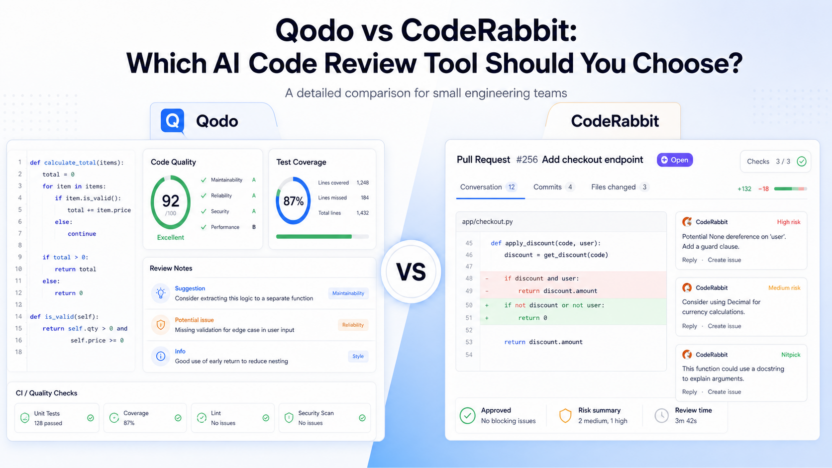
Qodo and CodeRabbit both help software teams review code faster, but they fit different buying decisions. CodeRabbit is the cleaner choice for teams that want an AI code reviewer focused on pull requests, repository review, IDE review, and command-line review workflows. Qodo is broader: it positions itself around code quality, agentic code review, testing, and quality intelligence across the development workflow.
Choose CodeRabbit if your main need is faster pull request review with clear repository coverage and straightforward per-developer pricing. Choose Qodo if your team wants AI review plus quality and testing workflows around code changes. Pricing last checked on July 19, 2026. CodeRabbit's official pricing page lists Pro at $24 per developer per month when billed annually, or $30 month to month. Qodo's official pricing page describes a credit-based Pro Team model at $0.012 per credit, with example monthly review volumes based on credit bundles, plus a 14-day free trial.
Related Dailytimespro reading:
- Best AI Sales Prospecting Tools
- Best AI Workflow Automation Tools
- Best AI Content Optimization Tools
- Best AI Customer Support Tools
Best For
CodeRabbit is best for engineering teams that want an AI reviewer directly in the pull request process. It is especially useful when reviewers need help with summaries, change-risk notes, issue detection, and review comments before a human maintainer approves the merge.
Qodo is best for teams that think code review should connect with code quality and test generation. It can make sense when the team wants review help but also wants better coverage around how code changes are validated.
Not Best For
Neither tool is a replacement for a senior reviewer, security review, architecture review, or release approval process. Small teams should also avoid adding AI review if they do not already have clear branch rules, ownership, and a definition of what must be reviewed by a person.
Our Evaluation Criteria
We evaluated Qodo and CodeRabbit by review quality, setup effort, repository workflow fit, pricing clarity, integration depth, review controls, developer experience, and value for small teams. For this category, the strongest product is not the tool that writes the longest review. It is the tool that helps reviewers focus on meaningful risks without flooding the pull request with low-value comments.
Key Features
CodeRabbit
CodeRabbit's official materials focus on AI code review across pull requests, IDE workflows, and command-line usage. For small teams, the practical advantage is that review support can happen where developers already work. A team does not need to create a separate meeting or separate quality checklist for every small change.
Useful CodeRabbit workflows include summarizing pull requests for reviewers, flagging suspicious logic changes, checking consistency with nearby code, asking follow-up questions in review threads, and helping the author understand review feedback. The best setup is still human-led: maintainers decide which comments matter and which changes are safe to merge.
Qodo
Qodo's official product material presents a broader quality platform, including code review and testing-oriented workflows. Its code review documentation describes agentic review designed to reason through changes rather than only search for simple style issues. For teams with frequent production changes, the link between review and quality validation can be valuable.
A SaaS team could use Qodo to review pull requests, improve test coverage around risky changes, and build a stronger habit of asking whether code is merely changed or actually verified. That is useful when a small team has many product changes and limited reviewer time.
Pricing
Pricing last checked on July 19, 2026.
| Tool | Official pricing note | Best-fit context |
|---|---|---|
| CodeRabbit | Pro is listed at $24/developer/month billed annually or $30 month to month | Teams that want predictable per-developer AI review pricing |
| Qodo | Pro Team is credit based at $0.012 per credit, with example review-volume bundles and a 14-day free trial | Teams that want review plus broader quality workflows |
| Graphite | Official site presents AI code review and a free first 30 days path | Teams comparing AI review with stacked PR workflows |
| Snyk DeepCode AI | Snyk publishes security plans starting from $25/month for paid AppSec paths | Teams prioritizing security findings over general PR review |
Review pricing should be compared against developer count, pull request volume, repository count, review depth, and whether the AI tool is used by every contributor or only maintainers.
Real Use Cases
First-Pass Pull Request Review
In a typical small engineering workflow, a developer opens a pull request and waits for another teammate to understand the change. AI review can summarize what changed, point out files that deserve attention, and surface possible regressions before the human reviewer starts. This does not remove human approval, but it can reduce the time spent reconstructing context.
Risk Notes for Busy Maintainers
A maintainer reviewing ten small pull requests in a day may miss a subtle edge case. AI review can help by highlighting risky condition changes, altered error handling, missing test coverage, or changed data assumptions. The maintainer still decides whether the risk is real.
Author Feedback Before Review
AI review is useful before a teammate is pulled in. Authors can fix obvious issues, add tests, or clarify the description before requesting review. This improves the quality of the human review because the reviewer spends less time on basic cleanup.
Better Test Conversations
Qodo is particularly relevant when the review discussion needs to connect with tests. A team can use AI feedback to ask whether the change needs unit tests, integration tests, or a manual QA note. That makes review more practical than a generic style pass.
Comparison Table
| Decision point | Qodo | CodeRabbit |
|---|---|---|
| Main fit | Code quality and AI review workflows | Pull request and developer review workflows |
| Pricing style | Credit based Pro Team pricing | Per-developer pricing for Pro |
| Best buyer | Teams connecting review with quality validation | Teams wanting a focused AI PR reviewer |
| Setup question | How will credits map to review volume? | Which repositories and developers need coverage? |
| Human review need | Still required | Still required |
Pros and Cons
Qodo Pros
- Broader quality angle around review and testing.
- Useful when code review is tied to validation and test coverage.
- Can fit teams that want more than pull request comments.
Qodo Cons
- Credit-based pricing needs volume planning.
- Broader platform scope may require more setup decisions.
- Teams only needing basic PR summaries may prefer a narrower product.
CodeRabbit Pros
- Clear fit for pull request review workflows.
- Public Pro pricing is straightforward to understand.
- Useful for teams that want review help inside developer workflow.
CodeRabbit Cons
- General code review still needs human judgment.
- Teams with deep test-quality needs may want broader quality tooling.
- Review noise must be managed with repository rules and reviewer habits.
Alternatives
| Alternative | Best for | Main strength | Limitation |
|---|---|---|---|
| Graphite | Teams using stacked pull requests | Review workflow and PR velocity | May be broader than AI review alone |
| Snyk DeepCode AI | Security-focused code analysis | AppSec and vulnerability context | Not a general human review replacement |
| GitHub Copilot code review | GitHub-native teams | Convenience in GitHub workflows | Fit depends on GitHub plan and team process |
How to Run a Responsible Pilot
Start with one repeated workflow, one owner, and one review rule. For AI code review, define where the work starts, what source material the AI can use, who reviews the output, and what system receives the final result. A useful pilot includes normal cases, incomplete inputs, edge cases, and one situation that should be escalated to a person.
Measure cleanup time, not only draft speed. The practical question is whether the approved result takes less effort after review. Track whether the tool reduced missed follow-ups, shortened review cycles, improved handoffs, created clearer reporting, or helped the team produce a more consistent result.
Keep permissions narrow during the pilot. Connect only the repositories, documents, tickets, call records, survey files, website data, or CRM records required for the first use case. If the tool touches customer data, code, contracts, support conversations, or internal notes, document who can see prompts, outputs, logs, and connected records.
At the end of the pilot, choose one of three outcomes. Adopt the workflow if it produces cleaner approved work. Revise it if prompts, permissions, data sources, or handoff rules need more structure. Stop it if cleanup time cancels the benefit or the team avoids using the process.
Buying Decision Details for Small Teams
The safest way to evaluate Qodo vs CodeRabbit is to start from the workflow, not from the feature page. Write down the repeated task the team wants to improve, the person who owns the task, the source information the tool will use, and the final output that must be approved. This keeps the buying decision grounded in work that already happens instead of a broad promise that sounds useful but is hard to measure.
For a small business, the first question is whether the tool removes friction from a high-frequency process. A tool that saves ten minutes on a task done twice a year is less valuable than a tool that saves five minutes on a task done every business day. This matters in AI Coding Tools because teams often buy software after seeing an impressive demo, then discover that setup, data cleanup, approvals, and user habits determine most of the value.
The second question is whether the tool fits existing systems. If your team already works in a CRM, help desk, repository, calendar, survey platform, document workspace, or publishing workflow, the tool should reduce handoff work. If it creates another isolated dashboard, adoption will usually be weaker. A practical implementation should make it clear where work starts, where the AI assists, when a person reviews the result, and where the approved output is stored.
The third question is whether pricing scales with real usage. Seat-based plans, credit-based plans, resolved-conversation pricing, annual contracts, API usage, and sales-led packages can all be reasonable, but they need different budget checks. Before buying, estimate monthly volume, required users, required integrations, review time, and the cost of mistakes. The cheapest plan is not always the best plan if it lacks the workflow control that keeps work reliable.
Setup Checklist
| Setup area | What to decide before rollout |
|---|---|
| Workflow owner | Who configures the tool, checks output quality, and decides whether to expand usage |
| Source material | Which repositories, documents, pages, tickets, chats, calls, survey answers, or CRM fields the tool can use |
| Review rule | What the AI may draft or suggest, and what a person must approve |
| Handoff | Where approved work goes after the AI step |
| Measurement | How the team will judge value after two to four weeks |
| Permissions | Which users can see source data, AI output, logs, and connected records |
| Pricing trigger | Which usage level, seat count, credit level, or contract threshold changes the monthly cost |
Common Buying Mistakes
The most common mistake is buying for a broad category instead of a specific workflow. A team may say it wants AI for productivity, lead capture, translation, support, code review, or feedback analysis, but that is not yet a buying requirement. A usable requirement is narrower: qualify website visitors before a sales call, summarize pull requests before maintainer review, translate support replies with human approval, or group survey comments into themes for a monthly product meeting.
Another mistake is treating AI output as the result instead of the starting point for review. The best tools in this category make people faster and more consistent, but they do not remove accountability. A small team should still define what good output looks like, what information must be checked, and which situations require escalation.
A third mistake is ignoring the operating cost. Even when subscription pricing looks acceptable, the team may need time for setup, prompt refinement, data cleanup, workflow mapping, training, and review. That cost is normal, but it should be planned. If the team has no owner for setup, even a strong product can become shelfware.
What Good Looks Like After 30 Days
After 30 days, the team should be able to point to a concrete improvement. For Qodo vs CodeRabbit: Which AI Code Review Tool Should You Choose?, good outcomes could include faster review cycles, cleaner handoffs, fewer missed follow-ups, better insight summaries, more consistent customer responses, stronger documentation updates, or reduced manual sorting. The metric should match the workflow, not the marketing category.
The team should also know where the tool is not useful. This is an important sign of a mature pilot. If users can explain which tasks still need human judgment, which inputs create weak results, and which cases should be escalated, the workflow is safer and easier to improve. If everyone treats the output as automatically correct, the process needs more control before it expands.
Finally, the tool should have a clear place in the stack. It should not duplicate another subscription without a reason. If two tools cover the same workflow, decide which one owns the process and which one should be removed or kept for a different job. Small teams benefit from fewer, better-defined systems.
Final Recommendation
Choose CodeRabbit if you want a focused AI pull request reviewer with clear per-developer pricing. Choose Qodo if code review is part of a wider quality program that includes testing and validation. For most small engineering teams, the better choice is the one that improves review discipline without encouraging people to merge code just because an AI comment looks confident.
FAQs
Is Qodo better than CodeRabbit?
Qodo is better when review needs to connect with broader code quality and testing workflows. CodeRabbit is better when the team wants focused AI pull request review.
Can AI code review replace human reviewers?
No. AI review can summarize changes and flag potential issues, but maintainers still need to approve architecture, security, product behavior, and release risk.
Which tool has clearer pricing?
CodeRabbit is easier to estimate by developer seat. Qodo requires estimating credits and review volume.
What should small teams pilot first?
Start with one repository and one pull request workflow. Track cleanup time, useful comments, missed issues, and reviewer satisfaction.
Should security review use these tools only?
No. Security-sensitive repositories should still use security review, dependency scanning, secrets scanning, and human review for risky changes.