AI can make competitive pricing analysis faster by collecting public price changes, matching comparable products, identifying patterns, summarizing promotions, and producing decision-ready reports. The useful outcome is not an automatic command to undercut every competitor. It is a repeatable system that combines reliable market data with your own costs, margins, inventory, positioning, and pricing rules.
Quick answer: start with a narrow list of comparable products and competitors, collect prices on a defined schedule, normalize the data, use AI to flag meaningful changes and explain patterns, then require a person to approve any price action. Browse AI is useful for no-code public web monitoring, Price2Spy is purpose-built for ecommerce price monitoring, ChatGPT Business can help analyze structured exports and draft summaries, and Power BI can maintain a governed dashboard. Use only collection methods permitted by the target site, applicable contracts, and relevant law.
Best for: ecommerce retailers, brands monitoring reseller prices, subscription businesses comparing public plans, category managers, and small teams that repeatedly check competitor prices.
Not best for: a business with no clear product matching, unreliable cost data, highly negotiated private pricing, regulated price-setting decisions without expert review, or a team expecting AI to determine strategy without commercial context.
AI Competitive Pricing Tool Stack at a Glance
| Tool | Best role | Main strength | Main limitation |
|---|---|---|---|
| Browse AI | No-code public price collection | Recorded robots, scheduled monitoring, structured extraction, and alerts | Credit usage and website changes can affect reliability and cost |
| Price2Spy | Dedicated ecommerce price intelligence | Product matching, price history, alerts, marketplace monitoring, and repricing support | Setup and pricing depend on catalog, URLs, frequency, and required features |
| ChatGPT Business | Analysis and reporting | Works with tables and business context to summarize changes and scenarios | Output depends on clean data and explicit instructions; it is not a price source |
| Power BI | Dashboard and governance | Repeatable models, filters, historical trends, sharing, and scheduled reporting | Requires data preparation and licensing for collaboration |
Pricing was last checked on October 7, 2026 from official vendor pages. Prices may vary by billing cycle, credits, monitored websites, users, product URLs, frequency, add-ons, and negotiated services.
What Is Competitive Pricing Analysis?
Competitive pricing analysis compares your prices and offers with relevant alternatives in the market. It may track list price, promotional price, shipping, availability, bundles, subscription terms, discounts, product variation, and the time and frequency of changes.
The word relevant matters. A premium product should not be treated as directly comparable with a stripped-down alternative merely because the category name matches. A subscription advertised monthly but billed annually is not equivalent to a true month-to-month plan. A marketplace seller with no stock should not drive an emergency price cut.
AI can help with repetitive work:
- extracting or importing public price data;
- matching product titles and variants;
- normalizing currencies, billing periods, and units;
- detecting price changes and promotions;
- grouping competitors by market position;
- summarizing trends and exceptions;
- drafting reports for sales, marketing, finance, and category teams.
It cannot know your minimum acceptable margin, contractual restrictions, strategic positioning, or inventory risk unless those rules are supplied and kept current.
Evaluation Criteria for a Pricing Workflow
A useful workflow should be evaluated on more than the number of pages it can scrape:
- Data accuracy: prices, currencies, variants, availability, and timestamps are captured correctly.
- Product matching: comparable products, packs, specifications, and subscription terms are aligned.
- Collection reliability: monitoring continues when layouts change and failures are visible.
- Analysis quality: alerts distinguish important movements from routine noise.
- Commercial context: cost, margin, stock, positioning, demand, and policy rules are included.
- Traceability: every recommendation links back to a source record and calculation.
- Governance: collection, storage, access, review, and approvals have clear owners.
- Total cost: credits, URLs, frequency, users, integrations, and maintenance are understood.
Step 1: Define the Decision Before Collecting Data
Do not begin by scraping every competitor page. Define what the business will decide from the analysis.
Examples include:
- whether to match a promotion on a group of high-traffic products;
- where a brand's products are being advertised below a stated policy;
- which subscription competitor has changed plan packaging;
- whether a category is moving toward bundles rather than discounts;
- which products are priced above the market without a clear value difference;
- where low stock at competitors creates room to protect margin.
Write the decision, owner, review frequency, and acceptable actions. A daily operational process needs different data from a quarterly strategy review.
Step 2: Build a Clean Competitor and Product List
Create a controlled list of competitors rather than relying on whatever appears first in search. Separate direct competitors, premium alternatives, low-cost substitutes, marketplaces, and resellers.
For each product or plan, store matching fields such as:
- internal SKU or plan ID;
- brand and exact model;
- size, color, storage, pack quantity, or service tier;
- billing period and commitment;
- included features or usage allowance;
- currency, tax treatment, and shipping;
- competitor URL and source type;
- confidence that the match is genuinely comparable.
AI can suggest matches from titles and descriptions, but a person should approve ambiguous mappings. A wrong product match creates a convincing but useless comparison.
Step 3: Collect Prices Responsibly
Use an official API, vendor feed, partner data source, or licensed pricing platform when available. For public web pages, review the site's terms, robots guidance, rate limits, authentication rules, and applicable law before automating collection. Do not bypass access controls or collect private account data.
Browse AI for no-code monitoring
Browse AI lets a user record a robot that extracts structured data or monitors a webpage. A small retailer could train robots on a limited set of public product pages, schedule checks, and send results to a spreadsheet or integration.
Its official pricing page lists a Free plan, Personal at $48 per month or $19 per month billed annually, Professional at $87 per month or $69 per month billed annually, and Premium starting at $500 per month billed annually. Credits depend on rows, detail pages, screenshots, and whether a website requires premium processing. Model expected runs before choosing a plan.
Price2Spy for dedicated price monitoring
Price2Spy is built specifically for product price monitoring, history, market reports, alerts, marketplace tracking, MAP monitoring, integrations, and repricing workflows. Its Starter tier targets simpler self-service monitoring, while Basic and Premium add deeper features such as marketplace monitoring, historical reports, API access, additional data, user management, and custom reports.
Price2Spy offers a 14-day trial without upfront payment information. The official pages reviewed describe tier capabilities but direct buyers to plan selection and account management rather than presenting one universal price for every catalog. Request a quote based on monitored URLs, competitors, check frequency, marketplaces, support, matching, reports, API access, and add-ons.
Step 4: Normalize the Data Before Using AI
Raw price rows are rarely comparable. Create calculated fields for:
- price before and after tax;
- shipping and mandatory fees;
- per-unit or per-seat cost;
- monthly equivalent for annual plans;
- promotional start and end date;
- coupon or membership requirement;
- stock status;
- last successful observation;
- currency conversion rate and date;
- product-match confidence.
Keep the original observed value beside the normalized value. This preserves an audit trail and makes errors easier to diagnose.
For SaaS pricing, distinguish list price from estimated total cost. A $20 seat may exclude minimum seats, usage credits, onboarding, or required add-ons. For retail, a lower displayed price may have higher shipping or an unavailable variant.
Step 5: Use AI to Find Changes and Explain Patterns
Once the table is clean, AI can assist with analysis. Give it explicit definitions and request evidence for every conclusion.
Useful analysis tasks include:
- rank products by percentage price gap against a defined competitor set;
- detect changes beyond a material threshold;
- separate temporary promotions from persistent price moves;
- identify products where competitors are out of stock;
- summarize which competitors lead or follow price changes;
- group plan changes by price, allowance, feature, or billing term;
- draft questions for a category manager to investigate.
A good prompt names the columns, time period, thresholds, and output format. For example: identify price changes over 5% in the last seven days, exclude low-confidence matches and out-of-stock sellers, calculate the current gross margin if our price matched the median, and cite the row ID for every finding.
ChatGPT Business for table analysis
ChatGPT Business can work with uploaded tables, create interactive analysis, and help teams summarize scenarios inside a managed workspace. Official pricing lists a Standard seat at $25 per user monthly or $20 billed annually, and a Premium seat at $125 monthly or $100 billed annually. A Business workspace requires at least two paid seats.
Do not upload data that the organization is not permitted to process. Remove unnecessary customer or supplier information, use approved workspace settings, and have a pricing owner verify calculations and source rows.
Step 6: Add Your Own Margin and Positioning Rules
Competitor data becomes useful only after it is combined with internal constraints. Add:
- unit or service cost;
- payment and fulfillment cost;
- minimum gross margin;
- inventory level and aging;
- demand or conversion trend;
- brand position;
- contractual or advertised-price rules;
- promotion budget;
- approval threshold.
Create decision bands instead of one automatic response. A green band might require no action, amber might trigger review, and red might require urgent investigation. A competitor price cut should not automatically create a matching cut if it would breach margin or weaken premium positioning.
For a broader market workflow that includes messaging, content, and positioning as well as price, see our AI competitor analysis workflow.
Step 7: Build a Review Dashboard
A useful dashboard should answer a small set of recurring questions:
- Which prices changed since the last review?
- Which changes are materially above the threshold?
- Where are we cheapest, median, or most expensive?
- Which competitors are out of stock?
- What is the projected margin under each scenario?
- Which records failed collection or have low match confidence?
- Which actions are awaiting approval?
Power BI can combine current observations with history, internal costs, inventory, and approvals. Microsoft's official page lists a free account, Power BI Pro at $14 per user per month paid yearly, and Power BI Premium Per User at $24 per user per month paid yearly. Sharing normally requires appropriate licenses or capacity.
Our Power BI pricing guide explains the licensing choices in more detail. Small teams can begin with a governed spreadsheet and move to BI software when history, refresh, access control, and cross-team reporting become difficult.
Step 8: Require Human Approval and Record Outcomes
AI should produce a recommendation packet, not silently change prices. The packet should contain:
- source URL or record ID;
- observation time;
- old and new competitor prices;
- normalized comparison;
- stock and promotion context;
- your current cost and margin;
- suggested options rather than one forced answer;
- confidence and data-quality warnings;
- named approver and final decision.
After the decision, record the outcome. Did conversion improve? Did margin fall? Did the competitor revert the promotion? Did stock sell through? This feedback prevents the workflow from optimizing only for relative price position.
Practical Use Cases
Ecommerce promotion monitoring
A retailer could monitor 100 high-traffic products across five direct competitors, flag price changes over 5%, exclude out-of-stock offers, and give category managers a morning exception list rather than thousands of rows.
Brand and reseller monitoring
A manufacturer could track advertised prices from authorized resellers, identify potential policy exceptions, and route evidence for review. Legal and channel teams should define what constitutes a violation and the permitted response.
SaaS plan comparison
A SaaS company could track public plan prices, billing periods, usage limits, included features, and add-ons. AI can summarize packaging changes, but a person should verify that plan names and entitlements remain comparable.
Local service benchmarking
A service business could compare publicly listed packages and fees in its region. It should focus on offer structure and value communication, not assume that every competitor serves the same customers or quality level.
Marketplace inventory and price signals
An ecommerce team could combine price and availability to avoid reacting to a seller that cannot fulfill orders. Stock context often matters as much as the lowest observed price.
Pros and Cons of AI Pricing Analysis
Pros
- Reduces repetitive manual page checks and spreadsheet updates.
- Creates a consistent history of market changes.
- Helps teams focus on material exceptions.
- Can normalize billing periods, units, and currencies.
- Produces faster summaries for category, finance, and leadership reviews.
- Supports scenario analysis when internal cost and margin data are included.
Cons
- Product matching and extraction errors can mislead the analysis.
- Website layouts, bot protections, and terms can limit collection.
- Credit-based monitoring costs rise with frequency and detail pages.
- AI may overstate patterns or ignore commercial context.
- Automatic repricing can start destructive price competition.
- Governance, review, and maintenance remain ongoing work.
Tool Alternatives
| Need | Primary option | Alternative | When the alternative fits better |
|---|---|---|---|
| No-code public monitoring | Browse AI | Apify | A technical team needs scalable actors, APIs, and custom extraction |
| Dedicated ecommerce pricing | Price2Spy | Prisync | A retailer wants a different packaged monitoring and repricing workflow |
| AI analysis | ChatGPT Business | Microsoft Copilot | The team already works primarily in Microsoft 365 and approved data stays there |
| Dashboards | Power BI | Looker Studio | Basic reporting can use Google-connected data and lighter sharing needs |
Choose the smallest stack that produces reliable decisions. A dedicated pricing platform may replace a scraper, spreadsheet, and part of the reporting layer. A custom stack provides flexibility but increases maintenance and ownership requirements.
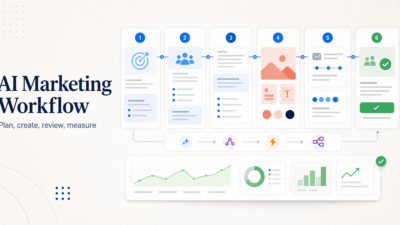
For teams already building repeatable marketing operations, our AI marketing workflow for small business shows how research can connect with planning and execution. Ecommerce teams can also improve the content layer with the best AI product description generators.
Final Recommendation
Use AI for competitive pricing analysis as an exception-management and decision-support system. Start with a small set of important products, verify every match, collect only permitted public data, preserve source records, and combine market prices with margin, inventory, demand, and positioning.
Browse AI is a practical no-code collector for a limited public monitoring project. Price2Spy is the stronger choice when ecommerce price intelligence is a core ongoing process. ChatGPT Business can accelerate structured analysis and reporting, while Power BI provides a governed history and dashboard. None of these tools should replace pricing ownership or approval.
FAQs
Can AI monitor competitor prices automatically?
Yes. Monitoring tools can check permitted public pages or approved data sources on a schedule and record changes. Reliability depends on page structure, matching, limits, and compliance with source rules.
Is competitor price scraping legal?
The answer depends on the source, access method, terms, contracts, location, and data involved. Use official APIs or licensed sources where possible and obtain legal guidance for the intended collection.
Should AI automatically match a competitor's lowest price?
No. A lower price may involve a different product, unavailable stock, temporary promotion, lower service level, or margin below your threshold. Require human review and internal rules.
What data should a pricing comparison include?
Include exact product or plan, price, currency, tax, shipping, billing period, pack size, availability, promotion terms, source URL, timestamp, and match confidence.
How often should competitor prices be checked?
Match frequency to market speed and decision value. Fast-moving ecommerce categories may need daily checks; stable service or SaaS pricing may need weekly or monthly review.
Which AI tool is best for competitive pricing analysis?
Price2Spy is purpose-built for ecommerce price intelligence. Browse AI is useful for flexible no-code collection, ChatGPT Business for analysis, and Power BI for governed reporting.
How can a small business start cheaply?
Begin with five to ten important products, a few direct competitors, a weekly schedule, and a governed spreadsheet. Validate the workflow before increasing pages or frequency.
What is the biggest risk in AI pricing analysis?
The biggest risk is acting on inaccurate or incomparable data. Product matching, source reliability, margin context, and human approval are more important than sophisticated summaries.