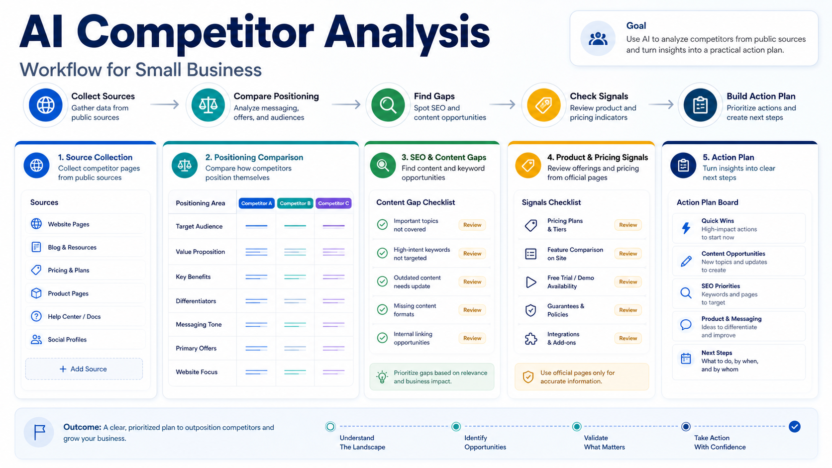
AI can make competitor analysis faster, but it can also make it sloppy if the workflow is not controlled. The goal is not to ask a chatbot to "analyze my competitors" and accept a confident summary. The goal is to collect public source material, compare it consistently, separate facts from assumptions, and turn the findings into better positioning, content, offers, and sales messaging.
This workflow is built for small businesses, marketers, agencies, and founders who want a practical, source-led way to use AI for better positioning, content, offers, and sales messaging.
Quick Answer
To use AI for competitor analysis, collect source URLs first, then ask AI to summarize each competitor using only those sources. Compare positioning, product pages, pricing signals, SEO content, customer pain points, social messaging, and offer structure. Then turn the findings into a short action plan: what to improve, what to avoid, what content to create, and what message your business should test next.
The safest workflow is source-led. AI should help you organize and compare evidence. It should not become the evidence.
What You Need Before Starting
You need a short list of competitors, a clear business goal, and a place to store findings. A simple spreadsheet or document is enough.
Useful tools can include ChatGPT, Perplexity, Semrush, Similarweb, and SparkToro. You do not need all of them. Start with the tools your team already has access to.
Pricing last checked on June 21, 2026. Pricing may vary based on plan, usage, or add-ons; use each official product page for current plan details.
Step 1: Define The Competitor Set
Start with three to five competitors. Include one direct competitor, one larger brand your customers know, one lower-cost alternative, and one company with strong content or messaging.
Do not let AI invent the competitor list unless you manually verify each company. A better prompt is:
“`text I will provide competitor URLs. Use only these URLs and the pasted page text. Do not add extra competitors unless I ask. “`
For a local service business, this could mean nearby companies targeting the same city. For a SaaS team, it could mean companies solving the same job for the same user type.
Step 2: Collect Source Material
For each competitor, collect public pages such as:
- homepage
- product or service page
- pricing page
- features page
- comparison or alternatives page
- FAQ page
- case study page, only if it is real and public
- blog category or top articles
Copy the page title, URL, and the relevant text into your research document. If you use Perplexity or another answer engine, ask it to provide source links and verify that the links are real before relying on the summary.
The important rule is simple: AI should summarize what is present in the source material. If the source does not mention a feature, price, customer type, or result, do not treat it as fact.
Step 3: Build A Positioning Snapshot
Ask AI to summarize each competitor in the same format:
| Field | What To Capture |
|---|---|
| Primary audience | Who the competitor appears to target |
| Main promise | The core outcome or benefit on the homepage |
| Product category | How the competitor describes itself |
| Proof points | Public proof shown on the site |
| Main offer | Trial, demo, plan, service package, or consultation |
| Pricing signal | Free plan, starting price, custom pricing, or no public pricing |
| Weakness or gap | Only source-supported observations |
This gives you a consistent comparison instead of six unrelated AI summaries. It also helps you spot positioning gaps. For example, if every competitor talks about automation but none talks clearly about onboarding support, that may be an angle to explore.
Step 4: Compare Product And Pricing Signals
Pricing is high-risk information, so treat it carefully. Only use official pricing pages, checkout pages, or official product pages when capturing pricing facts.
Create a simple pricing signal table:
| Competitor | Pricing Signal | Source |
|---|---|---|
| Competitor A | Public starting price, free plan, trial, or custom quote | Official pricing URL |
| Competitor B | Public starting price, free plan, trial, or custom quote | Official pricing URL |
| Competitor C | Public starting price, free plan, trial, or custom quote | Official pricing URL |
AI can help summarize plan differences, but it should not guess what is not visible. If pricing is custom or unclear, say that internally and move on. Do not turn uncertainty into a fake price.
Step 5: Analyze SEO And Content Gaps
Competitor analysis should not stop at homepages. Look at what competitors publish and what they ignore.
Use an SEO tool if you have one. Semrush, Similarweb, Ahrefs, and other SEO platforms can help with traffic estimates, top pages, keyword gaps, and content opportunities. If you do not have a paid tool, you can still collect blog categories, page titles, and topic patterns manually.
Ask AI to group competitor content into themes:
- buying guides
- comparison posts
- pricing pages
- how-to articles
- templates or checklists
- customer stories
- integration pages
- local landing pages
Then ask:
“`text Based only on these page titles and URLs, what topics are competitors covering repeatedly, and what useful topics are missing for a small business audience? “`
This is especially useful if your team is planning content. You may discover that competitors publish many broad guides but few practical workflows, or that everyone compares tools but no one explains implementation.
If you are improving your SEO workflow, our AI SEO content brief workflow can help turn these gaps into writer-ready briefs.
Step 6: Review Messaging And Offers
Next, compare how competitors talk to customers. Look at headlines, calls to action, product benefits, objections, and guarantees.
A useful AI prompt is:
“`text Compare these competitor homepage messages. Use only the pasted source text. Identify repeated claims, clear differentiators, vague claims, and opportunities for a small business to position itself more clearly. “`
Do not ask AI which message is "best" without criteria. Instead, evaluate:
- Is the promise specific?
- Is the target customer clear?
- Is the offer easy to understand?
- Is pricing or next step visible?
- Does the page answer common objections?
- Is there proof, documentation, or support information?
For a SaaS team, this might reveal that competitors focus heavily on enterprise buyers while small teams need simpler onboarding. For a local business, it might show that everyone says "trusted service" but no one explains speed, pricing, or guarantee clearly.
Step 7: Extract Customer Pain Points Carefully
Customer pain points are useful, but they are also easy to fake. Do not invent quotes. Do not claim "customers say" unless you have real public review data and cite the source internally.
A safer approach is to collect public review themes from trusted review platforms, support forums, product FAQs, or competitor documentation. Then summarize repeated themes as labeled observations, not as facts about all customers.
Use language like:
- "Public reviews often mention…"
- "A repeated support theme appears to be…"
- "Competitor documentation suggests users may need help with…"
For internal planning, this can help you improve FAQs, onboarding, comparison pages, and sales scripts.
Step 8: Create A Competitor Matrix
Once the source material is organized, build a matrix like this:
| Area | Competitor A | Competitor B | Your Opportunity |
|---|---|---|---|
| Audience | Source-backed summary | Source-backed summary | Narrower or clearer target segment |
| Offer | Source-backed summary | Source-backed summary | Simpler package or stronger CTA |
| Pricing signal | Official source only | Official source only | More transparent plan or better explanation |
| Content gap | Topics covered | Topics covered | Useful missing guide or comparison |
| Objections | Public FAQ/support themes | Public FAQ/support themes | Better FAQ, demo, proof, or onboarding |
This turns AI summaries into a decision tool. It also prevents a common mistake: collecting research but never deciding what to change.
Step 9: Turn Findings Into Actions
End the workflow with a short action plan:
1. Update one homepage section. 2. Improve one product or service page. 3. Write one missing comparison or buyer guide. 4. Add one pricing or FAQ clarification. 5. Test one stronger call to action. 6. Create one sales enablement note for common objections.
Keep the action list small. A competitor analysis that creates 50 tasks usually creates no movement. A good AI-assisted analysis should produce a few useful changes your team can make this week.
If your competitor analysis leads to broader marketing changes, the AI marketing workflow for small business is a useful next read.
Common Mistakes To Avoid
The biggest mistake is letting AI invent confidence. If the model says a competitor targets a specific segment, ask which source supports that claim. If it cannot point to the source text, remove the claim.
Other mistakes include:
- comparing too many competitors at once
- mixing official facts with user opinions
- copying competitor messaging
- treating SEO estimates as exact numbers
- using old pricing screenshots
- ignoring your own customer needs
- ending with research instead of action
AI competitor analysis is not about copying. It is about finding clearer positioning and better customer answers.
Source Safety Checklist
Before you act on any AI-generated competitor insight, run a quick source check. Ask whether the claim came from an official page, a public review source, an SEO tool estimate, or the model's own inference. Official pages are best for product facts and pricing signals. Review platforms can show repeated customer language, but they should not be treated as proof that every buyer has the same problem. SEO tools can suggest demand and visibility patterns, but their numbers are estimates.
A useful internal rule is to label each finding as fact, pattern, estimate, or idea. Facts can support website copy and sales enablement. Patterns can guide content planning. Estimates can help prioritize research. Ideas should be tested before they become strategy. This small labeling step keeps the workflow honest and makes the final action plan easier to trust.
Final Recommendation
Use AI as a research assistant, not a market oracle. Give it source material, require structured comparisons, and force every claim back to a public source. Then use the findings to improve your website, content, pricing explanation, sales messaging, and product positioning.
For most small businesses, the best workflow is simple: collect sources, summarize competitors, compare positioning, find content gaps, capture pricing signals from official pages, identify repeated customer pain points carefully, and choose three actions. That is enough to make competitor analysis useful without turning it into fake research.
FAQs
Can AI do competitor analysis?
Yes, AI can help organize competitor research, summarize public pages, compare messaging, identify content gaps, and create action plans. It should not invent market data, pricing, customer quotes, or performance statistics.
What is the safest way to use AI for competitor research?
The safest method is source-led analysis. Provide competitor URLs and copied source text, then ask AI to summarize only what appears in those sources. Treat unsupported claims as assumptions, not facts.
Which tools are useful for AI competitor analysis?
ChatGPT and Perplexity can help summarize and compare sources. Semrush, Similarweb, SparkToro, Ahrefs, and other research tools can support SEO, audience, or traffic analysis depending on your budget and use case.
Can AI compare competitor pricing?
AI can summarize pricing only when the source is official and current. Use official pricing pages, official product pages, or checkout pages. Do not use random screenshots, outdated articles, or guessed pricing.
How many competitors should I analyze?
Start with three to five competitors. More than that can become noisy. Choose direct competitors, larger category leaders, lower-cost alternatives, and companies with strong content or messaging.
Should I copy competitor content?
No. Competitor analysis should help you understand gaps and improve positioning. Copying competitors can make your site less distinctive and may create quality or originality problems.
How often should small businesses run competitor analysis?
Quarterly is enough for many small businesses. Run it sooner when launching a new offer, entering a new market, updating pricing, rebuilding a website, or planning a content strategy.
What should the final output be?
The final output should be a short action plan, not a giant report. Aim for three to six practical changes such as a new page, better FAQ, clearer pricing explanation, stronger CTA, or content gap to fill.