Intercom is powerful, especially for chat-first support and AI self-service, but it is not the right fit for every small business. Some teams need a deeper help desk. Some want a simpler shared inbox. Ecommerce teams may care more about live chat and store questions. Other companies need customer support connected to a CRM or an existing business suite.
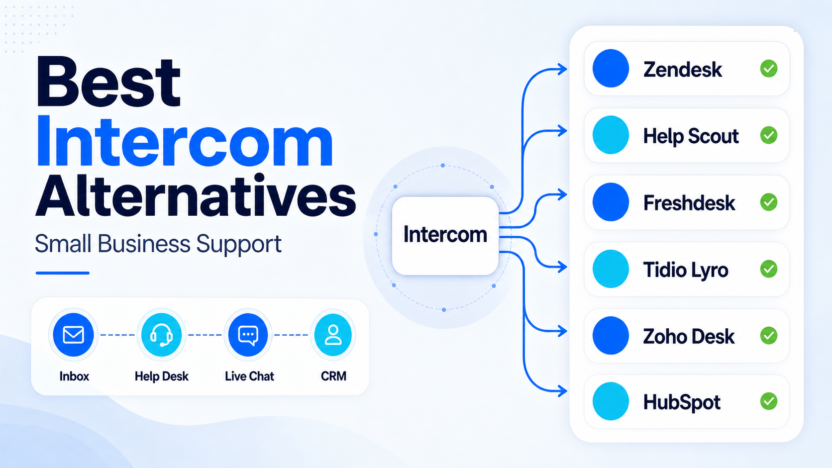
The best Intercom alternative depends on why you are looking beyond Intercom in the first place. Choose Zendesk if your support operation needs more help desk depth. Choose Help Scout if you want a simpler shared inbox. Choose Freshdesk if budget-conscious ticketing is the priority. Choose Tidio Lyro if ecommerce chat is the main channel. Choose Zoho Desk if your company already uses Zoho. Choose HubSpot Service Hub if support needs to connect closely with CRM and sales data.
If you want to stay inside the Intercom ecosystem, read our Intercom Fin review first. If you are comparing the broader support category, our best AI customer support tools guide is the better overview.
Quick Comparison: Best Intercom Alternatives
| Alternative | Best For | Why Choose It Instead Of Intercom |
|---|---|---|
| Zendesk | Scaling support teams | Deeper ticketing, routing, analytics, and help desk operations |
| Help Scout | Simple human support | Cleaner shared inbox experience for small teams |
| Freshdesk | Budget-conscious ticketing | Practical ticketing and automation without overbuilding |
| Tidio Lyro | Ecommerce live chat | Focused website chat and AI answers for common store questions |
| Zoho Desk | Zoho ecosystem teams | Help desk support connected to other Zoho products |
| HubSpot Service Hub | CRM-connected support | Support, customer data, and sales context in one CRM ecosystem |
Why Look For An Intercom Alternative?
Intercom is strongest when a team wants customer messaging, AI support, and chat-first support in one product. But not every business needs that exact shape.
Common reasons teams compare alternatives include:
- they want more traditional ticketing depth
- they prefer a simpler email-first inbox
- they need a lower-complexity setup
- ecommerce chat matters more than SaaS support workflows
- the company already runs on Zoho or HubSpot
- pricing needs to match a smaller support team
- the team wants reporting, routing, or CRM features that fit a different stack
The right alternative should solve the reason you are leaving. Do not switch just because another tool has a longer feature list.
1. Zendesk: Best Intercom Alternative For Full Help Desk Depth
Zendesk is the strongest Intercom alternative when your support operation needs structure. It is built around tickets, routing, help center content, reporting, and customer service workflows.
Zendesk makes sense when support is no longer just a chat widget. If your team needs clear assignment rules, multiple queues, manager visibility, and more traditional help desk controls, Zendesk is often the safer long-term choice.
Choose Zendesk if:
- support volume is growing
- tickets need assignment and ownership
- reporting matters
- you need a mature help center setup
- customer service operations are becoming more formal
Avoid Zendesk if your team wants the lightest possible support inbox. A very small team may find it more than they need at the beginning.
2. Help Scout: Best Intercom Alternative For A Simple Shared Inbox
Help Scout is a better fit when your team values simplicity, personal support, and a calm shared inbox. It is useful for founders, agencies, service businesses, and small SaaS teams that do not want support software to become heavy.
Help Scout is less about turning support into a complex operations center and more about helping humans reply well. That makes it a strong Intercom alternative for email-first teams.
Choose Help Scout if:
- support mostly happens through email
- your team wants a clean shared inbox
- you need docs and customer context
- human tone matters more than automation depth
- setup speed is important
Avoid Help Scout if you need advanced routing, enterprise-style reporting, or a chat-first AI agent experience at the center of support.
3. Freshdesk: Best Intercom Alternative For Budget-Conscious Ticketing
Freshdesk is a practical alternative for teams that want a help desk without immediately choosing the heaviest enterprise option. It provides ticketing, automation, customer conversations, and Freshworks' broader support ecosystem.
Freshdesk is often a good middle path. It is more structured than a simple inbox, but it can be more approachable for teams that want ticketing and automation without overcomplicating the stack.
Choose Freshdesk if:
- you need ticket management
- automation would reduce repetitive work
- email and other channels need structure
- your team wants a help desk with room to grow
- budget is a serious consideration
Avoid Freshdesk if you want the most polished chat-first customer messaging interface or if your team is already committed to Intercom-style product messaging.
4. Tidio Lyro: Best Intercom Alternative For Ecommerce Chat
Tidio Lyro is the most focused alternative for ecommerce teams that care about website chat, common product questions, and fast answers for shoppers.
Where Intercom can be broader and more SaaS-oriented, Tidio is easier to understand as a chat and automation layer for online stores. Lyro is especially relevant when customers ask repeated questions about products, returns, delivery, discounts, or order status.
Choose Tidio Lyro if:
- website chat is the main support channel
- ecommerce questions repeat often
- your team wants a focused chat automation tool
- speed to setup matters
- you do not need a full enterprise help desk
Avoid Tidio Lyro if your support team needs deep ticket operations, complex SLAs, or a full help center-driven support platform.
5. Zoho Desk: Best Intercom Alternative For Zoho Users
Zoho Desk is the best Intercom alternative for teams already using Zoho products. It brings help desk operations into the Zoho ecosystem, with Zia AI available inside Zoho Desk for teams that want AI support assistance.
Zoho Desk is strongest when customer support should connect to broader business tools such as CRM, finance, and operations. It may not be the first choice for teams that want a pure chat-first product, but it is practical for companies already using Zoho.
Choose Zoho Desk if:
- your company already uses Zoho apps
- support should connect with CRM or operations
- you need ticketing and reporting
- you want AI assistance inside the Zoho ecosystem
- keeping tools under one vendor matters
Avoid Zoho Desk if your team does not use Zoho and wants a standalone support product with a more modern chat-first feel.
6. HubSpot Service Hub: Best Intercom Alternative For CRM-Connected Support
HubSpot Service Hub is a strong alternative when support needs to live close to marketing, sales, and CRM data. For small businesses already using HubSpot, this can make more sense than running customer support in a separate tool.
HubSpot Service Hub is useful when support conversations should inform renewals, sales follow-up, customer health, or account management. It is less focused on being an AI-agent-first support tool and more focused on connecting customer service with the CRM.
Choose HubSpot Service Hub if:
- your company already uses HubSpot CRM
- support and sales need shared customer context
- service data should connect with marketing or account management
- your team wants a CRM-centered service platform
Avoid HubSpot Service Hub if all you need is a focused chat support tool or a lightweight inbox.
Migration Checklist Before You Leave Intercom
Switching support tools is not only a software decision. Before moving away from Intercom, list what must be preserved: active conversations, help center articles, saved replies, customer tags, routing rules, inbox ownership, reports, and any automation that affects customers. If your team uses Intercom for product messages or onboarding, confirm whether the replacement covers those use cases or whether you need a separate customer messaging tool.
Also check how each alternative handles three practical areas. First, knowledge base migration: your help content should remain easy to update because AI support quality depends on clean source material. Second, handoff rules: customers should know when they are speaking with automation and when a human will reply. Third, reporting continuity: support leaders need a way to compare volume, response time, and unresolved conversations after the switch.
A small business should not move everything at once unless the current setup is truly broken. A safer path is to export key support content, pilot the new inbox with one channel, train agents on escalation rules, and only then redirect all customers. This reduces the chance that the team solves one software problem while creating a customer experience problem.
Intercom Alternatives By Team Type
For SaaS teams, Zendesk and HubSpot Service Hub are usually the most strategic alternatives because both can support more structured customer operations. For service businesses and agencies, Help Scout is often easier because it keeps the inbox clean and personal. For ecommerce stores, Tidio Lyro is more focused on chat and shopper questions. For operations-heavy businesses already using Zoho, Zoho Desk can reduce vendor sprawl.
The best alternative is the one that removes friction from your current support process. If your team struggles with ticket ownership, choose a stronger help desk. If your team struggles with inbox clutter, choose a simpler shared inbox. If your team struggles with store chat, choose a dedicated chat tool. If your team struggles with customer data scattered across sales and support, choose a CRM-connected option.
When You Should Stay With Intercom
Do not switch if Intercom is already solving your core support problem. If Fin is resolving useful conversations, your team likes the messaging workflow, and customers are getting fast answers, a new platform may create more disruption than value. Intercom remains a strong choice when chat-first support, product messaging, and AI self-service are central to the customer experience.
A switch makes more sense when the mismatch is clear: your agents need deeper ticket operations, your team wants a simpler inbox, your store needs focused ecommerce chat, or your support data needs to live inside another CRM ecosystem.
Which Intercom Alternative Should You Choose?
Use this decision path:
- Choose Zendesk if support operations are getting more complex.
- Choose Help Scout if you want simple, personal support without heavy setup.
- Choose Freshdesk if you want practical ticketing and automation with budget awareness.
- Choose Tidio Lyro if ecommerce live chat is the priority.
- Choose Zoho Desk if your company already uses Zoho.
- Choose HubSpot Service Hub if support should connect tightly to CRM data.
Stay with Intercom if customer messaging, chat-first support, and Fin's AI agent experience are exactly what your team wants.
Final Recommendation
The best Intercom alternative for most growing support teams is Zendesk because it gives the strongest help desk foundation. The best simple alternative is Help Scout. The best ecommerce chat alternative is Tidio Lyro. The best ecosystem alternatives are Zoho Desk for Zoho users and HubSpot Service Hub for HubSpot users.
Do not choose based on brand familiarity alone. Choose based on your support channel, team size, customer volume, documentation quality, and whether you need a chat-first AI support experience or a broader help desk.
FAQs
What is the best Intercom alternative for small business?
Zendesk is the strongest alternative for growing support teams, Help Scout is best for simple shared inbox support, and Tidio Lyro is best for ecommerce live chat. The right choice depends on your support channel and team size.
Is Zendesk better than Intercom?
Zendesk is usually better for deeper help desk operations, ticketing, routing, and reporting. Intercom is usually better for chat-first customer messaging and AI-agent-first support with Fin.
Is Help Scout a good Intercom alternative?
Help Scout is a good alternative for small teams that want simple, human-feeling support. It is not as chat-first as Intercom, but it can be easier for email-first teams to manage.
What is the best Intercom alternative for ecommerce?
Tidio Lyro is a strong ecommerce-focused alternative because it centers on live chat and AI answers for common store questions. Zendesk and Freshdesk can also work when ecommerce support needs deeper ticketing.
Which Intercom alternative works best with CRM data?
HubSpot Service Hub is the strongest choice if your company already uses HubSpot CRM. Zoho Desk is a strong fit if your company already works inside the Zoho ecosystem.
Should I replace Intercom if I already use Fin?
Not necessarily. If Fin is resolving useful support questions and your team likes Intercom's messaging workflow, staying with Intercom may be smarter than switching. Compare alternatives only if Intercom no longer fits your support process.
Are Intercom alternatives cheaper?
Some alternatives may fit smaller budgets better, but price depends on plan, users, channels, AI usage, and support volume. Choose based on the total support workflow, not only the entry price.
What should I check before switching from Intercom?
Check your current channels, ticket volume, help center quality, handoff needs, reporting requirements, CRM needs, and AI support goals. Then choose the alternative that fixes the actual problem rather than adding new complexity.