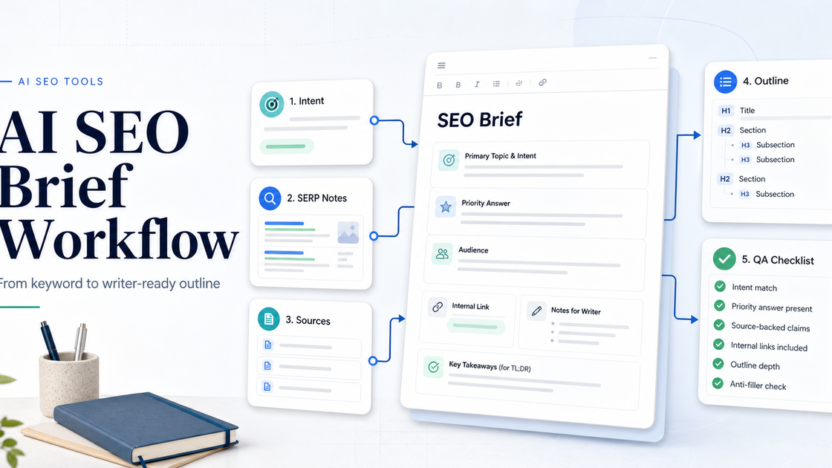
An AI SEO content brief workflow helps a team move from keyword idea to writer-ready brief without turning SEO into a checklist of random keywords. The goal is to define search intent, gather source-backed requirements, outline the answer the article must provide, check competitor patterns, add internal-link opportunities, and give the writer enough direction to create a useful article.
The best workflow uses AI to speed up research and structure, but it keeps editorial judgment in the loop. AI can suggest headings, questions, entities, and draft outlines. It should not decide the final angle alone. A strong SEO brief still needs a human to check intent, verify facts, remove filler, and decide what the reader needs first.
If your team is comparing SEO tools first, our Surfer SEO vs Frase comparison is the right next read. If the brief is part of a larger research process, see our AI research workflow for teams.
Quick Workflow Summary
| Step | Purpose | Output |
|---|---|---|
| 1. Confirm the keyword | Make sure the topic is worth briefing | Primary keyword and search intent |
| 2. Read the SERP | Understand what Google is rewarding | Content pattern notes |
| 3. Define the reader task | Clarify what the article must answer | Priority answer |
| 4. Collect source facts | Avoid unsupported claims | Source-backed notes |
| 5. Build the outline | Give the writer a useful path | H2 and H3 structure |
| 6. Add internal links | Connect related site content naturally | Link suggestions |
| 7. Create quality checks | Prevent generic AI content | Editorial checklist |
| 8. Review after draft | Improve the brief based on output | Updated process |
1. Confirm The Keyword And Intent
Start by confirming the keyword, not by writing headings. A keyword such as “AI SEO content brief workflow” implies a process-led article. The reader wants to know how to build the workflow, what steps belong in it, which tools help, and how to avoid weak AI-generated briefs.
Classify the intent before opening an AI tool:
- Tutorial or workflow
- Comparison
- Review
- Buyer guide
- Pricing
- Alternatives
- Troubleshooting
This matters because a workflow article should start with process and outcome. A comparison should start with verdict and tradeoffs. A buyer guide should start with recommendations. If the brief format does not match intent, the article feels wrong even if the keywords are present.
2. Read The SERP Without Copying It
An SEO brief should learn from top-ranking pages without copying their structure blindly. Look for repeated patterns:
- What problem does each page solve?
- What sections appear near the top?
- What questions are repeated?
- What examples or tables help the reader?
- What information is missing?
- Where do pages become thin or generic?
Google’s SEO Starter Guide emphasizes making content easier for search engines to crawl, index, and understand. A content brief should support that goal by making the article clear, structured, and useful for the reader.
Do not treat the SERP as a template library. The job is to understand expectations and find a better angle.
3. Define The Priority Answer
Every SEO brief should tell the writer what answer belongs near the top. This is where many AI-generated briefs fail. They list headings before defining the reader’s main job.
For a workflow article, the priority answer might be:
“An AI SEO content brief workflow should confirm search intent, analyze the SERP, collect source-backed facts, create a writer-ready outline, add internal links, and include quality checks before drafting begins.”
That answer should appear early in the article. The rest of the brief supports it.
4. Use SEO Tools For Research And Structure
Surfer’s Content Editor is designed to help with content research, outline creation, recommended entities and facts, and optimization progress. Surfer’s documentation also describes a Content Editor workflow that includes competitor exploration, questions, notes, outline work, and writing/optimization.
Frase positions itself as an SEO and GEO platform that researches markets, creates optimized content, tracks visibility across Google and AI search engines, and supports competitive research and content creation.
Semrush Content Toolkit combines AI writing capabilities with Semrush SEO data for content work. Semrush’s knowledge base also describes content workflows that move from idea to publication.
Use these tools to speed up research, but do not let any tool decide the article without review. SEO tools can reveal patterns. Editors decide what belongs in the final brief.
5. Build The Writer-Ready Outline
A writer-ready outline should include more than headings. Each section should explain what the writer must accomplish.
Good brief format:
- H2 title
- Purpose of the section
- Key points to cover
- Source notes
- Internal link opportunity
- Example or table idea
- What to avoid
For example:
| Section | Purpose | Writer Notes |
|---|---|---|
| Quick Workflow Summary | Answer the intent early | Include the full process in a table |
| Confirm Keyword And Intent | Prevent wrong article format | Explain intent types and priority answer |
| SERP Review | Use competitors responsibly | Learn patterns without copying |
| Source Facts | Keep claims safe | Use official sources for tools and SEO guidance |
| Quality Checks | Prevent generic AI output | Include human review and anti-filler checks |
This gives the writer direction without forcing a rigid template.
6. Add Source Requirements
AI can produce confident but unsupported claims. The brief should name which claims need sources before writing begins.
Source requirements may include:
- Official tool pages for features
- Official pricing pages if pricing is discussed
- Official documentation for platform limits
- Google Search Central for SEO principles
- Company help centers for product workflows
- Existing internal articles for related context
Do not ask writers to “add sources later.” The brief should identify source needs early so unsupported claims do not enter the draft.
7. Add Internal Link Opportunities
Internal links should be chosen before drafting, then inserted naturally where they help the reader. Do not add random internal links just to increase link count. A good internal link gives the reader a useful next step. It should fit the paragraph naturally, use a clean slug URL, and avoid repeated anchors.
8. Include An Anti-Filler Checklist
AI SEO briefs often become bloated. Add checks that prevent weak content:
- Does the article answer intent in the first 150 to 250 words?
- Does each section have a job?
- Are there unsupported tool claims?
- Are pricing claims verified or omitted?
- Are examples realistic without fake statistics?
- Are FAQs distinct?
- Is the conclusion specific?
- Are internal links natural?
- Are external links official where needed?
This checklist protects article quality before the draft reaches QA.
9. Draft, Review, And Improve The Brief
The brief should improve after the first draft. If the writer gets stuck, the brief may be too vague. If the draft repeats generic sections, the brief may need stronger section purposes. If the article misses the priority answer, the brief did not make the answer clear enough.
Review the draft against the brief:
- Did the writer answer the main intent early?
- Did the article use source-backed claims?
- Did the outline fit the topic?
- Did the article avoid generic AI phrasing?
- Did internal links fit naturally?
- Did the conclusion give a clear recommendation?
Then update the brief template so the next article is easier to write.
AI SEO Content Brief Template
Use this template:
1. Topic title 2. Primary keyword 3. Search intent 4. Priority answer 5. Target reader 6. Required sources 7. Tools mentioned 8. Suggested internal links 9. Recommended structure 10. Section-by-section notes 11. Examples or tables needed 12. Claims to avoid 13. FAQ candidates 14. Final recommendation angle 15. QA checklist
This is enough structure to guide the writer without turning every article into the same template.
Final Recommendation
Use AI and SEO tools to speed up content brief research, but keep the final brief editorial. The strongest AI SEO content brief workflow confirms intent, studies the SERP, defines the priority answer, gathers sources, creates a section-by-section outline, adds natural internal links, and includes quality checks before drafting begins.
If your team only does one thing, make the priority answer mandatory. It keeps the article useful from the beginning and prevents generic introductions.
FAQs
What is an AI SEO content brief?
An AI SEO content brief is a writer-ready plan that uses AI and SEO research to define search intent, outline structure, source needs, internal links, examples, FAQs, and quality checks before drafting.
Which tools can help create SEO content briefs?
Surfer, Frase, Semrush Content Toolkit, and general AI assistants can help with research, outlines, questions, entities, and draft structure. A human editor should still approve the final brief.
Should AI write the whole SEO brief?
AI can draft a brief, but it should not be the only reviewer. Editors need to check intent, source quality, internal links, section usefulness, and unsupported claims.
What should every SEO brief include?
Every SEO brief should include a primary keyword, search intent, priority answer, target reader, outline, source requirements, internal link opportunities, FAQ candidates, and quality checklist.
How long should an SEO content brief be?
The brief should be long enough to guide the writer but not so long that it becomes harder than the article. A practical brief usually fits into a few structured pages or a concise project document.
How do internal links fit into a content brief?
Internal links should be planned before drafting and inserted only where they help the reader. Use clean final URLs and natural anchor text.
Can SEO tools replace human keyword judgment?
No. SEO tools can surface patterns, questions, entities, and optimization suggestions, but humans still need to judge intent, usefulness, and brand fit.
What is the biggest mistake in AI SEO briefs?
The biggest mistake is generating a long outline without defining the priority answer. The writer needs to know what the article must answer first.
Should pricing be included in an SEO brief?
Only include pricing when official pricing sources are available and pricing matters to search intent. Otherwise, do not force pricing into the article.
How do you prevent generic AI SEO content?
Use specific search intent, source requirements, practical examples, internal links, clear section purposes, and a human review checklist before publishing.