Quick verdict: Intercom Fin is the better choice for a team that wants a focused customer-facing AI agent, transparent outcome pricing, and the option to use the agent with Intercom or an existing helpdesk. Zendesk AI is better for a support organization that needs AI agents inside a broader service platform with mature ticketing, omnichannel routing, knowledge, human-agent tools, analytics, quality assurance, and governance.
Fin is easier to price at a glance: Intercom lists most successful Fin outcomes at $0.99 each, while a qualified sales lead costs $9.99. Zendesk includes AI-agent capabilities with its service plans, then measures usage through automated resolutions and newer resolution tiers. Zendesk does not publish a universal dollar price for each current resolution tier on the public pages reviewed, so buyers need a quote or account-specific rate card.
Pricing was last checked on October 4, 2026 from official Intercom pricing documentation, Fin outcome rules, Zendesk pricing, and Zendesk automated-resolution documentation. Prices can vary by billing cycle, seats, channels, outcome volume, committed usage, add-ons, and contract terms.
Intercom Fin vs Zendesk AI at a Glance
| Decision point | Intercom Fin | Zendesk AI |
|---|---|---|
| Best for | A focused AI agent with clear outcome pricing | A complete service platform with AI embedded across support operations |
| AI usage model | Charged per successful Fin outcome | Automated resolutions, including newer value-based resolution tiers |
| Public AI unit price | From $0.99 per common outcome; $9.99 for a qualification | No single public dollar rate for current resolution tiers on reviewed pages |
| Helpdesk flexibility | Can run with Intercom or supported external helpdesks | Native to Zendesk; Zendesk also markets standalone AI agents for other platforms |
| Human support workspace | Intercom Inbox, tickets, Messenger, Copilot add-ons | Zendesk ticketing, routing, workspace, Copilot, QA, knowledge, analytics |
| Channels | Chat and email pricing is public; voice is sales-led | Messaging, email, web forms, voice, and broader omnichannel service options |
| Knowledge | Help Center, webpages, PDFs, internal content, and integrations | Zendesk knowledge plus connected third-party sources and a knowledge graph |
| Setup style | Fast deployment around content, guidance, procedures, and handoff | Broader implementation across channels, routing, knowledge, actions, and governance |
Best For and Not Best For
Choose Intercom Fin when
- You want to add an AI agent without replacing your existing helpdesk.
- You need a published per-outcome starting price for chat and email.
- The main goal is resolving FAQs, onboarding questions, billing queries, order questions, and routine support requests.
- Your team wants to configure procedures that can take actions and hand work to humans.
- You prefer a focused customer-agent rollout before rebuilding the whole support stack.
Fin is not the best fit when
- You need a deeply customized enterprise service platform and want one vendor for ticketing, workforce tools, QA, contact center, and AI governance.
- Most demand is voice and you need public self-serve pricing before speaking with sales.
- Qualification outcomes could become a major cost driver and the sales use case is not valuable enough to justify the higher per-outcome rate.
Choose Zendesk AI when
- Your team already uses Zendesk and wants AI agents tied to tickets, routing, knowledge, analytics, and agent workflows.
- You need a mature omnichannel support platform rather than a standalone AI layer.
- AI quality management, auditability, workflow governance, and human-agent assistance are central requirements.
- Your support operation spans messaging, email, voice, employee service, and complex action workflows.
Zendesk AI is not the best fit when
- You want a simple public AI unit price before a sales conversation.
- You only need a lightweight website agent and do not need the surrounding Zendesk platform.
- The team cannot invest time in knowledge cleanup, workflow design, routing, and administrative ownership.
Our Evaluation Criteria
We compared the products on the factors that determine whether an AI support system delivers useful service rather than merely producing chat responses:
- Answer quality and grounding: how the agent uses approved knowledge and conversation context.
- Actions and procedures: whether it can authenticate users, collect data, update systems, and complete a task.
- Escalation: how reliably it recognizes uncertainty, frustration, risk, or a request for a person.
- Helpdesk fit: whether the AI can work with an existing platform or requires a broader migration.
- Channel coverage: chat, email, web forms, social messaging, voice, and connected channels.
- Agent assistance: summaries, suggested replies, next actions, context, and administrative improvement tools.
- Reporting and governance: resolution measurement, quality review, controls, permissions, and auditability.
- Pricing clarity: seats, outcomes, automated resolutions, minimum commitments, and add-ons.
- Small-business value: setup effort, required expertise, and the point at which platform breadth becomes useful.
What Intercom Fin Does
Fin is Intercom's customer-facing AI agent. It uses support content and business data to answer questions, follow configured procedures, take actions, qualify or route prospects, and hand conversations to a person. Fin can be purchased with Intercom's helpdesk or deployed with supported external helpdesks such as Zendesk, Salesforce, HubSpot, and Freshworks products.
Intercom separates Fin from Copilot. Fin speaks directly with customers; Copilot assists human teammates in the Inbox. That distinction matters during evaluation because a team may need customer automation, human-agent assistance, or both.
Fin's public documentation describes knowledge from Help Center articles, internal support content, PDFs, and webpages. Its procedures can guide multi-step tasks and finish with a resolution, a workflow handoff, self-serve routing, qualification, or disqualification. It also recognizes images sent in chat or email, although availability can vary by workspace.
What Zendesk AI Does
Zendesk AI is the intelligence layer across Zendesk's Resolution Platform. AI agents handle customer interactions, while Zendesk Copilot assists human agents and administrators. Knowledge, ticketing, routing, action workflows, quality assurance, analytics, and governance sit in the same service environment.
Zendesk's current AI-agent positioning goes beyond article recommendations. Agents can reason through multi-step requests, ask clarifying questions, use knowledge and policies, and take action across business systems. Action Builder and procedure-based tools connect AI decisions to operational work. When a person takes over, the existing ticket, customer context, routing logic, and service history remain inside Zendesk.
The platform breadth is a strength for established support operations. It also means buyers should evaluate the service plan, AI resolution allowance, extra automated-resolution pricing, Copilot, voice, QA, workforce management, and implementation together rather than treating AI as one small add-on.
Feature Comparison
Knowledge and answer quality
Fin is appealing when a team wants to connect approved content quickly and improve the agent through a dedicated train, test, deploy, and analyze cycle. Intercom provides content guidance, testing tools, conversation insights, and knowledge-gap workflows around Fin.
Zendesk brings knowledge into a larger service graph. It can use Zendesk knowledge, policies, ticket context, procedures, and connected sources. This is useful when the answer depends on customer history, channel, routing, product policy, or an action rather than a static article alone.
Winner: Fin for a focused rollout and simpler content-centered administration. Zendesk for complex service context and platform-wide knowledge operations.
Actions and multi-step work
Fin Procedures can collect details, apply instructions, call integrations, complete tasks, and hand off to a person or workflow. Intercom bills a successful procedure handoff as an outcome, even when a human finishes the next stage.
Zendesk AI agents and Action Builder target end-to-end service workflows across Zendesk and connected systems. Zendesk's newer resolution tiers distinguish assisted, contained, and more valuable action-oriented outcomes, so buyers need to understand which workflows consume which allowance.
Winner: Tie. Fin offers a clear procedure model; Zendesk has a broader native service-workflow environment.
Human handoff
Fin does not charge an outcome when a customer asks for a person, Fin cannot answer and escalates, frustration triggers the default escalation, or a Procedure fails. A configured Procedure that successfully ends in a human handoff is billable because the procedure itself delivered the intended outcome.
Zendesk treats an interaction that ultimately requires a human differently from a fully automated resolution. Its 2026 tier documentation says an assisted escalation does not count against the resolution allowance, while different contained or autonomous outcomes can be classified separately.
Winner: Both support sensible escalation, but teams must test edge cases and read the billing definition attached to their account.
Agent workspace and administration
Intercom provides an integrated Inbox, Messenger, ticketing, Help Center, reporting, and add-ons. The Essential plan is practical for a small team, while Advanced and Expert add stronger automation, reporting, collaboration, security, workload, and multibrand features.
Zendesk offers a more established service-management stack with ticketing, omnichannel routing, analytics, knowledge, SLAs, permissions, QA, workforce management, and contact-center options. Copilot can suggest replies and actions for people handling escalated cases.
Winner: Zendesk for mature service operations. Intercom for teams prioritizing a streamlined AI-first support workspace.
Pricing Comparison
Intercom Fin pricing
Intercom's current annual seat prices are $29 per month for Essential, $85 for Advanced, and $132 for Expert. Monthly billing is $39, $99, and $139 per full seat respectively. Each plan includes access to Fin, but Fin usage is billed separately.
For Fin over chat and email, Intercom lists:
| Fin outcome | Published price |
|---|---|
| Resolution | $0.99 |
| Procedure handoff | $0.99 |
| Disqualification | $0.99 |
| Self-serve routing | $0.99 |
| Qualification | $9.99 |
Intercom charges at most one outcome per conversation even when Fin performs several steps. Failed procedures, unanswered questions that escalate, explicit requests for a person, and frustration-based default escalations are not charged as successful outcomes. Fin for an existing helpdesk is also listed at $0.99 per outcome for chat and email, with minimum commitments and no separate seat or platform charge. Voice, high volume, and specialized requirements use sales-led pricing.
For deeper budgeting, see our Intercom Fin pricing guide.
Zendesk AI pricing
Zendesk's published annual service prices start at $19 per agent per month for Support Team, $55 for Suite Team, and $115 for Suite Professional. Monthly prices are $25, $69, and $149 respectively. AI Agents require a plan with the relevant messaging, email, or voice capabilities.
Zendesk measures AI-agent consumption in automated resolutions. In May 2026 it introduced resolution tiers that distinguish the value and complexity of the result. Public documentation explains how tiers are measured, but the reviewed public page does not list one universal dollar amount per tier. Included allowances, committed usage, overage treatment, and contract pricing can differ by account and migration status.
That means a fair quote should identify:
- The exact Zendesk service plan and number of paid agents.
- Included automated-resolution allowance.
- Price and quantity for each current resolution tier.
- Committed-usage discounts and overage rates.
- Copilot, QA, workforce, voice, privacy, and support add-ons.
- Whether the account is on the newer tier model or a previous automated-resolution platform.
Our Zendesk AI pricing guide explains the surrounding plan structure.
Cost Scenarios
The calculations below are planning examples based on published Intercom prices. They are not customer results.
Small support team using Fin
A two-person team on Intercom Essential annual billing would have a base seat cost of $58 per month. If Fin produces 500 standard $0.99 outcomes, usage would add $495, for a simplified subtotal of $553 per month before taxes, messaging channels, add-ons, or special rates.
Fin with an existing helpdesk
At the published $0.99 outcome price, 1,000 standard outcomes equal $990. Minimum commitments may apply even though there are no Fin platform-seat charges in this deployment model.
Sales qualification caution
One hundred successful qualification outcomes at $9.99 equal $999. A sales qualification can be more valuable than an FAQ resolution, but the business should define qualification criteria carefully and compare the cost with lead value.
Zendesk cost cannot be calculated responsibly from ticket volume alone. A team needs its plan price, agent count, included allowance, expected mix of resolution tiers, and contracted unit prices.
Real Use Cases
FAQ and policy questions
Both platforms can answer shipping, returns, account settings, product availability, service rules, and onboarding questions from approved content. Fin is attractive for a narrow, content-led deployment. Zendesk is stronger when answers must also use ticket context, routing, policies, and service history.
Billing and account access
An AI agent can collect identifiers, explain a charge, retrieve an invoice, or begin an account-recovery workflow. A human should handle disputes, identity uncertainty, unusual refunds, security concerns, and exceptions. Authentication, audit logs, and action permissions matter more here than response style.
Ecommerce support
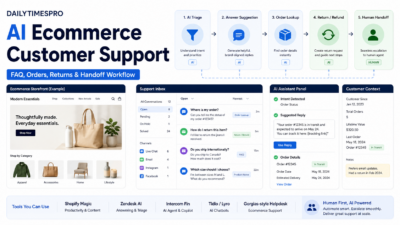
Fin Procedures or Zendesk actions can check an order, explain delivery status, start a return, or route a damaged-item claim. Our guide to AI ecommerce customer support covers the operational design behind these flows.
SaaS onboarding
An agent can answer setup questions, guide configuration, identify the user's plan, and escalate technical issues with context. Teams should keep product documentation current and test answers after every meaningful interface or policy change.
Ticket deflection and human handoff
Both tools can reduce routine tickets only when knowledge is complete and escalation rules are conservative. The better metric is not raw deflection. Track successful resolution, reopened conversations, escalation quality, customer feedback, handle time after handoff, and the amount of human cleanup required.
Implementation Differences
Fin can be the lower-friction choice when a company already has a supported helpdesk and wants to add a customer agent. The implementation still requires source selection, tone, guidance, procedures, identity controls, testing, outcome limits, and ownership.
Zendesk is a broader operational decision. Existing Zendesk teams can add AI without introducing a separate customer-service data model. New customers may need to migrate tickets, channels, knowledge, routing rules, reporting, permissions, and integrations. That extra work can be justified when the organization needs the full platform.
Before buying either product, run the same test set: common FAQs, ambiguous questions, unsupported requests, angry customers, billing issues, account access, multi-step actions, policy exceptions, and requests for a person. Review both the answer and the handoff record.
Pros and Cons
Intercom Fin pros
- Public outcome prices make early budgeting easier.
- Can work with Intercom or an existing supported helpdesk.
- Charges standard outcomes only when a defined result occurs.
- Strong train, test, deploy, analyze, and improvement workflow.
- Practical option for an AI-first support experience.
Intercom Fin cons
- Seat fees and outcome charges both apply when using the Intercom helpdesk.
- Qualification outcomes cost much more than standard support outcomes.
- Voice and high-volume pricing require sales involvement.
- Platform depth may be narrower than a large Zendesk deployment.
Zendesk AI pros
- AI agents sit inside mature ticketing and omnichannel service operations.
- Strong routing, knowledge, analytics, permissions, QA, and governance options.
- Copilot supports people after automation hands work over.
- Suitable for complex multi-step service and enterprise administration.
- Existing Zendesk customers can preserve their service data and workflows.
Zendesk AI cons
- Current tiered AI-resolution rates are not fully transparent on public pages.
- Total cost can include seats, resolutions, Copilot, voice, QA, workforce tools, and services.
- Broader implementation and administration can be excessive for a simple FAQ agent.
- Accounts on different pricing generations require careful quote comparison.
Alternatives
| Alternative | Best for | Main trade-off |
|---|---|---|
| Front | Collaborative customer operations across email and messaging | AI agent depth and outcome model differ; see our Front review |
| Help Scout | Smaller teams wanting a simpler helpdesk and AI assistance | Less enterprise breadth and workflow governance |
| Chatbase | A focused website chatbot built from company content | Not a full omnichannel helpdesk; see our Chatbase review |
| Tidio | Small ecommerce and website support teams | Simpler platform than Zendesk and a different automation model |
Final Recommendation
Choose Intercom Fin when you want a focused AI agent, value transparent outcome pricing, or need to layer AI onto an existing helpdesk. It is especially compelling for a team that can define a clean knowledge base, a limited set of procedures, and clear human-handoff rules.
Choose Zendesk AI when AI must operate as part of a complete service system. Zendesk is the stronger choice for organizations that need ticketing, routing, channels, agent assistance, analytics, quality assurance, governance, and enterprise controls in one environment.
For a small business, Fin is generally easier to pilot and model financially. For an established support organization already committed to Zendesk, the operational value of keeping AI inside the existing service platform can outweigh weaker public unit-price transparency. Request both vendors' full quotes using the same expected conversation mix, outcome definitions, channels, human seats, and add-ons.
FAQs
Is Intercom Fin cheaper than Zendesk AI?
It depends on volume, team size, and required platform features. Fin publishes standard outcomes from $0.99, while Zendesk combines service-plan seats with account-specific automated-resolution economics. Compare total annual cost using the same workload rather than one headline price.
Can Fin work with Zendesk?
Yes. Intercom offers Fin for existing helpdesks, including Zendesk. The published chat-and-email price is $0.99 per outcome, minimum commitments apply, and there are no separate Fin seat or platform fees for that deployment model.
What counts as a billable Fin outcome?
Intercom lists resolutions, successful Procedure handoffs, qualifications, disqualifications, and self-serve routing as outcomes. It charges at most one outcome per conversation. Pricing varies by outcome type.
What is a Zendesk automated resolution?
It is a customer request that the AI agent resolves according to Zendesk's measurement rules. Newer accounts can use resolution tiers that classify the value and complexity of the outcome. Assisted escalation does not consume the resolution allowance under the current tier documentation.
Which platform is better for human agents?
Zendesk has the advantage for mature service operations because ticketing, routing, Copilot, QA, knowledge, analytics, and governance are tightly connected. Intercom remains strong for teams that prefer its Inbox and want Fin plus optional Copilot assistance.
Which is easier for a small business to launch?
Fin is usually easier to scope as a focused AI-agent pilot, especially with an existing helpdesk. Zendesk can also start quickly, but a full platform rollout has more operational decisions.
Can either tool handle billing questions?
Yes, when the agent has approved knowledge and properly authorized actions. Disputes, sensitive account changes, identity uncertainty, and policy exceptions should move to a trained person.
Which tool is better for voice support?
Both vendors offer voice-related AI capabilities, but public self-serve pricing is limited and supporting telephony costs may apply. Evaluate voice accuracy, latency, recording rules, escalation, supported regions, and the full vendor quote.